Showing posts with label emissions. Show all posts

Sunday, April 4, 2010

A Year Well Spent: One Year Spent Carfree


Its been a year of carfree living and I must say that I'm surprised at how fast the time went by and how relatively easy it was to get through the last year. There is no party or press release to send out, just a sense of accomplishment in knowing that I stuck to a goal I set for myself and in the knowledge that that I have grown as a person and learned many things about myself and the world us humans have built for ourselves.

I started this little project to see just how much of a difference one person could make on a bicycle and it seems that I have accomplished more than collecting stats. Ashley informed me that she feels my commitment had challenged her to think about getting around town in a different way and inspired her and her family to hop on a bike or walk more often. I even got her cousin Katie from Houston to ride a bike after more than three years of missing out on such joy. Katie let me know that, "you just don't ride a bike in Houston."

I also wanted to experiment with carfree living in a small city. Many of the online discussions encouraging mass transit or active transportation featured the same old argument that in many American cities it just isn't possible to live without a car and that such a lifestyle is only for those elitists from the coast. Well I did it in the middle of Montana in a town with limited bus service. After a year I'm convinced that most of the barrier to people getting out of their cars is in fact psychological in nature.

Of course Missoula certainly isn't the worst place to ride a bike as your main transportation and I would even challenge towns such as Boulder, CO and Davis, CA to try harder because Missoula is catching up on these bicycling paradises. Missoula's grid system of streets sure helps, allowing cyclists to skirt around heavy traffic if they wish, and the strong emphasis on outdoor activities doesn't hurt either. Hell, people around here have such a hard time waiting out the winter that the first day in the 50s brings out shorts and Chacos. There were barriers and adjustments that I had to make. I missed out on a lot of the great outdoors that Montana is famous for. I was certainly confined to the Missoula urban area much more than a would have been normal, but I made the most of it given the great culture that Missoula has to offer.

I didn't get through this year alone and have many people that helped out in different circumstances. Ashley, my fiance, turned around from her initial skepticism and supported me till the end; Troy, a friend, never stopped offering me car rides and was there when I truly needed them, and Free Cycles allowed me to learn how to maintain my lowly fleet.

So how much of a difference did I make? Over the course of the year I logged 2,932.92 miles on my bike running errands and commuting. All those miles add up to 226.8 gallons of gas saved, and @ $3.00/gallon that adds up to $680.56 saved. Add in $1800 saved from not needing car insurance and $360/month, for a total of $4320/year, from car payments I no longer had to make and I saved a total of $6800.56 over the course of the year. Thats $6800.56 that I'm certain I spent elsewhere supporting Missoula business. I also saved 1750.98 Ibs of CO2 from entering the atmosphere just by using a bicycle as my main form of transportation.

Where are the keys? ... I'm going for a drive. That last part is a joke.

Tuesday, December 22, 2009

Eat Fluffy or Get Rid of the Family SUV?


A tough choice for any family, but according to a new study recently published the family dog looks to be contributing more to global warming than that favorite villain of environmentalists... the SUV. Read the full story here.

This really is disappointing news, if only this study had been published before I went on my carfree crusade I could have saved myself a lot of useless headache. Part of my reasoning for going carfree for a year was to reduce my ecological footprint, but it seems this new study gives me an easier alternative.

Rather than giving up my '83 Toyota Landcruiser that only gets 14 miles-to-the-gallon I could have been practicing a little population control on the neighborhood dogs, having a tasty meal, and saving the planet all at the same time. I could be out there stalking around my neighborhood at night dressed all in black luring neighbor's dogs out with the promise of steak, then capturing them for my planet saving plan... just garnish with some seasoning and a side of baked potatoes. I could still be driving around with a clean conscience and I could have had more of an impact than by giving up on driving... all the while hot having to screw around with riding a bike in subzero temperatures.

Now, I am only kidding as I never intentionally eat such a meal. But it is amazing to think that a pet could be twice as harmful to the environment as an SUV, mainly because of the food that we feed them. I think this study is great because pet ownership is something that most American enjoys and also an aspect of people's live that hasn't received such an analysis. The impact of our transportation and food systems are well known, continually being debated and revised. But pet ownership is something that completely fell under the scope of any analysis. I doubt this will seriously wake people up to the idea of getting rid of fluffy, but maybe it will inspire more debate and a new look at our collective ecological footprint.

Tuesday, December 15, 2009

Solutions to Climate Change must focus more on behavior and less on technology

Much of the focus this week in the media has been centered around the summit in Copenhagen focusing on climate change and the pledges of governments to cut emissions. But the media misses half of the solution in many cases; only focusing narrowly on technologies that can combat global warming and largely ignoring how people's behaviors are the true culprits of green house gas emissions. While a hybrid vehicle might be better than a regular SUV, a bike is even better and a person changing their behavior from driving to biking will do more for the environment than simply changing the tool that people use to express their everyday behavior.

An article in the Mother Nature Network by Ken Edelstein got me thinking about this subject. Even so called "Green" media outlets such as Treehugger and EcoGeek, when covering a topic such as transportation, usually discuss the latest hybrid or electric vehicle rather than the much more green option of not driving at all. Four out of seven of today's top articles in the transportation section of Treehugger are about cars. As Ken points out in his MNN article, stories about the latest in vehicular technologies provide a Wow factor that connects with American's love affair with the car

But I think it goes deeper than that and our current economic downturn can provide a little bit of insight. With the economic downturn everyone is suffering, not least of all the media industry and people don't like change. There is a big emphasis on the need for recovery and for things to get "back to normal." By normal I mean more cars sold, more vehicle miles traveled, more consumption, and a bigger than last year holiday sales season. Media outlets especially want this so that their advertising revenue can return to normal. I'm not claiming this is some conspiracy, it is just that people and media outlets perceive "back to normal" as being in their interest.

Thats why we have a government that wants us to go out and spend and a stimulus package that is designed to inject money back into the system. In Obama's opinion it is better to saddle us with debt so that we can spend now than it is to be frugal and let creative destruction take affect and reorganize our economic system. Its the same policy Bush put in place after the Dotcom bubble and 9/11; lower taxes, borrow more, and take out your credit cards and go to the mall.

Rather than learn lessons from my grandparents generation that had frugality and self reliance forced on them by the Great Depression, we are trying to spend our way out of the mess we created when we borrowed and spent too much in the first place. We are attempting to prop up an outdated economic system, one based on perpetual growth, consumption of ever more resources, and unlimited sprawl.

As Ken points out:

Even though repair backlogs can stretch years or decades into the future, nearly one-third of (stimulus)
money, $6.6 billion, went towards roadway new capacity projects. At a time when public
transportation ridership is hitting all-time highs and the budget crunch is causing transit agencies to cut
routes, service and jobs, an abysmal 0.9% was spent on public transportation. Only 2.8% percent was spent
on non-motorized projects (i.e., bike and pedestrian projects).


And that brings me back to our behavior. We can thrive on producing and consuming less because by doing so there is the potential to unleash previously locked up resources to create whole new business models, local economies, and industries. Economists for the longest time worried about the loss of union jobs in manufacturing because the jobs that replaced those lost usually payed less. William Travis in his book, New Geographies of the American West, cites two University of Montana economists, Thomas Powers and Richard Barret, who found that supporting such "old economy" industries such as manufacturing and resources extraction actually held back the Montana economy from developing faster and better allocating scarce resources of capital and labor. While manufacturing and union jobs have constantly declined since the '70s America is rich not poorer because of it.

Part of the problem is obviously design, as our cities, road networks, and economic connections are all designed to work toward moving vehicles, goods, and money through the system as fast as possible. Thats why the financial collapse happened. All of a sudden when a banks payment of a loan was held up by a second bank's inability to pay the first bank, the whole system came crashing down in a matter of days. Its the same with our cities, if we only connect communities with roads designed for cars, there will be no opportunity for a community to connect through walking and biking and that community will miss out on an opportunity to organize itself and social and economic activities around such activities

By changing behavior, i.e. consuming less, driving less, working less, we don't have to sacrifice our quality of life and can actually improve it while at the same time lessening our impact on the environment. Change can be a scary thing for many people because of the uncertainty that it fosters. But if people are serious about combating climate change and at the same time developing more resilient economies that offer opportunities for the future we have to focus on behavior and not just the technology.


Sunday, October 4, 2009

Week 26 Carfree Stats

Calculate your carbon emissions @http://www.carbonify.com/carbon-calculator.htm

Miles Biked: 48.36
Gallons Saved: 3.02
CO2 Not emitted: 18.93 Ibs

Sunday, September 27, 2009

Week 25 Carfree Stats

Calculate your carbon emissions @http://www.carbonify.com/carbon-calculator.htm

Miles biked: 62.47
Gallons Saved: 3.9
CO2 not Emitted: 24.52 Ibs

Sunday, September 13, 2009

Week 23 Carfree Stats

Calculate your carbon emissions @http://www.carbonify.com/carbon-calculator.htm

Miles Biked: 61.23
Gallons Saved: 3.83
CO2 Not Emitted: 24.03 IBS

Wednesday, September 9, 2009

Infrastructure Needs to be Factored in on Long-Term Transportation Cost/Carbon Emissions Calculations


Tracy White recently left a comment on an old blog post of mine that discussed the per-mile Carbon Dioxide emissions of different modes of travel. She brought up an excellent point that infrastructure costs and resource-use needs to be taken into account in cost-benefit analysis.

She even conveniently linked to an abstract of a research paper that indicated that adding such information to the analysis can significantly add to the lifetime energy use and greenhouse gas emissions (GHG). The study's abstract finds... "that total life-cycle energy inputs and greenhouse gas emissions contribute an additional 63% for onroad, 155% for rail, and 31% for air systems over vehicle tailpipe operation."

This seems like a a substantial impact... and I'm sure that it is. But the headline numbers touted in the abstract can be misleading. Now, I will admit that I have not taken a look at the full text of the study. Rail's impact on a per mile basis is much lower than that of cars, especially SOVs. It is because rail starts out at such a smaller GHG impact that the increase is so much higher when infrastructure is taken into account.

I'm sure that rail's lifetime environmental impacts are still much lower than that of vehicles, and from the research I have seen that is what people are finding. I'll have to dig into the study a little more when I have the time. Thanks Tracy for bringing up a great point that needs to be considered in these types of issues.

Sunday, September 6, 2009

Week 22 Carfree Stats

Calculate your carbon emissions @http://www.carbonify.com/carbon-calculator.htm

Miles Biked: 57.62
Gallons Saved: 3.6
CO2 Not Emitted: 22.61

Sunday, August 9, 2009

Week 18 Carfree Stats

Miles Biked: 64.98
Gallons Saved: 4.06
CO2 Not Emitted: 25.5 Ibs

Sunday, August 2, 2009

Week 17 Carfree Stats

This week I surpassed 1000 miles of commuting and errand running on my bike... and thats all I have to say today.

Week 17 Stats

Miles Biked: 88.62
Gallons Saved: 5.54
CO2 Not Emitted: 34 Ibs

Month 4 Carfree Stats

Miles Biked: 295.83
Miles on Bus: 1046
Gallons Saved: 83.86
CO2 Not Emitted: 1064 Ibs

Sunday, July 26, 2009

Week 16 Carfree Stats and Costco has Bike Racks?

Before I get to my weekly carfree stats, I fgured I would share how I carry quantities of stuff on my bike.

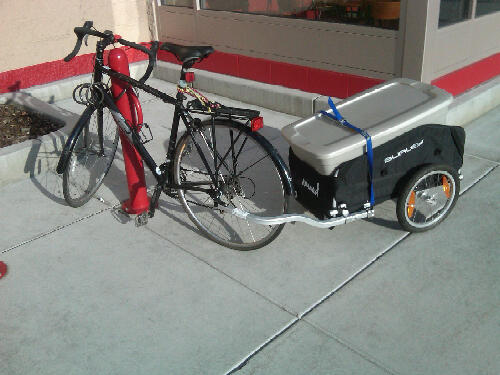
Usually, for small trips downtown or to the Safeway that is only five blocks away, all I need is either my messenger bag and maybe my set of panniers. But when it comes to grabbing larger quantity of things - usually from the box stores out on North Reserve - it requires the use of the Burley Nomad trailer.

Getting out to North Reserve on a bike or as a pedestrian can be a hazardous thing. First you have to find a place to cross Broadway, a big five lane expressway with speeds of 45mph. Luckily there is a new light on one of the cross streets that makes it a bit easier.

The other day I made this trip and first stopped at Target to pick up the large tub you see in the picture below.

North Reserve is not a friendly place for bicyclists - another one of those five land high speed expressways. In fact Reserve has 6 of the 10 worst intersections for wrecks in Missoula, and yet an 89 year-old man still crosses. Luckily I don't actually have to cross Reserve to get to Target and Costco. Along Box Store Row there aren't too many places to actually park your bike. Target has a rack as does Lowes and there is one in front of BestBuy, but the next set of Box stores holding Pet Smart and Michaels doesn't have one.

Heading out to Costco, I expected to find no place to lock up my bike. Riding slowly through the parking lot - I was a little scared of all the big SUVs not seeing me - I was surprised to find a rack, but less than thrilled with how Costco employees treat it. How the hell are people supposed to get to it with all those carts in front.
Luckily, all it took was one mention to the guy at the door and the mess in front of the racks was cleaned up. And when going through check out, I didn't even need any boxes, since everything fit pretty nicely into the giant tub, as you can see in the next photo.
All-in-all, a successful and efficient shopping trip. I even got a wave and thumbs up from a passenger in a car that passed me all while yelling that she liked what I was doing, which was a first.
Week 16 Carfree Stats
Miles Biked: 97.92
Gallons Saved: 6.12
CO2 Not Emitted: 38.43 Ibs

Thursday, July 23, 2009

Carbon Footprint Projection from being Carfree


I'm revisiting this topic that I have been meaning to get to at some point Now is a good time since I can't get to discussing my thoughts on transit and urban design in SLC since I'm having computer issues that prevent me from processing the photos I took.

Photo Credit: Sjabbar


As I've stated before, changing transportation behaviors is one of the fastest and most effective ways of reducing a person's carbon emissions and general impact on the environment. Not only does choosing alternative forms of transportation reduce a person's environmental footprint, but it also addresses issues of national security, consumption, health, and community. Of course if every American stopped consuming copious amounts of oil than our investment in our military would be all for nothing and our economy would crash since all the money we send over seas buying oil gets recycled into the US financial system, but thats a different post for a different blog.

Our transportation system is heavily dependent on oil to function - understatement on the year - and according to Matthew Yeoman in his concise and well written book Oil 97% of our transportation needs are powered by oil and half of all oil consumed daily goes towards keeping our cars on the road. Every day Americans consume approximately 19.5 million barrels of oil, thats 8.19 billion gallons of oil and half of that - 9.75 million barrels per day - is used just for transportation. For anyone interested at looking into this more, a good resource is the EIA and, funny as it sounds, the World Fact Book produced by the CIA.

Now, with that little digression finished, back to my original intent with this post. There are a lot of different websites out there offering various carbon emissions and ecological footprint calculators. The non profit I am working for, The National Forest Foundation, even has a calculator that lets you know the amount of carbon offsets you would need to purchase to make up for your emissions.


After testing out several sites, I choose to use My Footprint created by Redefining Progress. No, I wasn't just lazy and go for the one that topped Google search, but it must be up there for a reason, namely that this is probably the most robust and detailed questionnaire regarding eco-footprints on the web. You start out by answering a few simple demographic questions followed by sections that are meant to measure your carbon footprint, the impacts from the food you eat and the house you live in, and finally the consumption of goods that you partake in regularly.


Mainly through giving up my car and trying to live a carfree existence, my carbon emissions have been cut in half, from requiring 60 acres to sustain down to 32, and that is in comparison to the average American, whom requires 91 acres. In terms of non-transportation related activities, the house I live in requires only about 20% of the resources an average American home requires over its lifetime, including construction and lifetime energy use. However, I don't do so well in the food department, coming in just a sliver bellow the average American. Even with those improvements, it would still require 3.3 Earth's to supply everyone in the world with my lifestyle and I'm a relatively low-income college student, I would like to see the results of someone making a few hundred grand with several house. While the carbon emissions calculated at this site are not exclusive to transportation, I can assure you that the majority of the reduction comes from not driving.


For a more focused transportation look into footprints there are several good ones to choose from including Travel Matters and a good one from Berkeley, that bastion of radical liberalism.

Tuesday, July 21, 2009

Week 15 Carfree Statistics

Salt Lake was a fun time, and I have plenty to write about in a few coming posts. Of course the bus was the low point of the trip. Salt Lake City was not what I expected... in a good way.

The bus trip probably didn't save as much carbon as I had originally thought. The bus going both east and west between Missoula and Butte was completely full; we almost had to leave people behind in Butte. The journey down to SLC from Butte and back was nowhere near as full, maybe only 1/4 full. So I'm just going going to guess that I saved 50% , which would be about 600 Ibs of carbon. Thats some solid methodology.

Week 15 Statistics
Miles Biked: 77.46
Miles on Bus : 1046
Gallons Saved: 46.81
Carbon Not Emitted: 630.44 Ibs

Wednesday, July 15, 2009

And I'm leaving On a Greyhound, Don't Know When I'll be Back Again

I'll be heading down to Salt Lake City this weekend, and no I'm not driving. I figured I would take the opportunity of visiting my fiance at her clinical site to try out the luxurious travel offerings of Greyhound where I can expect to be treated to warm-moist towels and foi gras, and by warm-moist towels I mean sticky, urine-stained bus station restroom floors and by foi gras I mean vending machine pretzels.

The round trip is a total of 1046 miles and by taking the bus I expect to save about $25 in gas compared to the cost of the bus ticket. Of course the travel time almost doubles when taking the bus vs. a car, but then again my time is cheap since I have no real marketable skills.

So other than money, what can I expect to be saving (and the answer is certainly not my dignity)? As you can see by the chart below, a 3/4 full Transit Bus - intercity - produces approximately .2 Ibs of CO2 per passenger mile vs. approximately 1.2 Ibs of CO2 per passenger mile in a single occupancy vehicle (SOV).

Over 1046 miles my share of the CO2 produced adds up to 209.2 Ibs of CO2 for the bus vs. 1255.2 Ibs of CO2 for a car. So on the bus, my trip should produce only about 16% of the GHGs of an equivalent car trip.

Plus... there is the added bonus of not having to worry about getting a speeding ticket. That should be the only arguement anyone needs to hear to convince them that the only way to travel... is by bus.

Tuesday, July 14, 2009

Senate Bill Aimed at Alternative Transportation is Anything But Supportive of Alternative Transportation


Yesterday I read a short little blog post over at Eco Friendly Mag about a recently introduced Senate Bill (S. 1408) with the purpose of greatly expanding the incentives for investing in Natural Gas powered vehicles (NGV). The bill was introduced by Senator Robert Menendez, a Democrat from NJ.

The bill basically calls for huge tax credits to be lavished upon the buyers of NGVs. Credits would be available up to $80,000 for such vehicles while also giving a tax credit to the investment in new Natural Gas fueling stations. Thats a lot of money. The fact that the cap on the tax credit is so high makes me believe that this bill is mainly aimed at corporate fleets, which makes sense. Corporations with huge fleets incur correspondingly huge costs to maintain those fleets, and switching over to vehicles that pollute less - about 2/3 less smog and 1/3 less GHG - and get better gas mileage - although not much better - is a way to both save money and reduce the pollution coming out of millions of vehicles (in 2003 the 10 biggest fleet management companies managed 2.7 million vehicles).

We've all seen the T.V. ads by T. Boone Pickens, so we are most likely all familiar with the arguments in favor of NGVs. But is Natural Gas really a solution, or just an option that makes people feel like our Nation is working towards a solution without actually doing anything to alleviate our problems? And should we be listening to a guy with billions invested in the Natural Gas industry?

I would argue the former option. Based on the fact that American Natural Gas production - check out a great post at the Oil Drum - peaked back in the early 70's and prices have seen a dramatic increase in the last decade. A large increase of NGVs on the road would dramatically push prices higher and increase the speed with which Natural Gas supplies are depleted. Do we really want to go down another road similar to the one we went down with ethanol? We have spent billions investing in infrastructure to lesson our oil consumption and pollution only to find that it increases GHG and helps to contribute to food price inflation.


Can you even call Natural Gas an Alternative Fuel? While its not oil it is still a Fossil Fuel that is easily depleted, and once its gone, thats it. If we're truly looking for alternative fuels to lesson our dependence on oil, shouldn't we be looking for something that will have a lasting impact rather than a fuel that will only be available for a time span measured in decades?

Finally, the bill itself is titled "New Alternative Transportation to Give Americans Solutions." What about promoting NGVs make them a form of Alternative Transportation? Are they a form of Public Transportation? NO. Do they help to lesson traffic congestion? NO. Are they a predominately single occupancy vehicle that runs on fossil Fuels? YES.

The name of the of the bill is pure PR. Who the hell - besides me, I guess - actually reads through these things? All people are going to do is hear the name and think it promotes alternative transportation, which it doesn't. As I pointed out in a previous post, the term "alternative transportation" is one of those hot terms that has in the last few years seeped into our social conciseness, kind of like "synergy" invaded the business world about a decade ago.

Ultimately, are NGVs a solution? No. Are they one option in a myriad of options that must be explored and invested in so that we can overcome our Nation's oil dependence and transportation problems? Yes.

Thursday, July 9, 2009

Why I Went Carfree

I had a conversation with someone - who shall remain nameless - about my little project and the general sentiment that I got from that person was that what I am trying to do here is ridiculous, a waist of my time and my life. Among many pearls of wisdom I was offered were; real people that need to feed their families drive cars, adults don't ride bikes, cyclists don't pay for the infrastructure they use, and the hypocrisy of going carfree when most things I'm buying are trucked in anyway.

Thats a long list of grievances and goes to illustrating the attitudes that advocates of alternative transportation are up against. I don't even really know where to begin with all these, and I've had ample time to think and reflect on what was said before sitting down to write this post.

First off, I'm not stupid enough to believe that all people in every part of the world can live their lives without owning a car. But what I see as the challenge is moving to a reality in which people don't have to own a vehicle to be a productive member of society. Already much of Europe is like this, but here in America - because of our auto-centric urban growth patterns of the last 70 years - there is plenty of opportunity for people to change their behaviors.

Secondly, I consider myself to be a pragmatist, meaning that I believe we need to find a way to reduce our individual environmental impact while continuing to use the technological advances of the industrial and information revolutions. This person said they could only respect someone attempting what I am doing if they went to the extreme and moved to a plot of land and lived a self contained life off the land. While yes this would significantly drop my carbon emissions and ecological footprint, no matter what humans do there will always be an environmental impact. The fact is that this is not an option anymore. The Earth has a population of over 6 billion people, so there is no possibility of everyone having 40 acres all to themselves. We are also now living in a mostly urban world, with over 50% of the worlds population living in urbanized areas. And while this situation creates many challenges ti also creates many unique opportunities in terms of better urban design and transportation.

Remember that the approach of living a self contained life has already been tried, and for various reasons, failed to hold the attentions of Americans other than a small die-hard minority. I have written in previous posts about the failings of the political movements of the 60's. The attitude of turning away from civic culture as so eloquently captured by Timothy Leary, "Turn on, tune in, drop out," failed. When an attempt to turn this mantra into reality - in the form of communes, Haight-Ashbury, etc. - the people who flocked to there new social experiments (new to America) didn't last very long. The model of society being proposed was to radical a departure for most Americans to find appealing, leading to a large backlash the produced Reagan, Gordon Gekko, and yuppies.

This is illustrated yell - in the rather terrible movie - Rude Awakening in which Cheech (without Chong) is a radical revolutionary hippie from the 60's that is forced into exile in South America when the government raids the commune he was a part of. The friends he leaves behind are transformed during his absence into everything they were fighting against and when he returns in the 80's he finds they are aspirational elitist New York yuppies.

We must build a mainstream movement of people that are interested in environmental and social justice issues. Thats a big goal, but if you give people easy choices that allow them to feel good knowing they are doing something positive, and spread that across millions of people, there is a chance for a real impact.

Of course this means educating people, and since we live in a Capitalist system, that mainly means education about the choices people make every time they consume something. Being a pragmatist, I see no contradiction or hypocrisy in choosing not to drive while many of the things I consume continue to be shipped into Missoula from many thousands of miles away. I have very little control over where things are manufactured, but I do have control when it comes to local transportation. And this being, mostly, a free market economy, I gladly choose to commute by bicycle.

A good example of this pragmatism is the argument over food miles and the true cost of our food and agricultural system. Localivores often argue for the 100 mile diet, but here in Missoula that would mean NO BREAD. A recent article I read (I wish I had a link) stated that a study found that only 20% of a food products environmental impact comes from transportation while the majority comes from the excessive use of chemical fertilizers, pesticides, herbicides, and diesel consumed by a tractor. So given a choice, its between organic that was trucked in and something local from a traditional agribusiness farm, the organic wins out in terms of lessening the products impact.

While its nice to stick to principles, taking the pragmatic approach allows many more people to participate in a given social movement. Rigid adherence to principals and a radical approach are what brought the political and environmental movements of the 60's to a halt and actually set them back about a decade.

So given the choice of being an appathetic consumer, turning my back on civic life, or taking the middle road and being pragmatic about the choices I make in my daily life, I'll choose to be pragmatic. Already, the little changes I have made have resulted in a significant reduction of my ecological footprint (which I'll go into more detail in a later post). My carbon emission are reduced by about 50% from going carfree while my overall ecoligical footprint has been lowered by approximately 1/3. Other than not driving, I haven't radically changed my behavior its just that the little things I have changed add up.

Monday, June 1, 2009

Two Months Down

It has been two months since I went car-free and so far I have found the transition to be easy. Other than a few arguments with my fiance all has been smooth. In two months of commuting and running all my errands by bicycle I have racked up almost 450 miles, which averages out to about 7.5 miles per day. This really isn't that much, as I had expected to register more miles.

I really haven't changed my behavior all that much. Other than foregoing a few trips and not staying downtown as late at night not much has really changed. One thing I have had to think about and plan out is my trip chaining; rather than a lot of little trips for small things throughout the week, I have tried to bundle all errands into one go. Its funny how easy it is to put 20-30 miles in on one day just from going from place to place in town.

In the two months of being car-free I really haven't saved that much money on gas: only a little over $60. But with oil almost back up to $70 per barrel its still one headache I don't have to worry about. I don't foresee any hardships in the next few months with summer here and great cycling weather into the foreseeable future.

Week 8 Stats
Miles Biked: 43
Gallons Saved: 2.68
CO2 Not Emitted: 16.8775 Ibs

Month One Stats
Miles Biked: 269.2
Gallons Saved: 16.825
CO2 Not Emitted: 422.644 Ibs

Month Two Stats
Miles Biked: 170.49
Gallonos Saved: 10.655
CO2 Not Emitted: 267.669 Ibs

Sunday, April 12, 2009

Sunday Quote and Some Stats

Amateurs accustomed to emulation made great places. It is the professionals of recent decades that have ruined our cities and our landscapes with their inventions.
-Andres Duany

Some statistics:

Now that I've actually gone car-free, I'll be keeping track of the imapct this has, in terms of miles, gas saved, and CO2 not emitted.

Week One

Miles biked: 38.52
Gallons of gas saved: 2.5
CO2 not emitted: .00756 tons or 15.12 Ibs
Bookmark and Share