Showing posts with label new urbanism. Show all posts

Wednesday, January 20, 2010

An Interesting Repercusion from Missoula's New Title 20 Zoning


Missoula's new Title 20 zoning ordinance hasn't been been in place for very long, but already it is starting to stir up some controversy and play havoc on some people's building plans.

You see, the updated ordinance prohibits garages that extend past the front of a house's facade, such as the one in the photo below. This move essentially limits the type of housing that has been prevalent in America's suburbs since the 1970's. The reason for the new ordinance is an attempt to shape the aesthetics of new construction to fit with Missoula's more historic neighborhoods where a garage is usually in the back facing a alley or non-existent.


Essentially the uproar has come from a builder that was planning a small development. His argument is that the ordinance raises the cost of construction because it is so difficult to find stock architectural plans where the garage doesn't dominate the front of a home that he will be forced to pay an architect to design homes that fit in with the newly updated ordinance and could even force several future projects to fail because of additional costs.

This news came from the city council listserve that our Councilman Bob Jaffe maintains. From the sound of it, no one at that level of local gov't knew of this ordinance and there is already talk of revising the language to make it less restrictive.

Part of the idea behind the zoning update was to make the language simplified and easier to understand, but at the same time to make it easier for more traditional, mixed use and compact development to take place to fit in with the Missoula community's vision of growth and Downtown Master Plan. A component of this vision is our recent passage of a complete streets ordinance.

In my opinion, a house dominated in the front by a garage doesn't add anything to the character of a neighborhood or to the streetscape. And complete streets is about more than just how the roadway is configured, but should also consider the buildings along the street and how they come to make an "outdoor room" and how those buildings interact with the public space (road) out front. A large garage in the front of a house sends a poor signal, both aesthetically and architecturally, while confining the since of public space more so and limiting the interactivity of elements along the streetscape.

Thursday, November 19, 2009

David Orr on Post-Carbon Cities


Missoula was lucky enough yesterday to have David Orr in town. In between the meetings usual social events, there was enough time for him to give two lectures at the University of Montana.

For those of you who don't know of David Orr, he is a leading thinker and innovator environmental issues, green building, and ecological design. Within the last decade he gained national press for his effort and subsequent success in building a fully carbon-neutral building on the campus of Oberlin College which can be seen above. It integrates passive solar design by orienting the building to take advantage of the suns energy, a roof fully covered by solar panels, sustainable materials, food production in the form of a garden and orchard on the north side of the building, and environmental restoration on the wetlands immediately adjacent.

David Orr covered post-carbon cities in the lecture I attended. The scope of his talk was extensive, delving heavily into the philosophy behind green building/urban design. What resounded with me was his call to take a systems approach to issues. He blames academia for the tradition of reductionist thought that breaks issues/objects into components without concerning itself with how the whole works or interacts with the world. He used the example of optimizing the Hvac system of a building without also optimizing the insulation or materials used in the building.

By taking a systems or wholistic world view we can come to better understand the world and the interaction between our actions and the environment. This is true of economics - which as a student of economics I fully agree with - where one doesn't pay the full cost of any product. Externalises exist everywhere and with every purchase; a vehicle doesn't really cost only $20,000 if you include the pollution from its manufacture and operation, the cost of the roads it travels, and the cost of disposal, etc. If all these costs where taken into affect, our world would be a much different place. There would be no coal fired power plants if the coal industry had to directly pay for every death caused by the pollution it creates.

Back to post-carbon cities. David has an ambitious goal of turning Oberlin into a carbon-neutral city, starting by redeveloping the downtown area to be an eco-village. He is taking a ground up approach by gathering support and investment from within the community. This seems like a much better approach for such a project than the one taken by Saudi Arabia and China in attempting to build their own respective eco-cities, both of which after years of being in the design and planning phases have gone nowhere.

Of course, building a fully carbon-neutral town is a big challenge, as not only do the buildings have to be redesigned, but people's behavior's have to radically change and a whole new local economy built from scratch. If David Orr has any misgivings about such a project, its is that he doesn't know whether people are willing to do what needs to be done to create such an ecologically friendly future.

He is optimistic in terms of having all the tools ready and at his finger tips. David talked of how over the last thirty years scientists and entrepreneurs have developed the tools to create such a future and now everything simply has to be brought together and integrated. Social awareness has also progressed enough to allow the building of such a future. This is especially true within professions that can move something such as eco-cities along. Daniel Narrin over at Discovering Urbanism illustrates this point in a recent post. Having found a planning text book from the early 1990s, he was surprised to see how far the profession has developed in two decades, having found that the book never once mentioned pedestrians or cyclists and describes environmentalists only as obstructionists against progress.

It now seems very possible that the environmentalists so reviled by many only two decades ago will be the ones innovating and creating our future as it has gone from a movement of obstructionism to one of practical application and problem solving. Best of luck to David Orr and his vision of a carbon-neutral future, I hope to experience it one day.

Monday, September 28, 2009

A Few Thoughts on Jane Jacobs

I finally made it through Death and Life of Great American Cities the other day and can move on with my life. I'm embarrassed to say that I started reading Jane Jacobs' classic last spring while there was still snow flying.

While the book is showing its age, especially regarding discussion about banks and housing projects (now that most housing projects have been or will be torn down). Nut overall Death and Life is still a very important piece of literature.

Jane Jacobs obviously takes a lot of pride in the small details that make up a city, the parks, people, sidewalks, building facades, and local entrepreneurs that make up a city. The small details are what matter the most when it comes to building a community with a sense of place and character and it is precisely these most important small details that planners often over look.

That is the inherent contradiction of planning, it is a profession that takes a look at the big picture for the most part, and until recently when collaborative planning has become part of the process, the small details that make a community thrive were missing from planners' radars. That is way the collaborative process is so important, to fill in gaps in knowledge and design that planners might not have access to.

The book is a big proponent of cities as "organic" structures that are not stagnant but alive and constantly in flux. As such, organic growth of neighborhoods, associations, relationships, and the urban structure of cities are what make fro vibrant and strong cities and not massively scaled urban renewal projects that attempt to sanitize an area.

She doesn't spend much time on the car, other than to emphasize the positive feedback the car's influence on city design has on the erosion of vibrant and diverse cities. Cars must be designed for, and in accommodating the use of cars, forces a separation and spreading out of what used to be mixed-use areas because of the pressures of moving and storing vehicles.

Her message from all this critique is simple; that people have to take back the planning process from government bureaucrats that don't have a city's or neighborhood's best interests in mind. Ideas such as Radiant City and Garden City design must be thrown out and replaced with something that actually expresses the reality of people's needs and psychology.

I guess since planning will be my profession I need to heed her words even though the planning process has significantly changed since the book was originally written.

Thursday, September 10, 2009

Missoula Roundabout Opening


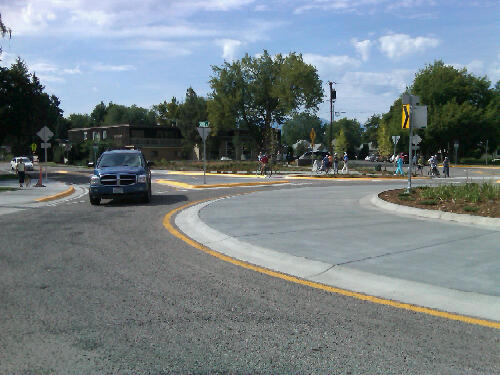
Last week Missoula's first roundabout opened to the public. It was a pretty large event for the opening of an intersection; maybe because it was built with stimulus money and was the first large project to be completed in the state of Montana. A lot of big political players sent people from their offices, such as Senators Tester and Baucus and all the local politicians were on hand for the ribbon cutting.

Before I get any farther along though, I would like to point people's attention to the photo above. Hopefully people can notice the abundance of signage present; 32 in all, even everyone in my Land Use Planning class thought that was a little excessive. I think Montana's DOT was a little scarred of stupid or distracted drivers driving through the middle.

Of course I believe the signage itself is a bit distracting, and even with all the signs people in cars still tried to blow through the intersection when it first opened. Most of these people were on cell phones and one even came close to running over city councilman Jason Wiener.

Here in America, traffic engineers like to tell the public exactly what type of behavior is expected of them, mostly through signs (but then we do things like have speed limits on wide, open, and straight roads that encourage speeding). Drivers are mostly o.k. with this, since it allows them not to have to think too much while simultaneously being on the phone.

But does having 32 signs at a roundabout do anything for safety, or does it fill a contractor's pockets? A roundabout is a perfect situation for "shared space," a concept first proposed by Hans Monderman. Essentially, shared space takes away all on road instructions and allows users of the road to "negotiate" with one another for road space. The intent is to slow traffic, increase safety, and allow all users to share the road more equitably. I can almost guarantee that most people's reaction to this idea in America would anger and puzzlement. There are places in America that already implement this principal, such as Savannah, GA as pointed out at the Proper Scale blog.


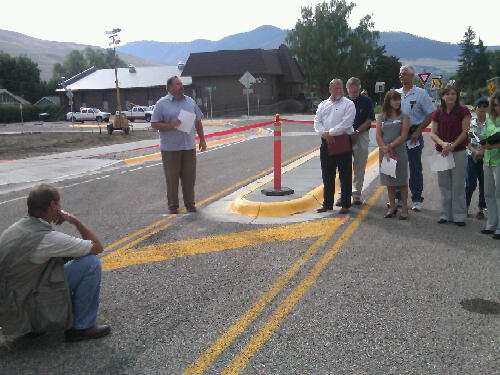
Anyway... back to the opening ceremony. Below is the ribbon cutting ceremony performed by our mayor, John Engen and Jim Lynch, head of the MDOT.


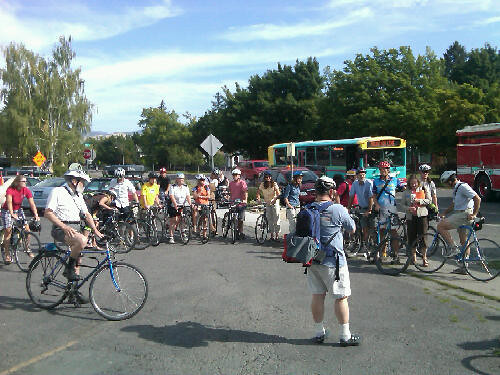
And what would the opening of a roundabout be without cyclists to test it out? As you can see in the photo below, we had a pretty good turnout. The MDOT was giving out pamphlets on how cyclists and pedestrians should behave in the roundabout. It called for cyclists to dismount and walk their bikes through the cross-walks. Lets just say that none of us cyclists performed that stunt.

Missoula's own bicycle ambassadors, where there to educate the riding public about proper on street behavior. Ben even had a hand painted helmet on, go Vikings!
Dogs even came out to participate in such a monumental moment. Below is a BWAM member's dog along for the first ride through the roundabout.

Monday, August 31, 2009

Complete Streets Comes to Missoula

Within the last week Missoula Montana has joined the likes of San Diego, Salt Lake City, Miami, and New York by passing a resolution that calls for Complete Streets. The resolution passed the Missoula City Council on Aug. 24th a wide margin. The resolution has been pushed for by local resident John Salmonson and its thanks to his hard work and many others including BWAM that we have this change in policy. More can be viewed here and the actual resolution can be found here.

The new policy calls for any new construction or reconstructed streets to be designed with all users in mind to create a safe environment for pedestrians, cyclists, motorists, and transit. Missoula is already a fairly friendly place for pedestrians and cyclists, but that usually only extends to certain neighborhoods such as those around campus and closer to downtown. There are currently many sidewalks badly in need of repair and even many places where sidewalks just abruptly end.

The Complete Streets measure won't change anything overnight; there are millions of dollars of projects spread around Missoula that need to be taken care of. This will be a decades long process to "complete our streets" here in Missoula. But this is still a major step forward for the bicycle and pedestrian organizations within Missoula. The hard work that many of these groups and the individuals volunteering their time to advocate the city, county, and state for better infrastructure over the last decade is finally legitimized in this resolution. The potential is great as the design process is now officially sanctioned to have Complete Streets designed in rather than as something that local groups have to push and fight for.

Wednesday, April 8, 2009

Day One and the Missoula Master Plan

Actually its day three of being car-free, but I don’t think anyone is really counting. I really screwed up by relaxing all through spring break when the weather was miserable, now that its nice, I’ve got too much to do to enjoy the weather.

The Missoula Downtown Master Plan is once again in the news as the final language is being set and the city council starts the long process of overhauling zoning ordinances to make the Plan an eventual reality. The zoning rewrite will most likely be a long process, but already a few points are causing some controversy.

ADUs are part of the called for zoning changes. What are ADUs? Additional Dwelling Units, basically they allow for a second dwelling to be built on a residential lot, like an above garage apartment, or what is sometimes called a mother-in-law house. These allow for affordable housing to be supplied in neighborhoods with high property values and for homeowners to have an additional sources of income. Both the Indy and the blog Missoulapolis have good takes on the issues.

Some neighborhoods already have these as part of their zoning, like the area just across Brooks from the Vietnam Memorial Park. The new zoning would expand the area where these are allowed and make them easier to be built. Right now ADUs must go through a process of approval before they can be built.

Those opposed to ADUs claim they are worried about the “character” of a neighborhood and the density that they may bring with them. I may be wrong, but what I hear is that people don’t want those with lower incomes mixing into their nice, high income neighborhoods while also worrying about what ADUs might do to other people’s property values.

ADUs are a good way to create affordable housing, and how could the ability to earn money from rent hurt property values? The density increase would be miniscule, adding an additional 1-3 people per residential lot, and its not like every lot would suddenly sprout ADUs. This type of infill would also make greater use of the alleyways that currently only serve as access to garages and trash cans.

Jane Jacobs in her book, Death and Life of Great American Cities, concentrates a great deal of her time to explaining what makes up a good working neighborhood. The key comes down to having a variety of activities throughout the day and a mixture of users. ADUs will create safer neighborhoods by placing more eyes on the streets at various times of day when right now their might not be any. This would happen because the people living in ADUs would most likely live on a different schedule from those living in the main houses.

The reality is that this is an issue of how we, as a community, want to accommodate future growth. Missoula already has a large problem when it comes to supplying affordable housing, so do we want to continue to build large apartment complexes full of low and middle income residents on the edge of town, like those built in the last few years around North Reserve? This creates an additional problem of forcing people who have less means to afford commuting to have longer commutes.

We have a choice to make do we want development to occur on the edge of town, or do we want to concentrate on infill. If we continue to grow outwards, large developers, retiring farmers, and the construction industry win out big, but Missoula will lose valuable farm land, open space, and wildlife habitat that helps to make Missoula a great place to live, while taking more money from taxpayers for infrastructure, increasing congestion, and pollution. If we choose infill, we get to keep the overall character of Missoula, keep the open spaces we love so much for recreation, and create a more walkable community while giving homeowners the ability to invest in their own property to provide a better income and home for Missoula residents not lucky enough to afford a home.

Monday, February 23, 2009

Past Peak Oil

For anyone interested, the Oil Drum has a great post today about non-OPEC member nations being past peak oil production. From the statistics it appears that non-OPEC nations reached peak back in 2004 in regards to oil.

What does that mean? For most people, the only concern this will bring to mind is the utterly unsustainable oil price of $40 a barrel. If production declines even moderately, say 2-3% a year, the price will once again shoot-up. Maybe not immediately to the peaks we recently experienced, but give it some time and we will see oil prices much higher this go around. Even with the current economic crisis, oil demand is not falling at 2-3% a year, so we have a situation where demand will be far out pacing supply, leading not only to higher prices, but to shortages ala the 1970's, only this time we won't get over the oil shocks.

How can people prepare for this inevitable future? First, as a nation, we can stop building suburbs and start concentrating on refurbishing existing towns along New Urbanist guidelines while building the transportation and alternative energy infrastructure needed to help make the transition to a world with less oil. People that live in urban areas consume less energy and produce less carbon emissions according to an article over at City Journal (thanks to CarFree USA Blog for finding the article) Thats only part of the solution. As individuals, one of the fastest ways to lower personal energy consumption is to stop driving. I know that our current living arrangements in America don't always allow for this to be a reality, but no other behavioral change will do more to reduce energy consumption and save people money. For other ideas on what can be done, check out the book Plan C: Community Survival Strategies for Peak Oil and Climate Change by Pat Murphy and anything by James Howard Kunstler is also a great source of information.

Thursday, February 19, 2009

Sorry David - A Statement of Belief

A recent op-ed by renowned conservative intellectual, David Brooks, I Dream of Denver has been bouncing around the net and making a big stir within the planning community. He basically states that planners have their heads in the clouds when it comes to reshaping the way Americans live and how our cities and communities operate and relate to one another. According to Brooks, the current downturn in the development industry is only temporary and that once the good old American economy is back up and running, Americans will continue to move farther away from urban cores to the exurbs.

I guess this is a good time to write a brief statement of my beliefs regarding planning and why I have chosen to give up my car... most of which opposes Brooks' point of view.

It is true that as a future planner I would like to see American cities revitalized and become livable and walkable environments. Why? Because I believe that as a nation we have to change the way that we live and interact with one another and our environment for the future vitality of our country. We can't go on expanding suburbia ever outward, there aren't the resources, the oil isn't there to allow use to continue to increase our driving and our society can't take the pressure that sitting in a tin-can for three hours a day does to a person. Do we really want to pave over every acre of farm land, or meadow, or rid ourselves of the charms of small towns and replace these things with the monotony of cul-de-sacs and strip malls?

Not only is suburbia an aesthetic and culture sink hole, but the economics can't last. I know the American economy is built upon the ever expanding binge-consumption of useless plastic crap, but for the health of ourselves, our communities, and our environment we need to consume and want less. Its a difficult transition to make, because almost everything in our American culture tells us that consumption is good, your not a good American if you don't consume. Our last president even told us that the most patriotic thing, as Americans, that we could do was to go to the mall.

The car and the physical infrastructure that is required to maintain the aoutocentric, mobile lifestyle of Americans is becoming to big, to destructive, and to costly. Living a life in which alternative transportation plays a large part consumes less, pollutes less, costs less, and has the added benefit of allowing face-to-face interactions with those individuals that you call neighbors. We need community right now, to get use through tough times, and that can't be fostered sitting in a car competing for lane space.
Bookmark and Share