Showing posts with label transit. Show all posts

Monday, February 15, 2010

The view from Portland

My feet hurt... thank you Portland. Four days of a carfree mini vacation using a walking/transit combo put a lot of miles on the feet. Still tired from traveling today and then immediately diving into work back in Missoula so this post will be short and quick... for some great thought provoking writing check out @Urbanophile's arguement for fare-free transit, which would be perfect for Portland, and this article that shows that being sighted close to transit is saving homes from entering foreclosure.

Enjoy the pictures... I'll write more on Portland later... especially the Hipster economy.


Plane from Seattle --> Portland. A little greenwashing? I think so


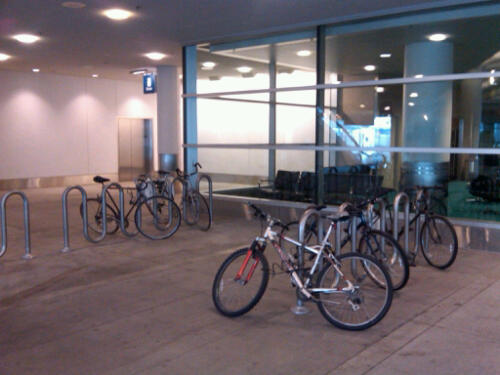
You know your entering a different world when there is bicycle parking at the airport terminal.


My ride from the airport awaits.


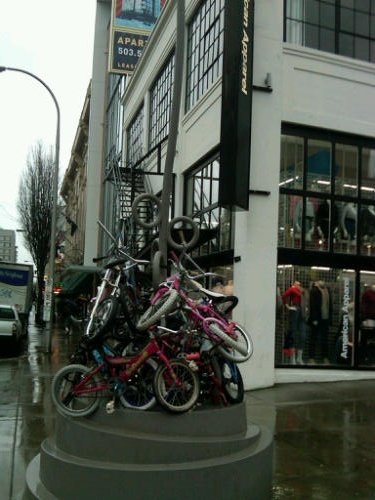
On-street Bicycle parking at Powell's Books


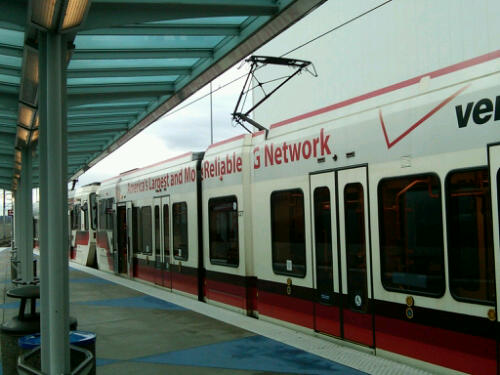
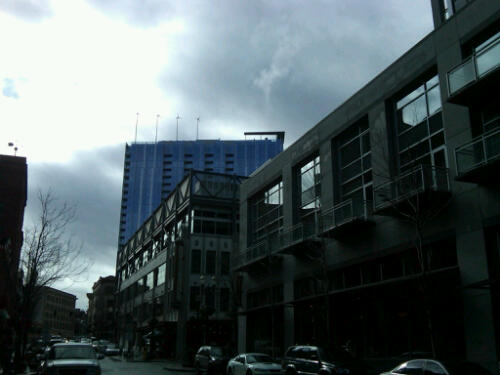
Portland does a great job of using public (park) space to accentuate the utility and connectivity of the various rail lines.


Only in Portland


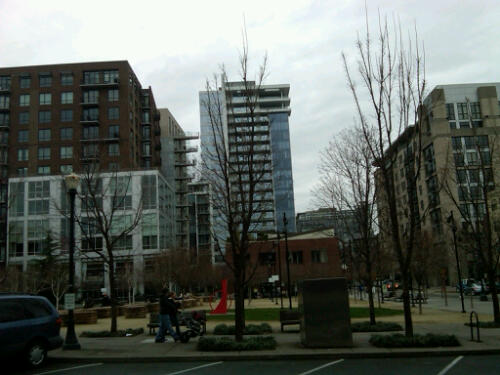
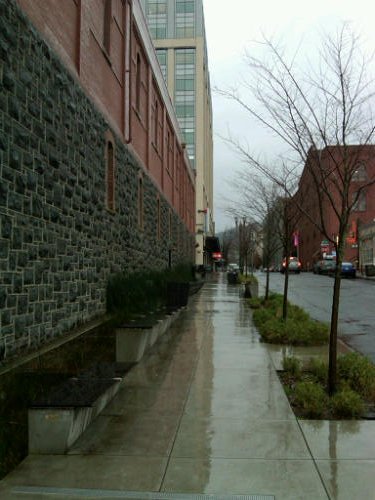
Another innovative urban design... this time add green infrastructure and reduce rain water runoff.


Building with both wind turbines and solar on the roof.


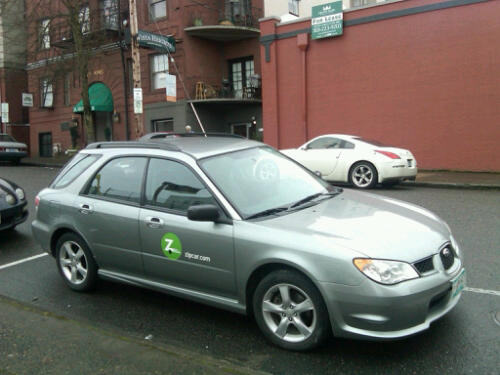
Making it that much easier not to own a car.


And finally the beer... my god the beer. A little nitro never hurt anyone... and anyway can't get this shit in the stores. Don't worry Kettlehouse, your still the beer I hold dear... though I think I'll miss Amnesia.

Monday, January 11, 2010

Coeur d Alene: Safety Fail, No Saftey in Numbers for Bike/Peds

Over the weekend I was hit by a car, and it provides me with a good opportunity to talk about safety in numbers that cyclists and pedestrians create and how streetscapes and development patterns contribute to safety.

Let me setup what happened. I took the Greyhound from Missoula to Coeur d' Alene (CDA) Saturday morning to visit my folks. There is no physical transfer station in CDA, rather the bus drops you off at a gas station that sits at the corner of a large intersection (Ramesy and Appleway) where two four-lane arterials meet (total of 22 lanes at the intersection).

Anyway, the bus dropped me off at a different location than the Greyhound website gave for the (nonexistent) station. My father was coming to pick me up, but since he doesn't have a cell phone there was no way to get a hold of him, so I decided to walk north along the western side of Ramsey to find a good place to wave him down as he came to pick me up.

Two blocks later I was crossing the intersection below, which is an old picture as the intersection now has a four-way light, within the cross walk while a car was waiting for an opening to turn right-on-red. I walked out in front of his car, attempting to make eye contact because I could sense he was ready to hit the gas to make an opening, but he was looking the other direction. Needless to say he hit the gas and ran right into me. Luckily he immediately stopped and I wasn't hurt other than a small bruise on my leg.


This incident got me thinking how ridiculous the incident was. Living in Missoula, I have walked hundreds, perhaps even a thousand miles around town over the course of seven years. In that time I have never been hit by a car... I don't even remember having a close call. But here I am, back in the town I grew up in, and five minutes after stepping off the bus I am hit be a car.

The whole time I lived in CDA, I never once got around by walking or biking, rather the only real way to get around is by car. Seven years of walking in Missoula = no problem, five minutes of walking in CDA = getting hit by a car. Missoula and CDA are also fairly close in terms of population size.

Why is this? Because of not only the streetscape that dominates in CDA (suburban arterials with speeds above 35 mph) but also the development pattern that essentially forced those types of roadways to be built.

You can see these patterns at play in the photo of CDA below. I have highlighted all the four lane arterials (red corresponding to suburban arterial design and yellow representing four lane roads with an urban character). CDA is a maze of suburban subdivisions that are only connected to the wider community through the use of a lot of arterials. Only a small portion of CDA (which also includes the towns of Dalton Gardens, Hayden, and Hayden Lake) actually has a street network laid out in a grid. This pattern results in a very spread out population with very low densities (Dalton Gardens is zoned at 1 house/acre).


Because people have to drive everywhere and there are almost no pedestrians or cyclists, the motorists don't look out for these types of people. Those whom do walk or bike are mostly a working-poor underclass -except for the roadies - that most suburbanites don't spend any time thinking of between trips to Starbucks, work, and dropping the kids off at soccer practice.

Now contrast this with Missoula (a photo with the same types of streets highlighted can be seen below). The bulk of Missoula is based on a grid system and subdivisions with a suburban character only exist at the fringes of the town. Not only that, but the most of the four lane roads that Missoula does have exist within areas that are urban in character (higher densities, tree lined streets, sidewalks, smaller lot setbacks, and slower speeds). The four lane suburban arterials are located again mostly at the edges of Missoula and so cyclists and pedestrians can largely avoid these roads by choosing quieter streets.

Also consider the the geographic distance these two photos show. The photo of Missoula covers most of the town and most of the town's population. The photo is 3.5 miles x 3.5 miles while the photo of CDA shows an area 7.5 miles x 7.5 miles that leaves out a considerable amount of development to the north. Missoula's compact nature encourages alternative transportation simply through its shorter distances.


The higher densities, shorter distances, and more welcoming streetscape encourages people to walk and bike. In much of the central part of Missoula you can't go more than a couple of blocks without seeing another pedestrian or cyclist. Just the numbers of pedestrians and cyclists using Missoula streets makes motorists more aware of them and creates a situation where motorists must constantly be on the lookout. This creates a Safety in Numbers phenomenon whereby the more cyclists and pedestrians out on the roads, the less absolute fatalities and crash cars have with cyclists and pedestrians.

Describing what had happened, even my very conservative father understood the relationship between development patterns, streets, and mode of travel. In his opinion, and I have to agree with him, CDA is a town that will never see a lot of people walking, biking, or using transit simply because the towns infrastructure makes those options economically difficult and even dangerous.

Wednesday, September 9, 2009

Infrastructure Needs to be Factored in on Long-Term Transportation Cost/Carbon Emissions Calculations


Tracy White recently left a comment on an old blog post of mine that discussed the per-mile Carbon Dioxide emissions of different modes of travel. She brought up an excellent point that infrastructure costs and resource-use needs to be taken into account in cost-benefit analysis.

She even conveniently linked to an abstract of a research paper that indicated that adding such information to the analysis can significantly add to the lifetime energy use and greenhouse gas emissions (GHG). The study's abstract finds... "that total life-cycle energy inputs and greenhouse gas emissions contribute an additional 63% for onroad, 155% for rail, and 31% for air systems over vehicle tailpipe operation."

This seems like a a substantial impact... and I'm sure that it is. But the headline numbers touted in the abstract can be misleading. Now, I will admit that I have not taken a look at the full text of the study. Rail's impact on a per mile basis is much lower than that of cars, especially SOVs. It is because rail starts out at such a smaller GHG impact that the increase is so much higher when infrastructure is taken into account.

I'm sure that rail's lifetime environmental impacts are still much lower than that of vehicles, and from the research I have seen that is what people are finding. I'll have to dig into the study a little more when I have the time. Thanks Tracy for bringing up a great point that needs to be considered in these types of issues.

Monday, August 31, 2009

Complete Streets Comes to Missoula

Within the last week Missoula Montana has joined the likes of San Diego, Salt Lake City, Miami, and New York by passing a resolution that calls for Complete Streets. The resolution passed the Missoula City Council on Aug. 24th a wide margin. The resolution has been pushed for by local resident John Salmonson and its thanks to his hard work and many others including BWAM that we have this change in policy. More can be viewed here and the actual resolution can be found here.

The new policy calls for any new construction or reconstructed streets to be designed with all users in mind to create a safe environment for pedestrians, cyclists, motorists, and transit. Missoula is already a fairly friendly place for pedestrians and cyclists, but that usually only extends to certain neighborhoods such as those around campus and closer to downtown. There are currently many sidewalks badly in need of repair and even many places where sidewalks just abruptly end.

The Complete Streets measure won't change anything overnight; there are millions of dollars of projects spread around Missoula that need to be taken care of. This will be a decades long process to "complete our streets" here in Missoula. But this is still a major step forward for the bicycle and pedestrian organizations within Missoula. The hard work that many of these groups and the individuals volunteering their time to advocate the city, county, and state for better infrastructure over the last decade is finally legitimized in this resolution. The potential is great as the design process is now officially sanctioned to have Complete Streets designed in rather than as something that local groups have to push and fight for.

Wednesday, August 26, 2009

Bicycle & Transit Infrastructure More Efficient Than Car - Road Combo

Classes start up again within a week, and what am I doing for my last week of summer? Why... reading a book titled Sustainability and Cities by two professors, Peter Newman & Jeffrey Kenworthy.

The book lays out how the automobile city is an extremely inefficient method of moving both people and goods in an urban setting. The freedom that has seduced so many people into buying a car in the belief that all roads are empty like in car commercials is questioned and proven to have been a very short transitory state. Sustainability and Cities is full of great data compiled from academic studies - admittedly a little old at this point, as most were undertaken in the '80s and '90s -but still very useful.

Again and again the bicycle and transit come out on top of all other types of transportation. For example, a study (Aschauer 1989) of transportation costs associated with moving around the Boston urban area shows that on a per mile basis, cycling is the cheapest form of transportation. In the study cycling costs $.13-.14 per mile compared with a single occupancy vehicle (SOV) at $.81-.94 per mile while rail operated at $.29 per mile.

The costs associated with personal vehicles is something that most people dealing with transportation and alternative transportation are well aware of. Even so, it can be a very contentious issue as promoters of laissez faire will point out that cars promote economic activity, provide freedom of movement, and are what the public wants, and so roads are needed because the demand is present; this, of course, discounts the fact that roads are a government provided service, that externalities are discounted, and the billions of dollars spent convincing people that they aren't good Americans without a car.

In five studies conducted in the early '90s the average external costs of operating a vehicle came to $3,063 per year (those costs not taken into account and not paid for by the individual). In 2007, there were roughly 250 million registered vehicles on the road in America. That comes to $765 billion in external costs that are not factored into our conscience decision to operate a motor vehicle (very rough estimate, probably higher at this point). Externalities in this case include pollution, loss of productivity from congestion, traffic accidents, etc.

This doesn't even begin to take into account all the myriad costs associated with the build out of auto-centric cities. Dependence on auto use forces other urban systems to change - we need a place to park all those cars - and each one, sprawl, parking lots, land paved over for roads, congestion, adds to the inefficiencies of automobile use.

This point can be visualized in the following graph (sorry for the low quality), which displays the relationship between density and private transportation energy use. The graph shows per capita energy use - basically how efficiently we use our wealth to accomplish our daily needs - and America scores very badly - with our cities hovering around 60,000 megajoules (MJ) expended for transportation on a per capita basis. One MJ is equal to 947 BTUs, 1 million joules, 238 kilocalories or .277kilowatt hrs - thats a lot of energy. 60,000 MJs are equal to 56 million BTUs.


Every other region of the world is more efficient in moving people and goods around their cities than America, with Asia being the most efficient. Pretty straightforward, the more dense a city, the less one has to travel to take care of their daily needs and trips to work. Why drive when most things are within a mile of your residence.

America has, for a long time, believed that economic and ecological constraint do not apply to how we organize our society. We could always develop land on the urban fringe to create jobs and housing for our growing population while ignoring the costs. This worked well for the first half of the experiment, but now the costs have so exceeded the benefits of low density sprawl that we are seeing major environmental, economic, health, and even moral consequences from our arrangement of cities. Suburbs aren't going away, and neither is the car or the detached single family house, but its important that these things are re-envisioned to meet America's needs and challenges in the 21st century.

Friday, June 26, 2009

Republican John Mica on Alternative Transportation

This will be one of the rare times I quote a Republican congressman (unless its to disagree with them), but Representative Mica from Florida seems to have his head on straight when it comes to understanding transportation issues.

"Even if your a fiscal conservative, which I consider myself to be, you quickly see the benefits of transportation investment. Simply, I became a transit fan because its so much more cost effective than building a highway. Also, it's good for energy, it's good for the environment - and that's why I like it... seeing the cost of one person in a car. The cost for the environment. The cost of energy. You can pretty quickly be convinced that there's got to be a more cost effective way."

-Rep. John Mica, from a PBS interview

WOW, a conservative that actually advocates conservation of our resources, that's a novel concept. I feel like I'm living in the days of Teddy Roosevelt. My cynical side thinks he only expressed this view because he knew non of his fellow Republicans would be paying attention to PBS, but lets hope not.

Glad to have Rep. John Mica on our side, he's the type of Republican we need more of; to replace the fundamentalist types.
Bookmark and Share