Showing posts with label safety. Show all posts

Wednesday, February 10, 2010

Missoula Residents Show Up to Support Active Transportation

Missoula has started the long and arduous bureaucratic process of updating one of its many long term plans. And this time its an update to the non-motorized transportation plan and recently Missoula's Office of Planning and Grants (OPG) held a community workshop to get input from Missoula citizens. And the general message from the good people of Missoula was for the city to finish the trail/sidewalk/bike lane system.


Missoula's planning apparatus (and I use that term half jokingly because we are a small community that gets a lot of planning done on limited resources) has in recent years really integrated collaborative planning into the process and this time is no different. Collaborative planning aims to be as open and inclusive of different interests and community groups as possible to allow a wide variety of input to be included in the planning process.

And from the parts of the process I have been involved in... there is a lot of input coming in. Transportation is one of those topics in Missoula that really brings out a lot of people and groups. The advisory committee alone has close to thirty people (from various city/county departments, nonprofits, community groups, and business organizations) in attendance guiding the process.

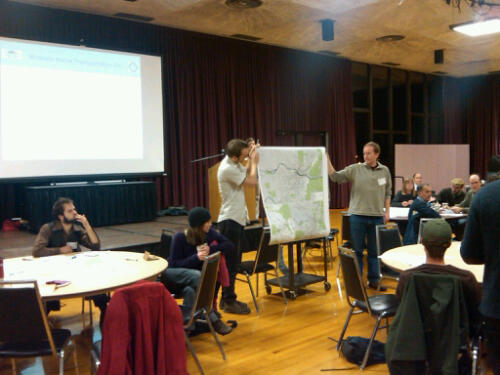
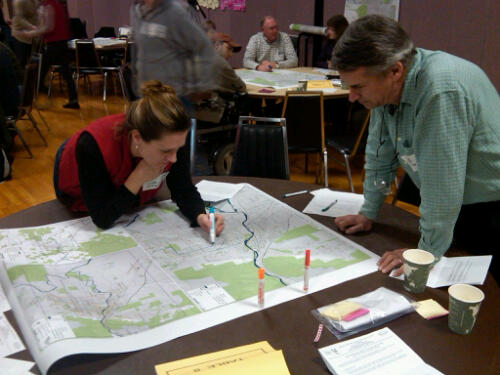
The community workshop was pretty interesting to watch play out. The night it was held was cold and snowy, yet about 2/3 of people biked and most of the rest walked. With perhaps upwards of 60 or 70 people in attendance, everyone worked through a series of group oriented activities. Of course everyone's favorite involved drawing on a map of Missoula.


And once the individual groups had finished their discussion and mapping each shared their results with the entire workshop.


Out of this event came a lot different input but the general themes included:
- improved connectivity
- finish the trail/sidewalk/bike lane network
- reduce posted speed limits, at most 35 mph
- improve street lighting
- implement our complete streets policy
- focus transportation more on safety than traffic flow

Tuesday, February 2, 2010

Stupid Inflammatory Comment of the Day

This quote comes from Sgt. Tom O'Brien up in Ontario Canada in a recent op-ed.

"
...bicycles in London should generally disappear after the first few days of snow and not reappear until the drains are filling with melt water... I am amazed why anyone would jeopardize their lives by riding on icy, slippery roads where any miscue could lead to a nasty fall or worse."

Thanks for the concern officer, I just hope you don't start enforcing that opinion like officers have started enforcing imaginary laws in Texas to get cyclists off the street.

Tuesday, January 26, 2010

"Riding a Bicycle on a Roadway" Now Illegal (in Texas)

For days I have been enthralled by the slowly unraveling story of fellow cyclist and carfree blogger ChipSeal who has been arrested - more than once - for driving his bike on a public roadway (in Texas) in the last week. Each day he reveals more details or more of his inner thoughts on the utter stupidity of the situation.

I won't cover the whole story, since ChipSeal does it so well with very well timed wit, for the real thing go to his blog, or visit Commute Orlando for a great commentary largely inspired by ChipSeal's ordeal and the ordeals of other cyclist's in similar situations.

Essentially he is being harassed by law enforcement at the behest of whinny motorists for obstructing their right to go fast without any impediments to their forward progress. In his last post ChipSeal prods bicycle advocates to give a shit and show it by doing something other than lobbying for laws and infrastructure and get down to something that will be real and solid in protecting/enforcing cyclist rights in Texas.

I might be a long way from Texas... but it sounds like small town Texas could be infused with some of the enthusiasm for theme rides that the cyclists of Portland are infected with. Seems to me that a "Solidarity Ride" needs to be organized to bring cyclists from all over Texas (or the nation) to ride through these small towns that are trying to restrict cyclist's rights, or harassing the few cyclists present on the road, as a show of solidarity and numbers.

But what do I know about Texas from my perch in the snowy mountains of Montana.

And I was going to do a short post on the little parking ticket I received on campus yesterday... though I still managed to slip it in there.

Tuesday, January 19, 2010

Winter Riding Update

Temperatures have risen to a balmy 40 F the last two days. It actually been a fairly warm week in general with temps hovering just above freezing most days. And to give you an idea of just how bad the ice was the last couple of weeks... there is still ice in places on the road after a week of melting. Now that temperatures are back up I'm no longer the lone cyclists out there and even with rain today there are a number of people out on their bikes.

I really felt unsafe in many situations over the course of the worst road conditions here in Montana. My usual routes along neighborhood side streets were often completely un-ridable from the thick coating of undulating ice. Which forced me onto many main streets where the roads were clear but the traffic was heavy. I never had a close call, but it was still very unsettling to to be forced onto busy roads that had become constricted because of plowed snow piling up on the roadway. Just from a personal perspective, the perception that an auto is safer in such conditions really does make them much more utilitarian than a bike.

As for the score so far this winter... Ice - 2, Me - 0. And yes, to all those family reading this... I had a helmet on both times I took a spill on the ice.

Wednesday, January 13, 2010

Walkscore: Something seems a little off

What do I do with my free time? Play around with Missoula's Walk Score of course... and find that it is broken.

For those who have never been to the Walk Score website, the purpose is to calculate the friendliness of different neighborhoods based on the proximity of amenities such as services, restaurants, etc. According to the Walk Score website, the algorithm used assigns the maximum number of points for amenities that are within a 1/4 mile of the location entered. While this is a good measure of walkability, I would argue that factors such as street design, traffic volume, speed limits, and neighborhood character would make the model Walk Score uses much more accurate and relevant.

To illustrate my point you can see below the streetscape of Phillips, the street on which I live. My address received a 69, meaning that only 27% of locations had higher walkscores than my house.


Now contrast my neighborhood's Walk Score with the one received by the location seen below. I randomly typed in an address along Brooks, a four lane arterial with speeds ranging from 35-45 with lots of traffic, congestion, business activity, and almost no cyclists or pedestrians.


This section of Brooks received a Walk Score of 83, 14 points higher or about 20% more "walkable" than where I live. I think its pretty intuitive just from the pictures of the two different locations which one would be more friendly to active transportation... and its not the one Walk Score recommends.


There is a lot more to getting people walking than just how close they live to given amenities or their job. Paramount is safety, or at least the perception of safety along design aesthetics. I would venture to guess most people would rather walk down a tree lined, quiet street with on street parking acting as a buffer, than a busy, loud arterial surrounded by parking lots and neon lights.

I think Walk Score might be broken.

Monday, January 11, 2010

Coeur d Alene: Safety Fail, No Saftey in Numbers for Bike/Peds

Over the weekend I was hit by a car, and it provides me with a good opportunity to talk about safety in numbers that cyclists and pedestrians create and how streetscapes and development patterns contribute to safety.

Let me setup what happened. I took the Greyhound from Missoula to Coeur d' Alene (CDA) Saturday morning to visit my folks. There is no physical transfer station in CDA, rather the bus drops you off at a gas station that sits at the corner of a large intersection (Ramesy and Appleway) where two four-lane arterials meet (total of 22 lanes at the intersection).

Anyway, the bus dropped me off at a different location than the Greyhound website gave for the (nonexistent) station. My father was coming to pick me up, but since he doesn't have a cell phone there was no way to get a hold of him, so I decided to walk north along the western side of Ramsey to find a good place to wave him down as he came to pick me up.

Two blocks later I was crossing the intersection below, which is an old picture as the intersection now has a four-way light, within the cross walk while a car was waiting for an opening to turn right-on-red. I walked out in front of his car, attempting to make eye contact because I could sense he was ready to hit the gas to make an opening, but he was looking the other direction. Needless to say he hit the gas and ran right into me. Luckily he immediately stopped and I wasn't hurt other than a small bruise on my leg.


This incident got me thinking how ridiculous the incident was. Living in Missoula, I have walked hundreds, perhaps even a thousand miles around town over the course of seven years. In that time I have never been hit by a car... I don't even remember having a close call. But here I am, back in the town I grew up in, and five minutes after stepping off the bus I am hit be a car.

The whole time I lived in CDA, I never once got around by walking or biking, rather the only real way to get around is by car. Seven years of walking in Missoula = no problem, five minutes of walking in CDA = getting hit by a car. Missoula and CDA are also fairly close in terms of population size.

Why is this? Because of not only the streetscape that dominates in CDA (suburban arterials with speeds above 35 mph) but also the development pattern that essentially forced those types of roadways to be built.

You can see these patterns at play in the photo of CDA below. I have highlighted all the four lane arterials (red corresponding to suburban arterial design and yellow representing four lane roads with an urban character). CDA is a maze of suburban subdivisions that are only connected to the wider community through the use of a lot of arterials. Only a small portion of CDA (which also includes the towns of Dalton Gardens, Hayden, and Hayden Lake) actually has a street network laid out in a grid. This pattern results in a very spread out population with very low densities (Dalton Gardens is zoned at 1 house/acre).


Because people have to drive everywhere and there are almost no pedestrians or cyclists, the motorists don't look out for these types of people. Those whom do walk or bike are mostly a working-poor underclass -except for the roadies - that most suburbanites don't spend any time thinking of between trips to Starbucks, work, and dropping the kids off at soccer practice.

Now contrast this with Missoula (a photo with the same types of streets highlighted can be seen below). The bulk of Missoula is based on a grid system and subdivisions with a suburban character only exist at the fringes of the town. Not only that, but the most of the four lane roads that Missoula does have exist within areas that are urban in character (higher densities, tree lined streets, sidewalks, smaller lot setbacks, and slower speeds). The four lane suburban arterials are located again mostly at the edges of Missoula and so cyclists and pedestrians can largely avoid these roads by choosing quieter streets.

Also consider the the geographic distance these two photos show. The photo of Missoula covers most of the town and most of the town's population. The photo is 3.5 miles x 3.5 miles while the photo of CDA shows an area 7.5 miles x 7.5 miles that leaves out a considerable amount of development to the north. Missoula's compact nature encourages alternative transportation simply through its shorter distances.


The higher densities, shorter distances, and more welcoming streetscape encourages people to walk and bike. In much of the central part of Missoula you can't go more than a couple of blocks without seeing another pedestrian or cyclist. Just the numbers of pedestrians and cyclists using Missoula streets makes motorists more aware of them and creates a situation where motorists must constantly be on the lookout. This creates a Safety in Numbers phenomenon whereby the more cyclists and pedestrians out on the roads, the less absolute fatalities and crash cars have with cyclists and pedestrians.

Describing what had happened, even my very conservative father understood the relationship between development patterns, streets, and mode of travel. In his opinion, and I have to agree with him, CDA is a town that will never see a lot of people walking, biking, or using transit simply because the towns infrastructure makes those options economically difficult and even dangerous.

Thursday, October 1, 2009

Random Bicycle Crap Fridays - Only the coolest PSA ever

Pet Peeve Regarding Motorists Number 1


Throughout my time being carfree there is one nagging behavior that keeps popping up among motorists that really annoys me. The complete disregard certain drivers (assholes) display for a cyclist waiting at an intersection. Here I am in these situations trying to obey traffic laws and be a good little cyclist when some asshole acts like an asshole. Maybe assholes just don't view people on bikes as real people, and therefore they can ignore and marginalize us. We are less then them, we are... sub-asshole. For more on the subject of assholes, cars, and the cyclists they hate, you should read this blog post from the Boston Biker Blog, explaining how to deal with assholes.

Over and over again while I wait patiently at intersections, a vehicle will come from behind and not stop after me, but pass and stop in front of me at an intersection. It happened again yesterday and seems to happen regardless of whether I have taken the lane or am waiting behind another vehicle.

At the intersection of Scott and Toole, I stopped behind an SUV turning left, about ten seconds later a Chevy truck pulled up and rather than acknowledge me, nudged in behind the SUV. When I waved at the driver to get his attention and using my hands to explain, not the middle finger, that I was there before him, he just looked at me and shook his head in apparent disgust. At which point, when the SUV got an opening to go, I quickly moved forward to block the asshole from moving forward.

At the same spot a month back I was the only one at the intersection trying to take a left but cross traffic was to heavy to find an opening when an Eclipse pulled up, passed me, and without stopping peeled-out into traffic. Of course I learned a valuable lesson then... Eclipse are officially cool again now that I know they can peel-out.

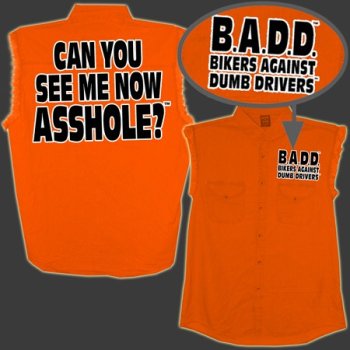
These incidents seem to happen mostly at stop signs. But still, in the 6 months I've been carfree, this has happened 6 or 7 times. Maybe I need something like the clothing below to fend off assholes:


Monday, August 24, 2009

Missoula Roundabout Almost Ready to Ease Traffic Headaches


Missoula is getting its first single lane roundabout at the intersection of Higgins - Hill - Beckwith. This is completely different than the current traffic circles that can be found in our towns residential neighborhoods; which are meant to calm traffic at non-controlled intersections.

The roundabout has been under construction for about two months (more here) and is meant to make safer and more efficient a major intersection for traffic going to both the University of Montana and downtown. Pedestrian safety was a major design factor for the reconstructed intersection as the old intersection provided no safe or marked way for pedestrians to cross.

Roundabouts like the one about to open have been proven in numerous studies (here and here) have shown that roundabouts can reduce traffic accidents at intersections by anywhere from 30% to 70% depending on the prior intersection environment; this is mostly due to decreased speeds and the elimination of traffic crossing paths.


The Higgins - Hill - Beckwith roundabout will also feature some beautification with a park on one corner and the landscaping that can be seen in the photo below.

Wednesday, August 19, 2009

Confirmation - More Bicycles on the Road = Safer Cycling Environment

My neighbor, Hank Green of EcoGeek.org, came across an interesting graph courtesy of Treehugger. In this short article here Treehugger shows the relationship between the number of people taking to the road on bicycles and the number of annual injuries and fatalities.

Essentially, the graph shows that between 1998 and 2008 the number of cyclists on New York City streets roughly doubled while annual casualties dropped from roughly 5,000 to under 3,000. This is something that many bicycle advocates have been arguing for some time now. The original article out of The Atlantic Magazine is conformation of this relationship.

Now... there is more going on here than just increased numbers bringing about increased safety for cyclists. The increased demand from bicycle commuters has corresponded to an increased supply of bicycle facilities on NYC streets and the inclusion in the design process of road features that makes cycling a more attractive and safe option.

Whatever other factors contribute to the decrease in cyclist fatalities, the situation in NYC is something that all bicycle and alternative transportation supporters should take note of. Just from my own and other people's experiences in the parts of Missoula - where cyclists have become normal and even clog the bike lanes at certain times of day - there is an increased awareness of and respect for cyclists coming from motorists. However, in parts of town where cyclists rarely venture, the slaughter continues, on streets like Reserve - a five lane expressway.

Thursday, August 6, 2009

Missoula Hit-&-Run Incident Sparks Same Old Us vs Them Arguement

In this post I get a little local... but I'm sure this kind of thing happens in every corner of America.

You would think that when an innocent elderly women gets killed as a result of a hit and run incident at a busy intersection, people from the community would band together to express their grief and desire for a safer transportation environment. But no, thats not what happened. Very quickly the Missoulian articles... here and here turned into a shouting match between people (mostly avid cyclists and pedestrians) blaming the motorist and those that deafened the motorist and said that anyone on a bicycle or a pedestrian on that road was an idiot and most likely deserved what they got. (Its a shame that by now you can't view the long series of comments made about the initial news story).

I'll just give a quick overview of what happened. On June 22nd at the intersection of Brooks and Reserve streets (a big 20+ lane intersection with sweeping corners) a women was walking her bike across the intersection in the crosswalk going northbound when a pickup truck that was idling in the left hand turn lane suddenly proceeded into the intersection and struck Beverly Joyce Felton whom eventually died of brain injuries.

The man in the pickup sped off and later turned himself in and admitted to hitting Beverly, this of course was only after a witness had come forward and identified for the police the man's vanity plates.

As I said before, I wish the record of comments was still available, but I can sum things up for people from memory. Within only a few comments people started blaming the "victim" for not paying enough attention to her surroundings, for even being on that street because it is so dangerous, complaining generally that cyclists and pedestrians act as if they own the road and that their arrogant behavior was the problem, and that Beverly was an idiot for even being out there while not in a car.

The "Bicycle Nazi," as some of the angry motorists called them, fired back with the usual stupid people in SUVs rant.

All this went on all the while Beverly's family members were participating in the debate, calling for all sides to calm down and realize that a human being had just died and that people need to respect that fact and not use this as a forum to express hatred of "the other."

The sad thing is that it now continues in the latest article, although not nearly as bad. It only takes one person's comment to send the rest of the discussion on a tangent about the cranial deficiencies of the other group. All the while Beverly's memory is trampled upon while individuals get in their own hateful speech about their adversaries on bikes or in cars.

Perhaps the most ridiculous thing about all this is the fact that the man turned himself in and admitted to hitting Beverly, and yet is now pleading not-guilty. The judge has let him out on bail with his driver's licence in hand. People are defending this decision as his right to a fair trial and that we shouldn't jump to conclusions. But honestly... when someone is charged with murder using a hand gun I don't think they let that person out of court with a Glock in their hand... no, they confiscate any deadly weapons, but apparently this man still has access to his.

Tuesday, June 23, 2009

What NOT to do With a Car Door and Stupid Bicycle Tricks

This post is a little scattered, just like my life right about now. But I'm going to get to the business end out of the way and leave the funny till later. In the following video, I don't think a bike helmet would have helped, but a brain for the car passenger would have.

Warning: Sensitive subject mater


The above scene is a tragedy, and an awful example of what can happen when people in cars don't take people on Bicycles seriously. I saw this yesterday in the local bike shop and everyone watching couldn't believe what they saw. The automatic response was anger at the idiot that was trying to door the bicyclist. Obviously the kid doing the dooring realized he fucked up big time, but remorse for an action is not good enough.


Many motorists still feel that cycling is a joke, and that somehow they have the right to ostracize and harass bikers simply because we are not in a vehicle of equal size and killing power. At a recent group ride in San Jose that my cousin took part in, along with 1500 other bikers, participants were repeatedly spit on and had things thrown at them by motorists. That is the type of behavior that prompts cyclists to be agressive and militiristic in their approach to asserting their rights to the road; if motorists won't respect us and share the road, we'll take our share of the road.

The San Jose Bike Party:


Now for something lighter on the stomach: Spot the Lame video

Two videos I came across the other day, both involving fixed gear tricks, but very different styles. Both are kind of lame, but only one actually displays some crazy skills with a fixed gear.


The first video is pretty amazing to watch, but the music and the setting makes me feel like I'm watching Olympic gymnastics, which I can't stand. The second video seems to have all the elements of a sick video with some crazy tricks; urban setting, fixies, high speeds, and some catchy music. However, all you really see in the teaser is a bunch of kids braking on their fixies and balancing. If I remeber correctly from the time long ago when I learned how to ride a bike, those are the first two things you learn as a child. So, if the tricks in the first video could be combined with the style of the second, fixed gear tricks might be cool.

Friday, June 19, 2009

Stupidest Bicycle Safety Video

Bicyle safety is an important part of getting more people out on the road on their bikes. But this is just silly and possibly derogatory towards apes.

Thursday, June 18, 2009

Creating Bike/Pedestrian Friendly Neighborhoods

I realy don't have all the answers when it comes to designing spaces that cyclists and pedestirans will feel comfortable using alongside traffic. But I do know that one of the elements that MUST be included are lower speed limits.

5 miles an hour doesn't seem like much, but it can be an important factor in changing the way motorists, pedestrians, and cyclists interact with each other on the street. Lowering the speed limit to 30 mph or lower can make a big difference by reducing traffic accidents and providing pedestrians with a higher level of safety.

This is something that I have noticed living and commuting in Missoula. The streets that have a 25 mph speed limit are very safe for other types of road users. The vast majority of the time motorists will automatically stop for both pedestrians and cyclists (even though they are not supposed to with cyclists). On the major arteries of our town however, its a nightmare to get cars to stop, and crossing at a light becomes the only option. If a car did stop, it would most likely cause a traffic accident.


Even on the major arteries that I cross on my commute, as long as the speed limit is no higher than 30mph, the vast majority of cars will yield the right of way if they see you early on and have enough time to easily stop.


Can you imagine trying to get across traffic like this as a pedestrian? Hell no.
Bookmark and Share