Showing posts with label urban landscape. Show all posts

Friday, February 19, 2010

Ecotopia... Random Bicycle Crap Fridays

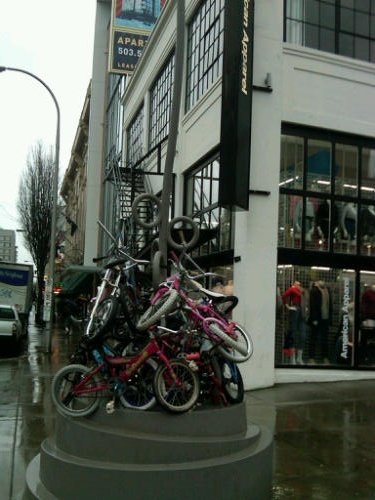
I recently started reading the classic environmental polemic Ecotopia written by Ernest Callenbach. Its got a lot of amazing ideas and innovative design techniques for urban centers. I'll get into those in longer posts later, but for now I'll just give a teaser related to bicycles.

"Ecotopians setting out to go more than a block or two usually pick up one of the sturdy white-painted bicycles that lie about the streets by the hundreds and are available free to all. Dispersed by the movements of citizens during the day and evening..."

Monday, February 15, 2010

The view from Portland

My feet hurt... thank you Portland. Four days of a carfree mini vacation using a walking/transit combo put a lot of miles on the feet. Still tired from traveling today and then immediately diving into work back in Missoula so this post will be short and quick... for some great thought provoking writing check out @Urbanophile's arguement for fare-free transit, which would be perfect for Portland, and this article that shows that being sighted close to transit is saving homes from entering foreclosure.

Enjoy the pictures... I'll write more on Portland later... especially the Hipster economy.


Plane from Seattle --> Portland. A little greenwashing? I think so


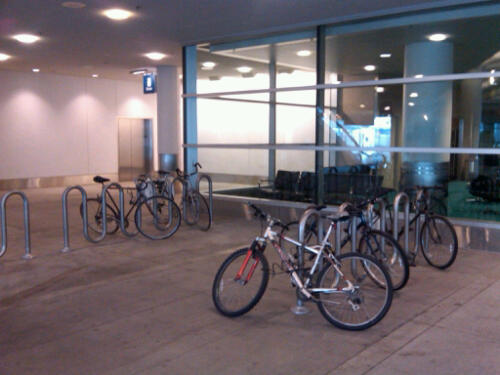
You know your entering a different world when there is bicycle parking at the airport terminal.


My ride from the airport awaits.


On-street Bicycle parking at Powell's Books


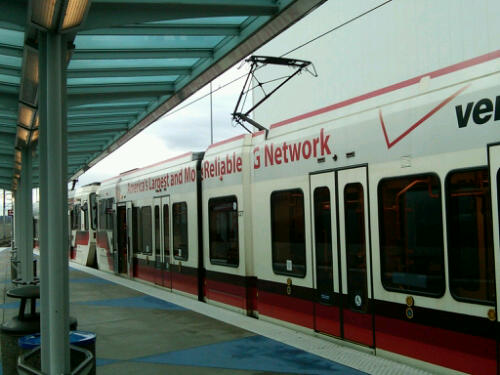
Portland does a great job of using public (park) space to accentuate the utility and connectivity of the various rail lines.


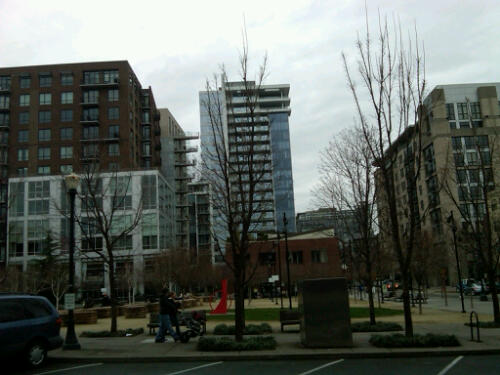
Only in Portland


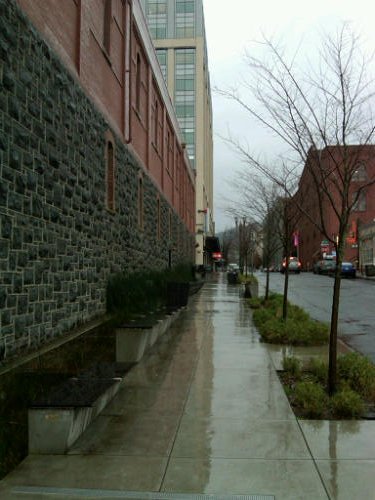
Another innovative urban design... this time add green infrastructure and reduce rain water runoff.


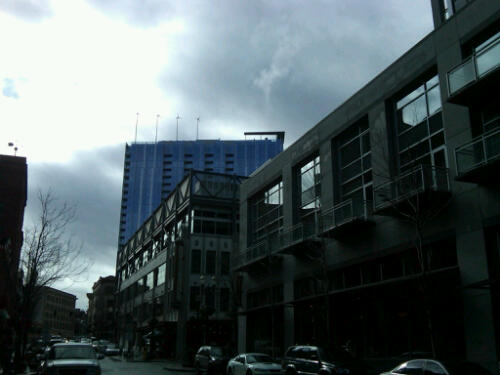
Building with both wind turbines and solar on the roof.


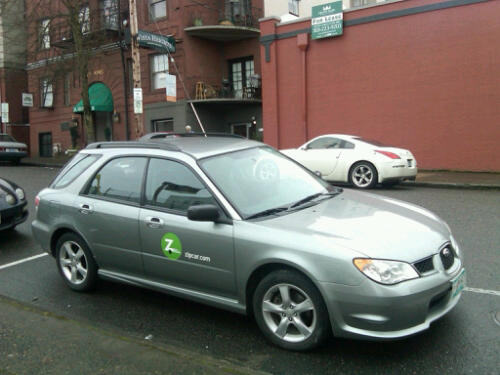
Making it that much easier not to own a car.


And finally the beer... my god the beer. A little nitro never hurt anyone... and anyway can't get this shit in the stores. Don't worry Kettlehouse, your still the beer I hold dear... though I think I'll miss Amnesia.

Wednesday, February 10, 2010

Missoula Residents Show Up to Support Active Transportation

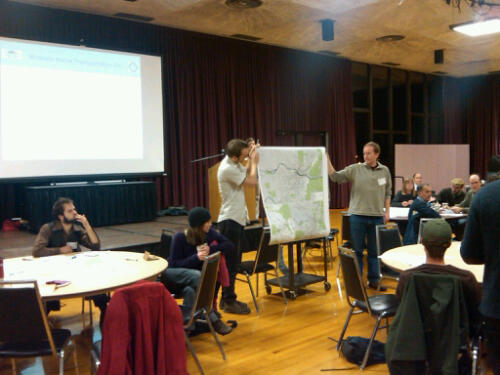
Missoula has started the long and arduous bureaucratic process of updating one of its many long term plans. And this time its an update to the non-motorized transportation plan and recently Missoula's Office of Planning and Grants (OPG) held a community workshop to get input from Missoula citizens. And the general message from the good people of Missoula was for the city to finish the trail/sidewalk/bike lane system.


Missoula's planning apparatus (and I use that term half jokingly because we are a small community that gets a lot of planning done on limited resources) has in recent years really integrated collaborative planning into the process and this time is no different. Collaborative planning aims to be as open and inclusive of different interests and community groups as possible to allow a wide variety of input to be included in the planning process.

And from the parts of the process I have been involved in... there is a lot of input coming in. Transportation is one of those topics in Missoula that really brings out a lot of people and groups. The advisory committee alone has close to thirty people (from various city/county departments, nonprofits, community groups, and business organizations) in attendance guiding the process.

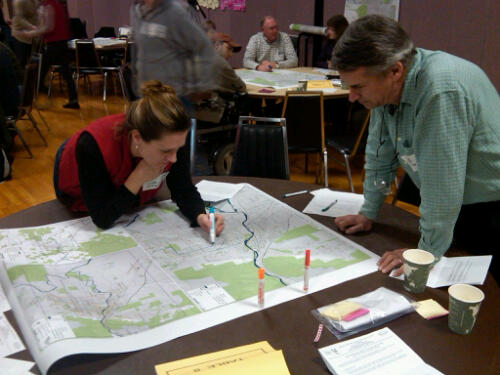
The community workshop was pretty interesting to watch play out. The night it was held was cold and snowy, yet about 2/3 of people biked and most of the rest walked. With perhaps upwards of 60 or 70 people in attendance, everyone worked through a series of group oriented activities. Of course everyone's favorite involved drawing on a map of Missoula.


And once the individual groups had finished their discussion and mapping each shared their results with the entire workshop.


Out of this event came a lot different input but the general themes included:
- improved connectivity
- finish the trail/sidewalk/bike lane network
- reduce posted speed limits, at most 35 mph
- improve street lighting
- implement our complete streets policy
- focus transportation more on safety than traffic flow

Wednesday, January 20, 2010

An Interesting Repercusion from Missoula's New Title 20 Zoning


Missoula's new Title 20 zoning ordinance hasn't been been in place for very long, but already it is starting to stir up some controversy and play havoc on some people's building plans.

You see, the updated ordinance prohibits garages that extend past the front of a house's facade, such as the one in the photo below. This move essentially limits the type of housing that has been prevalent in America's suburbs since the 1970's. The reason for the new ordinance is an attempt to shape the aesthetics of new construction to fit with Missoula's more historic neighborhoods where a garage is usually in the back facing a alley or non-existent.


Essentially the uproar has come from a builder that was planning a small development. His argument is that the ordinance raises the cost of construction because it is so difficult to find stock architectural plans where the garage doesn't dominate the front of a home that he will be forced to pay an architect to design homes that fit in with the newly updated ordinance and could even force several future projects to fail because of additional costs.

This news came from the city council listserve that our Councilman Bob Jaffe maintains. From the sound of it, no one at that level of local gov't knew of this ordinance and there is already talk of revising the language to make it less restrictive.

Part of the idea behind the zoning update was to make the language simplified and easier to understand, but at the same time to make it easier for more traditional, mixed use and compact development to take place to fit in with the Missoula community's vision of growth and Downtown Master Plan. A component of this vision is our recent passage of a complete streets ordinance.

In my opinion, a house dominated in the front by a garage doesn't add anything to the character of a neighborhood or to the streetscape. And complete streets is about more than just how the roadway is configured, but should also consider the buildings along the street and how they come to make an "outdoor room" and how those buildings interact with the public space (road) out front. A large garage in the front of a house sends a poor signal, both aesthetically and architecturally, while confining the since of public space more so and limiting the interactivity of elements along the streetscape.

Wednesday, January 13, 2010

Walkscore: Something seems a little off

What do I do with my free time? Play around with Missoula's Walk Score of course... and find that it is broken.

For those who have never been to the Walk Score website, the purpose is to calculate the friendliness of different neighborhoods based on the proximity of amenities such as services, restaurants, etc. According to the Walk Score website, the algorithm used assigns the maximum number of points for amenities that are within a 1/4 mile of the location entered. While this is a good measure of walkability, I would argue that factors such as street design, traffic volume, speed limits, and neighborhood character would make the model Walk Score uses much more accurate and relevant.

To illustrate my point you can see below the streetscape of Phillips, the street on which I live. My address received a 69, meaning that only 27% of locations had higher walkscores than my house.


Now contrast my neighborhood's Walk Score with the one received by the location seen below. I randomly typed in an address along Brooks, a four lane arterial with speeds ranging from 35-45 with lots of traffic, congestion, business activity, and almost no cyclists or pedestrians.


This section of Brooks received a Walk Score of 83, 14 points higher or about 20% more "walkable" than where I live. I think its pretty intuitive just from the pictures of the two different locations which one would be more friendly to active transportation... and its not the one Walk Score recommends.


There is a lot more to getting people walking than just how close they live to given amenities or their job. Paramount is safety, or at least the perception of safety along design aesthetics. I would venture to guess most people would rather walk down a tree lined, quiet street with on street parking acting as a buffer, than a busy, loud arterial surrounded by parking lots and neon lights.

I think Walk Score might be broken.

Monday, January 11, 2010

Coeur d Alene: Safety Fail, No Saftey in Numbers for Bike/Peds

Over the weekend I was hit by a car, and it provides me with a good opportunity to talk about safety in numbers that cyclists and pedestrians create and how streetscapes and development patterns contribute to safety.

Let me setup what happened. I took the Greyhound from Missoula to Coeur d' Alene (CDA) Saturday morning to visit my folks. There is no physical transfer station in CDA, rather the bus drops you off at a gas station that sits at the corner of a large intersection (Ramesy and Appleway) where two four-lane arterials meet (total of 22 lanes at the intersection).

Anyway, the bus dropped me off at a different location than the Greyhound website gave for the (nonexistent) station. My father was coming to pick me up, but since he doesn't have a cell phone there was no way to get a hold of him, so I decided to walk north along the western side of Ramsey to find a good place to wave him down as he came to pick me up.

Two blocks later I was crossing the intersection below, which is an old picture as the intersection now has a four-way light, within the cross walk while a car was waiting for an opening to turn right-on-red. I walked out in front of his car, attempting to make eye contact because I could sense he was ready to hit the gas to make an opening, but he was looking the other direction. Needless to say he hit the gas and ran right into me. Luckily he immediately stopped and I wasn't hurt other than a small bruise on my leg.


This incident got me thinking how ridiculous the incident was. Living in Missoula, I have walked hundreds, perhaps even a thousand miles around town over the course of seven years. In that time I have never been hit by a car... I don't even remember having a close call. But here I am, back in the town I grew up in, and five minutes after stepping off the bus I am hit be a car.

The whole time I lived in CDA, I never once got around by walking or biking, rather the only real way to get around is by car. Seven years of walking in Missoula = no problem, five minutes of walking in CDA = getting hit by a car. Missoula and CDA are also fairly close in terms of population size.

Why is this? Because of not only the streetscape that dominates in CDA (suburban arterials with speeds above 35 mph) but also the development pattern that essentially forced those types of roadways to be built.

You can see these patterns at play in the photo of CDA below. I have highlighted all the four lane arterials (red corresponding to suburban arterial design and yellow representing four lane roads with an urban character). CDA is a maze of suburban subdivisions that are only connected to the wider community through the use of a lot of arterials. Only a small portion of CDA (which also includes the towns of Dalton Gardens, Hayden, and Hayden Lake) actually has a street network laid out in a grid. This pattern results in a very spread out population with very low densities (Dalton Gardens is zoned at 1 house/acre).


Because people have to drive everywhere and there are almost no pedestrians or cyclists, the motorists don't look out for these types of people. Those whom do walk or bike are mostly a working-poor underclass -except for the roadies - that most suburbanites don't spend any time thinking of between trips to Starbucks, work, and dropping the kids off at soccer practice.

Now contrast this with Missoula (a photo with the same types of streets highlighted can be seen below). The bulk of Missoula is based on a grid system and subdivisions with a suburban character only exist at the fringes of the town. Not only that, but the most of the four lane roads that Missoula does have exist within areas that are urban in character (higher densities, tree lined streets, sidewalks, smaller lot setbacks, and slower speeds). The four lane suburban arterials are located again mostly at the edges of Missoula and so cyclists and pedestrians can largely avoid these roads by choosing quieter streets.

Also consider the the geographic distance these two photos show. The photo of Missoula covers most of the town and most of the town's population. The photo is 3.5 miles x 3.5 miles while the photo of CDA shows an area 7.5 miles x 7.5 miles that leaves out a considerable amount of development to the north. Missoula's compact nature encourages alternative transportation simply through its shorter distances.


The higher densities, shorter distances, and more welcoming streetscape encourages people to walk and bike. In much of the central part of Missoula you can't go more than a couple of blocks without seeing another pedestrian or cyclist. Just the numbers of pedestrians and cyclists using Missoula streets makes motorists more aware of them and creates a situation where motorists must constantly be on the lookout. This creates a Safety in Numbers phenomenon whereby the more cyclists and pedestrians out on the roads, the less absolute fatalities and crash cars have with cyclists and pedestrians.

Describing what had happened, even my very conservative father understood the relationship between development patterns, streets, and mode of travel. In his opinion, and I have to agree with him, CDA is a town that will never see a lot of people walking, biking, or using transit simply because the towns infrastructure makes those options economically difficult and even dangerous.

Thursday, December 17, 2009

Parking Wars in Downtown Missoula


Missoula's downtown faces many of the same problems that most downtowns in America face. One of those problems is dealing with parking. Our cities long term planning envisions big growth for our little city over the next 20 years, especially in our urban core (seen above) where a lot more people will not only come to shop and eat lunch, but also increasingly come to live. To deal with this growth and the subsequent need to accommodate more cars downtown, Missoula's Downtown Master Plan calls for the building of seven new publicly owned multi-story parking structures at the cost of tens of millions of dollars to tax payers and using up precious real estate for the storage of our communities vehicles.
Recently this issue came up in Missoula's city council and discussed further in a great local list serve updated by one of our council members to keep Missoula citizens informed. A possible update to Missoula's parking meter system erupted into the biggest debate I have yet to witness occur over the email list serve. Over 30 emails went back and forth detailing almost all points of view people have on parking downtown.

Friend and colleague Jordan Hess made some very succinct point about the absurdity of spending public money to subsidize parking downtown. Jordan had this too say:

There is no such thing as free parking. Ever. Even the parking at Walmart is highly
subsidized in the form of infrastructure improvements the the city has to foot the bill for (such
as the idea of adding a second left turn lane from Reserve to Mullan).


If parking in the urban core is free, than it will be taken up by people parking for a long period
of time, such as employees or area residents and it won't be available for customers of
downtown businesses or for folks stopping by government offices. There are many ways to
properly price downtown parking to make it hassle-free and affordable. If parking were free, I
believe it would actually be a strain on downtown businesses because less would be available
to their customers. It would certainly be a strain on city budgets.

Building new parking structures is far more expensive than providing premier transit. At
$50,000+ per space
(I've seen figures more in line with $15,000 - $30,000 per space),
parking structures are an extremely expensive way to get people downtown. It is absurd to
imply that Missoula can't have a good transit system because we are not a large city full of
wealthy people. There are solutions for our size of community.


I'm going to use the University (of Montana) as an example, because I am more familiar with
it than with downtown in terms of parking and transportation, but the two function similarly in
these regards. On campus, ASUM spends about $0.65 per ride provided on the Park and Ride.
While this may seem like a lot, in order to provide parking for the same amount of money, a
parking space would have to turn over more than 5 times a day, 365 days a year for 40 years
(a rather generous lifespan for a parking garage). This doesn't take into account the cost of
maintaining the garage (about $1,000 per space per year).


Consider this: paying for one person to NOT use a parking space is the exact same thing as
building one new parking space. If by providing better bus service, I opt not to use an
on-campus parking space, it is functionally identical to the university building one additional
parking space, but the difference is that it cost the university a fraction of the cost.


We need to use this model downtown. Do not build any additional parking. Instead, spend this
money on increasing transit into downtown. This WILL free up parking used by people who
find the current level of transit service to be inconvenient. This newly available parking can be
used by folks who cannot or simply choose not to ride transit.


I couldn't agree more. Providing alternatives to driving and parking is a much more cost effective way to use a communities limited resources. Missoula's zoning regulations allow for business to replace one parking spot with 8 bike parking spots. Even if you figure that surface parking costs between $5,000 - $10,000 per spot then exchanging one parking space for 8 is a great value. Not only does a developer save money, but the city saves from reduced impacts on city streets from encouraging people to ride bicycles, and everyone wins when congestion is reduced. Eight bicycle parking spots would probably cost between $500 - $800 while an equivalent number of surface parking spots for vehicles would cost at least $40,000. Big difference.

Planners and urban design theorists are starting to come around to the idea that "if you build it, they will come." One commenter on the list serve said
so long as personal vehicles remain the preferred and affordable means for people to go to and from Downtown, it is necessary to accommodate vehicles. This is the standard argument used for everything from road expansion to our current federal transportation spending.

If you build a large 6 lane expressway, it will encourage people to drive and if you design cities to sprawl and build large box stores with large parking lots then people will largely be forced to drive. Building more roads will not reduce traffic and building more parking spaces will not reduce parking problems, but in fact induce people to drive and use those extra spaces. This situation is called the Jevons Paradox in which gains in efficiency actually encourages more consumption. Homes built today are more energy efficient than those built 40 years ago, but they are also so much bigger to the point that the average house uses more energy than 40 years ago.

This works just as well in reverse. If you reduce road capacities, congestion is actually reduced as people find better and easier ways to get around that doesn't require driving. At the same time, if bicycle infrastructure is invested in and mass transit increased this will induce demand for these services as it becomes more convenient. Not only does a community spend less money to accommodate locally focused transportation but it frees up real estate when fewer roads need to be expanded and fewer parking structures built. This extra real estate can be invested in, creating wealth and jobs in the local community rather than creating a larger tax bill for city residents.

Fewer roads and parking spaces and more transit, bicycle infrastructure, and buildable real estate = lower tax payer costs, more wealth, more investment, more jobs, and a more vibrant, resilient, and livable community.

Thursday, November 19, 2009

David Orr on Post-Carbon Cities


Missoula was lucky enough yesterday to have David Orr in town. In between the meetings usual social events, there was enough time for him to give two lectures at the University of Montana.

For those of you who don't know of David Orr, he is a leading thinker and innovator environmental issues, green building, and ecological design. Within the last decade he gained national press for his effort and subsequent success in building a fully carbon-neutral building on the campus of Oberlin College which can be seen above. It integrates passive solar design by orienting the building to take advantage of the suns energy, a roof fully covered by solar panels, sustainable materials, food production in the form of a garden and orchard on the north side of the building, and environmental restoration on the wetlands immediately adjacent.

David Orr covered post-carbon cities in the lecture I attended. The scope of his talk was extensive, delving heavily into the philosophy behind green building/urban design. What resounded with me was his call to take a systems approach to issues. He blames academia for the tradition of reductionist thought that breaks issues/objects into components without concerning itself with how the whole works or interacts with the world. He used the example of optimizing the Hvac system of a building without also optimizing the insulation or materials used in the building.

By taking a systems or wholistic world view we can come to better understand the world and the interaction between our actions and the environment. This is true of economics - which as a student of economics I fully agree with - where one doesn't pay the full cost of any product. Externalises exist everywhere and with every purchase; a vehicle doesn't really cost only $20,000 if you include the pollution from its manufacture and operation, the cost of the roads it travels, and the cost of disposal, etc. If all these costs where taken into affect, our world would be a much different place. There would be no coal fired power plants if the coal industry had to directly pay for every death caused by the pollution it creates.

Back to post-carbon cities. David has an ambitious goal of turning Oberlin into a carbon-neutral city, starting by redeveloping the downtown area to be an eco-village. He is taking a ground up approach by gathering support and investment from within the community. This seems like a much better approach for such a project than the one taken by Saudi Arabia and China in attempting to build their own respective eco-cities, both of which after years of being in the design and planning phases have gone nowhere.

Of course, building a fully carbon-neutral town is a big challenge, as not only do the buildings have to be redesigned, but people's behavior's have to radically change and a whole new local economy built from scratch. If David Orr has any misgivings about such a project, its is that he doesn't know whether people are willing to do what needs to be done to create such an ecologically friendly future.

He is optimistic in terms of having all the tools ready and at his finger tips. David talked of how over the last thirty years scientists and entrepreneurs have developed the tools to create such a future and now everything simply has to be brought together and integrated. Social awareness has also progressed enough to allow the building of such a future. This is especially true within professions that can move something such as eco-cities along. Daniel Narrin over at Discovering Urbanism illustrates this point in a recent post. Having found a planning text book from the early 1990s, he was surprised to see how far the profession has developed in two decades, having found that the book never once mentioned pedestrians or cyclists and describes environmentalists only as obstructionists against progress.

It now seems very possible that the environmentalists so reviled by many only two decades ago will be the ones innovating and creating our future as it has gone from a movement of obstructionism to one of practical application and problem solving. Best of luck to David Orr and his vision of a carbon-neutral future, I hope to experience it one day.

Tuesday, November 10, 2009

Complete Streets WIN

Complete Streets policy has been spreading for some time now thanks largely in part to groups like the National Complete Streets Coalition and local advocacy groups like Missoula's own BWAM and MIST. For the uninitiated, complete streets is a concepts and policy goal of designing streets that are accessible to all populations. This means a de-emphasis on moving at high rates of speed and making infrastructure improvements that make safety for pedestrians and bicyclist more of a priority.

Check out this map of America showing where complete streets are taking affect. And for those interested, Transportation for America has an online petition that asks DOT head LaHood to emphasize pedestrian safety.

And now it appears that we have some evidence that complete streets design is actually helping to make our most abundant of public spaces safer. Transportation For America recently released a long worked on report, Dangerous By Design, that highlights street design failings and success.

Columbia, MO seems to be a shinning example of complete streets policy at work.

This from an article at KOMU.com by Josh Frydman:

In 2004, Columbia passed a complete streets ordinance, which specified how streets should be designed. This included five-foot sidewalks on all streets as well as bicycle accommodations on certain streets, and that sent a very clear signal that Columbia is serious about encouraging people to walk and bike in Columbia.

Columbia's Pedestrian Danger Index scored four times lower than the national average. Columbia reported just two pedestrian fatalities from 2007 to 2008, and just 3.8% of the total traffic deaths during that time were pedestrians.

This is just a portion of the rethinking of street design that is slowly sweeping across our country. After more than half a century of placing almost all our efforts into moving more cars and seeing this strategy fail over and over change is finally snowballing. Bike paths/lanes, mass rapid transit, sidewalks, green streets, and the redesigning of intersections are the new fashionable strategies in many cities for dealing with transportation.

We are even importing a few good ideas from the Europeans, GASP! Hans Monderman's design concept of shared space is replacing the idea of traffic control with controlled chaos. This can be seen in the growing number of roundabouts and uncontrolled intersections that force different modes of transportation to actually interact and be cautious towards one another.

Each roundabout or transportation plan that includes complete streets is only a small step, but a decade of small steps takes you far from your starting point.

Monday, September 28, 2009

A Few Thoughts on Jane Jacobs

I finally made it through Death and Life of Great American Cities the other day and can move on with my life. I'm embarrassed to say that I started reading Jane Jacobs' classic last spring while there was still snow flying.

While the book is showing its age, especially regarding discussion about banks and housing projects (now that most housing projects have been or will be torn down). Nut overall Death and Life is still a very important piece of literature.

Jane Jacobs obviously takes a lot of pride in the small details that make up a city, the parks, people, sidewalks, building facades, and local entrepreneurs that make up a city. The small details are what matter the most when it comes to building a community with a sense of place and character and it is precisely these most important small details that planners often over look.

That is the inherent contradiction of planning, it is a profession that takes a look at the big picture for the most part, and until recently when collaborative planning has become part of the process, the small details that make a community thrive were missing from planners' radars. That is way the collaborative process is so important, to fill in gaps in knowledge and design that planners might not have access to.

The book is a big proponent of cities as "organic" structures that are not stagnant but alive and constantly in flux. As such, organic growth of neighborhoods, associations, relationships, and the urban structure of cities are what make fro vibrant and strong cities and not massively scaled urban renewal projects that attempt to sanitize an area.

She doesn't spend much time on the car, other than to emphasize the positive feedback the car's influence on city design has on the erosion of vibrant and diverse cities. Cars must be designed for, and in accommodating the use of cars, forces a separation and spreading out of what used to be mixed-use areas because of the pressures of moving and storing vehicles.

Her message from all this critique is simple; that people have to take back the planning process from government bureaucrats that don't have a city's or neighborhood's best interests in mind. Ideas such as Radiant City and Garden City design must be thrown out and replaced with something that actually expresses the reality of people's needs and psychology.

I guess since planning will be my profession I need to heed her words even though the planning process has significantly changed since the book was originally written.

Wednesday, September 23, 2009

Random Bicycle Updates

As I said in my previous post, its getting to be busy around here, and so I'm falling behind with posts and not keeping up with things as I should be. Case in point, two widespread events that I missed until the days of the events; Park(ing) Day and World Carfree Day.

First up is a call for public participation in a new series of photo slide shows at Streetsblog.org

From the Streetsblog:

We need your help.
We want to see what you're seeing when you're out there on the streets of America, and we're going to be asking you to send us your pictures on specific themes in the weeks to come.
This week: bike traffic.
In pretty much every part of the country, fall is prime biking weather -- not too hot, not too cold. Just right for riding to work, doing your errands or getting out and about for some recreation.
Well, we want the proof. Shoot us your pictures of bike traffic in the places you live -- the more cyclists the merrier. Of course, while pictures of jam-packed bike lanes are welcome, feel free to send along anything noteworthy, beautiful or just plain fun.
We'll gather the results and put them together in a slide show for your enjoyment and edification.
You can send JPEGs to me at sarah [at] streetsblog [dot] org. Or tag your photos with streetsblog in Flickr.
Don't forget to include caption info, and let us know how you want to be credited.
Need a deadline? Submit your entries by next Tuesday, September 29th.
And have fun out there!


Next:
This being Missoula, Montana, we don't have the population, or the people paying attention and willing to organize for everyone of these big events. But we're doing our best here.

Park(ing) Day took place on Sept. 18th and was a demonstration of citizens taking back public space from cars. The local paper, the Missoulian, even covered the event in their Strange News section. Part creative art project, part public demonstration project... the goal is to show that public space currently used for parking cars can offer much more in the way of public needs, engagement, and cultural expression.

World Carfree Day took place yesterday, and while not a big event in America, certainly a big rallying cry around the world. Both these events ultimately aim to get people engaged in thinking about how cities can be different from the auto-dominated environments most are today.

Here in Missoula, Pedalfest took over Caras park all day Saturday. A celebration of everything cycling, the day started with a costumed ride around downtown, followed by lots of music, bicycle stunts, bike jousting, and plenty of flowing beer. I'll have a more in depth look at the event with photos within a week.

Finally, Missoula is once again attempting to organize a series of Sunday Streets events for next year. Originally they were going to happen this year, but too much organization had to be done in too little time. The tentative idea is that two events will happen next year, one in the spring and one in the fall. If anyone is interested in being part of the planning and organizational process, meetings happen once every two weeks on Fridays @ 9 am @ Liquid Planet. Nest meeting is this week.

Monday, September 21, 2009

James Corless of Transportation for America

Photo via T4A

Last week was a big week in terms of both my class load and things happening that I want to write about. I hope I can catch up a little this week.

On Thursday, James Corless from Transportation for America (T4A) was in Missoula for a small conference on health. While he was here he also gave a short guest lecture at the University of Montana sponsored by ASUM Transportation.

What is T4A? Its a large non-profit organization geared toward campaigning and advocating for reworking America's national transportation system. A large coalition has been built around the need for reform of over 300 other non-profit, for-profit organizations, and government officials. As an organization, T4A is very much geared toward lobbying and policy, but have a wide range of resources available for partner groups to access.

Mr. Corless' speech covered the usual "why we need reform" points that most of the people in the audience had probably heard before; certainly preaching to the quire. But he had a lot of good points to pass along. He stressed the connection of land-use and transportation and that the two are so interrelated that they can not be treated separately.

Our current land-use patterns certainly don't promote people getting out of their cars and hopping on transit or a bike. The last 70 odd years have seen an erosion of our cities and public spaces to provide for vehicular traffic. And as this process has continued, the more cars are accommodated, the more cars are present on our roads and need to be stored somewhere, which then reinforces the need for more space for cars and more travel by cars.

The only way to stop such a process is to stop designing for ever more cars and design for more public space to be given over to transit, sidewalks, and cyclists; as demonstrated by the recent Park(ing) Day events that aimed to take public space back from vehicles. This strategy needs to be accompanied by a reorganization of our land-use practices. Putting a transit corridor down a an area of sprawl does little to alleviate traffic. But add in mixed-use zoning and Transit Oriented Development (TOD) along that corridor for several blocks on either side, and all of a sudden you have a game changing situation.

Another important factor is the cost of transportation, not just monetary, but time and convenience (as even Thomas Friedman knows and points out in his recent column). If transit can be made to be faster and easier to use, while var travel is made harder to use, people will naturally switch. This is what has happened for almost a century, but in reverse; making it harder for people to use transit or walk to where they need to go. And so people have intuitively made the switch by the millions to use of the SOV because other modes of transportation where so damn hard and confusing to use.

Once people see that transit or active transportation (biking/walking) can be enjoyable, easy to use, convenient, and cheap they will flock to it to reach there destinations. Vehicular traffic now creates so much of its own friction as people compete for limited road space and congestion builds, that people don't want to deal with the stress of driving. Give people an enjoyable experience on their way to a destination, as Phoenix is discovering with their new light-rail line, and people will flock to public transportation.

A long road to reform looms ahead, but already local and national organizations like BWAM and T4A are already working hard to make a difference. It will take a lot of collaborative effort to achieve T4A's vision for transportation. Thanks again to James Corless for talk with us here in Missoula.

Monday, September 14, 2009

A Little Wisdom from Jane Jacobs

Traffic arteries, along with parking lots, gas stations, and drive-ins, are powerful and insistent instruments of city destruction. To accomidate them, city streets are brocken down into loose sprawls, incoherent and vacuous for anyone on foot.

-Jane Jacobs, Death and Life of Great American Cities

Thursday, September 10, 2009

Missoula Roundabout Opening


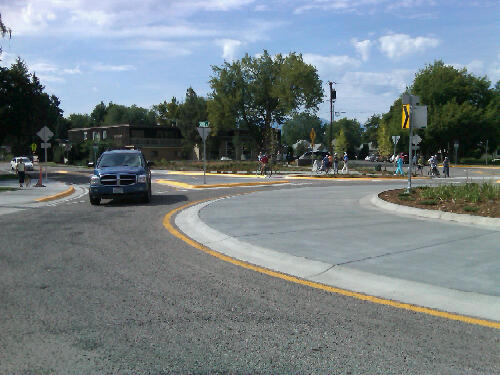
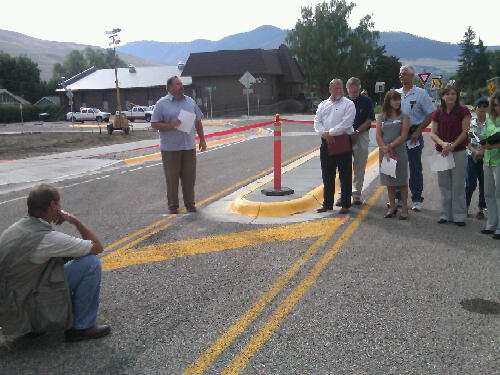
Last week Missoula's first roundabout opened to the public. It was a pretty large event for the opening of an intersection; maybe because it was built with stimulus money and was the first large project to be completed in the state of Montana. A lot of big political players sent people from their offices, such as Senators Tester and Baucus and all the local politicians were on hand for the ribbon cutting.

Before I get any farther along though, I would like to point people's attention to the photo above. Hopefully people can notice the abundance of signage present; 32 in all, even everyone in my Land Use Planning class thought that was a little excessive. I think Montana's DOT was a little scarred of stupid or distracted drivers driving through the middle.

Of course I believe the signage itself is a bit distracting, and even with all the signs people in cars still tried to blow through the intersection when it first opened. Most of these people were on cell phones and one even came close to running over city councilman Jason Wiener.

Here in America, traffic engineers like to tell the public exactly what type of behavior is expected of them, mostly through signs (but then we do things like have speed limits on wide, open, and straight roads that encourage speeding). Drivers are mostly o.k. with this, since it allows them not to have to think too much while simultaneously being on the phone.

But does having 32 signs at a roundabout do anything for safety, or does it fill a contractor's pockets? A roundabout is a perfect situation for "shared space," a concept first proposed by Hans Monderman. Essentially, shared space takes away all on road instructions and allows users of the road to "negotiate" with one another for road space. The intent is to slow traffic, increase safety, and allow all users to share the road more equitably. I can almost guarantee that most people's reaction to this idea in America would anger and puzzlement. There are places in America that already implement this principal, such as Savannah, GA as pointed out at the Proper Scale blog.


Anyway... back to the opening ceremony. Below is the ribbon cutting ceremony performed by our mayor, John Engen and Jim Lynch, head of the MDOT.


And what would the opening of a roundabout be without cyclists to test it out? As you can see in the photo below, we had a pretty good turnout. The MDOT was giving out pamphlets on how cyclists and pedestrians should behave in the roundabout. It called for cyclists to dismount and walk their bikes through the cross-walks. Lets just say that none of us cyclists performed that stunt.

Missoula's own bicycle ambassadors, where there to educate the riding public about proper on street behavior. Ben even had a hand painted helmet on, go Vikings!
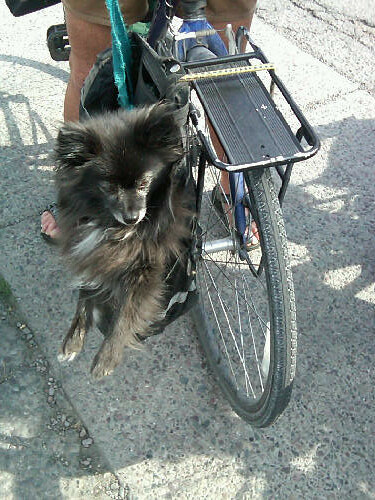
Dogs even came out to participate in such a monumental moment. Below is a BWAM member's dog along for the first ride through the roundabout.

Friday, September 4, 2009

100th Post - Random Bicycle Crap Fridays

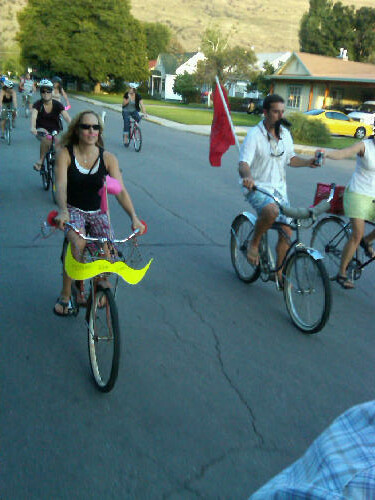
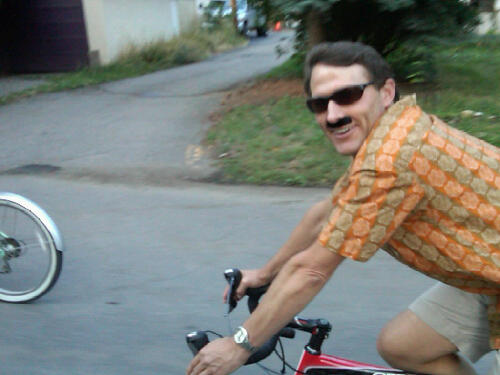
The Mustache Ride

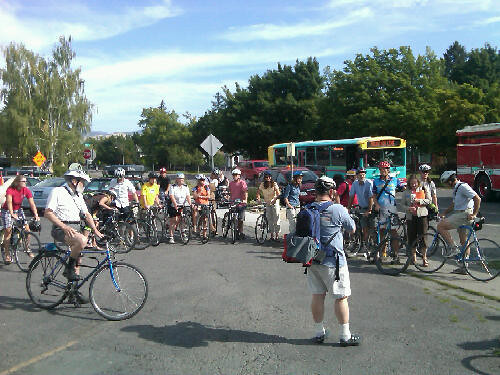
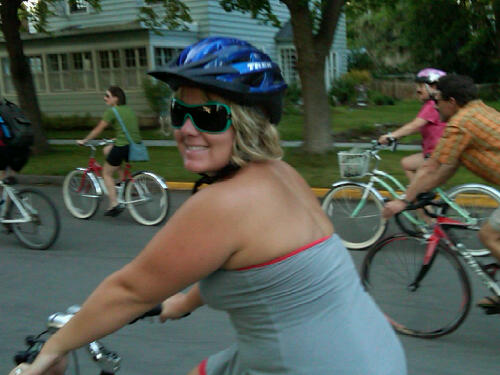
Just a few pictures from the Sean Kelly's Cruise Tour held on Wedsnday Sept. 2nd. About 70 people showed up, their biggest turnout this season.


Thursday, September 3, 2009

Does Motorist Road Rage Against Cyclists Never End?


Yesterday I came across two stories describing extremely disturbing examples of road rage against cyclists. Thanks to BikePortland and Cyclicious for covering the incidents.

The first happened in Portland during the afternoon. Apparently a motorist in an SUV and cyclists got into an argument in a parking lot. The driver then proceeded to back his vehicle into the cyclist, a man in his fifties, at approximately 40 mph. "After impact the the victim appeared to be stuck to the back of the SUV." The cyclist was taken to the hospital in critical condition with his condition improving since the incident.

The second story I came across didn't end so well for the cyclist. Canadian politician Michael Bryant was arrested on on Tuesday for criminal negligence in the death of a cyclist. Witnesses say that Mr. Bryant and bicycle messenger were involved in a collision. When Mr. Bryant tried to flee the scene, the cyclist grabbed on to the driver side door and wouldn't let go. The car then accelerated and tried to knock the cyclist off the car by running into lampposts and mailboxes. Eventually he succeeded and the cyclist fell off after which he was taken to the hospital and died shortly after arriving.

These are both sad examples of how utterly unequally matched cyclists and motorists are. If a cyclist ever got pissed off and rammed an SUV the poor cyclist would probably walk away with a few broken bones.

These are WTF kind of moments. What is it that is causing all this road rage against cyclists? I can't believe that people on bicycles are behaving so badly as to warrant a lot of this behavior. And I also can't believe that these motorists are truly as big a set of assholes as these incidents seem to portray them as. I think its more to do with the situation society has built for itself in terms of our urban environment - we must really suck at providing a healthy urban environment that produces well adjusted adults.

These two incidents are just as bad as the man who shot at a cyclist for riding with his family on a busy street a few months back. In the end there is NO rational explanation for this kind of behavior other than that these people really need to get out of their cars more often.

I'm a big believer that cars kill communities; whether they be communities of people or wildlife, the car is not a force that brings people and places together, but divides them. Cars compete for a limited amount of road space usually at high speeds and a limited number of parking spots. This situation isn't conducive to cooperative community building, but I guess it is the American way; fighting to appropriate a limited resource, CAPITALISTIC social engineering at its best. The infrastructure needed to support cars even destroys whole neighborhoods, especially when building freeways, just so that better off suburbanites can get to their downtown office jobs a little faster.

When people get out of the car and walk or bike, they have time to appreciate their surroundings, they can meet their neighbors and have an in depth conversation, and generally interact with the world from a totally different perspective than from the protected-electronic cockpit of a car. But thats just the opinion of one carfree asshole, I'm sure a bunch of motorist assholes would wholly disagree with me and be willing to back over me to prove it.

Monday, August 31, 2009

Complete Streets Comes to Missoula

Within the last week Missoula Montana has joined the likes of San Diego, Salt Lake City, Miami, and New York by passing a resolution that calls for Complete Streets. The resolution passed the Missoula City Council on Aug. 24th a wide margin. The resolution has been pushed for by local resident John Salmonson and its thanks to his hard work and many others including BWAM that we have this change in policy. More can be viewed here and the actual resolution can be found here.

The new policy calls for any new construction or reconstructed streets to be designed with all users in mind to create a safe environment for pedestrians, cyclists, motorists, and transit. Missoula is already a fairly friendly place for pedestrians and cyclists, but that usually only extends to certain neighborhoods such as those around campus and closer to downtown. There are currently many sidewalks badly in need of repair and even many places where sidewalks just abruptly end.

The Complete Streets measure won't change anything overnight; there are millions of dollars of projects spread around Missoula that need to be taken care of. This will be a decades long process to "complete our streets" here in Missoula. But this is still a major step forward for the bicycle and pedestrian organizations within Missoula. The hard work that many of these groups and the individuals volunteering their time to advocate the city, county, and state for better infrastructure over the last decade is finally legitimized in this resolution. The potential is great as the design process is now officially sanctioned to have Complete Streets designed in rather than as something that local groups have to push and fight for.

Wednesday, August 26, 2009

Bicycle & Transit Infrastructure More Efficient Than Car - Road Combo

Classes start up again within a week, and what am I doing for my last week of summer? Why... reading a book titled Sustainability and Cities by two professors, Peter Newman & Jeffrey Kenworthy.

The book lays out how the automobile city is an extremely inefficient method of moving both people and goods in an urban setting. The freedom that has seduced so many people into buying a car in the belief that all roads are empty like in car commercials is questioned and proven to have been a very short transitory state. Sustainability and Cities is full of great data compiled from academic studies - admittedly a little old at this point, as most were undertaken in the '80s and '90s -but still very useful.

Again and again the bicycle and transit come out on top of all other types of transportation. For example, a study (Aschauer 1989) of transportation costs associated with moving around the Boston urban area shows that on a per mile basis, cycling is the cheapest form of transportation. In the study cycling costs $.13-.14 per mile compared with a single occupancy vehicle (SOV) at $.81-.94 per mile while rail operated at $.29 per mile.

The costs associated with personal vehicles is something that most people dealing with transportation and alternative transportation are well aware of. Even so, it can be a very contentious issue as promoters of laissez faire will point out that cars promote economic activity, provide freedom of movement, and are what the public wants, and so roads are needed because the demand is present; this, of course, discounts the fact that roads are a government provided service, that externalities are discounted, and the billions of dollars spent convincing people that they aren't good Americans without a car.

In five studies conducted in the early '90s the average external costs of operating a vehicle came to $3,063 per year (those costs not taken into account and not paid for by the individual). In 2007, there were roughly 250 million registered vehicles on the road in America. That comes to $765 billion in external costs that are not factored into our conscience decision to operate a motor vehicle (very rough estimate, probably higher at this point). Externalities in this case include pollution, loss of productivity from congestion, traffic accidents, etc.

This doesn't even begin to take into account all the myriad costs associated with the build out of auto-centric cities. Dependence on auto use forces other urban systems to change - we need a place to park all those cars - and each one, sprawl, parking lots, land paved over for roads, congestion, adds to the inefficiencies of automobile use.

This point can be visualized in the following graph (sorry for the low quality), which displays the relationship between density and private transportation energy use. The graph shows per capita energy use - basically how efficiently we use our wealth to accomplish our daily needs - and America scores very badly - with our cities hovering around 60,000 megajoules (MJ) expended for transportation on a per capita basis. One MJ is equal to 947 BTUs, 1 million joules, 238 kilocalories or .277kilowatt hrs - thats a lot of energy. 60,000 MJs are equal to 56 million BTUs.


Every other region of the world is more efficient in moving people and goods around their cities than America, with Asia being the most efficient. Pretty straightforward, the more dense a city, the less one has to travel to take care of their daily needs and trips to work. Why drive when most things are within a mile of your residence.

America has, for a long time, believed that economic and ecological constraint do not apply to how we organize our society. We could always develop land on the urban fringe to create jobs and housing for our growing population while ignoring the costs. This worked well for the first half of the experiment, but now the costs have so exceeded the benefits of low density sprawl that we are seeing major environmental, economic, health, and even moral consequences from our arrangement of cities. Suburbs aren't going away, and neither is the car or the detached single family house, but its important that these things are re-envisioned to meet America's needs and challenges in the 21st century.
Bookmark and Share