Showing posts with label mass transit. Show all posts

Monday, February 15, 2010

The view from Portland

My feet hurt... thank you Portland. Four days of a carfree mini vacation using a walking/transit combo put a lot of miles on the feet. Still tired from traveling today and then immediately diving into work back in Missoula so this post will be short and quick... for some great thought provoking writing check out @Urbanophile's arguement for fare-free transit, which would be perfect for Portland, and this article that shows that being sighted close to transit is saving homes from entering foreclosure.

Enjoy the pictures... I'll write more on Portland later... especially the Hipster economy.


Plane from Seattle --> Portland. A little greenwashing? I think so
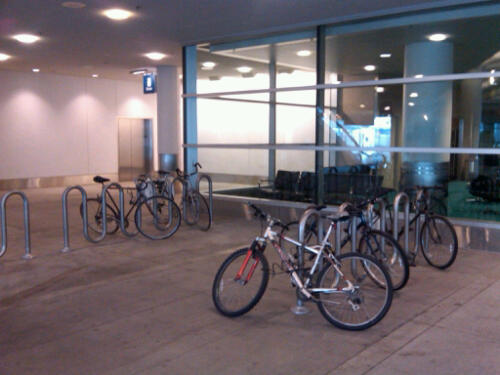


You know your entering a different world when there is bicycle parking at the airport terminal.
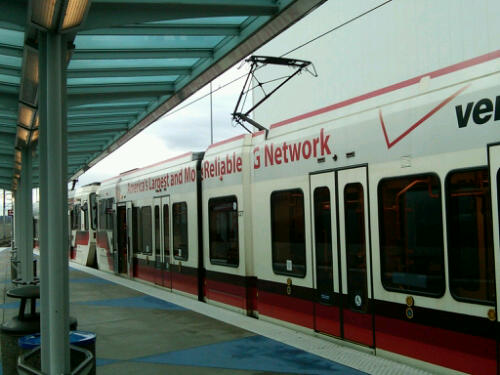


My ride from the airport awaits.


On-street Bicycle parking at Powell's Books
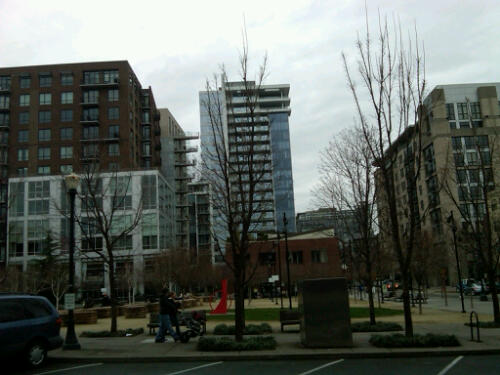


Portland does a great job of using public (park) space to accentuate the utility and connectivity of the various rail lines.
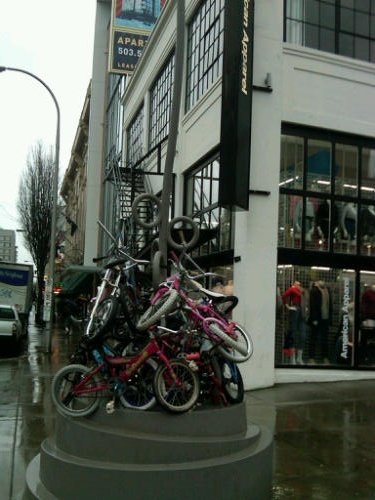


Only in Portland
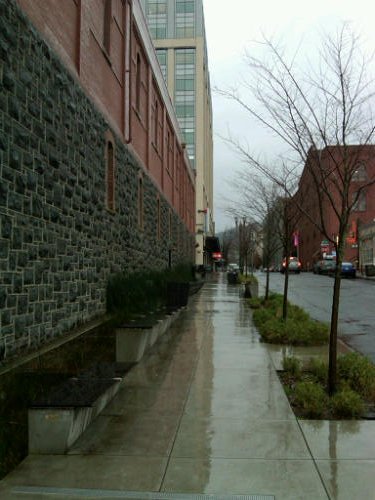


Another innovative urban design... this time add green infrastructure and reduce rain water runoff.
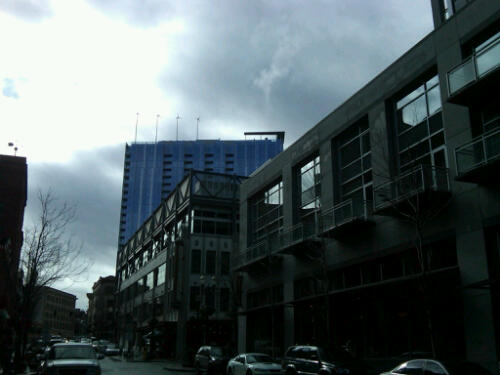


Building with both wind turbines and solar on the roof.
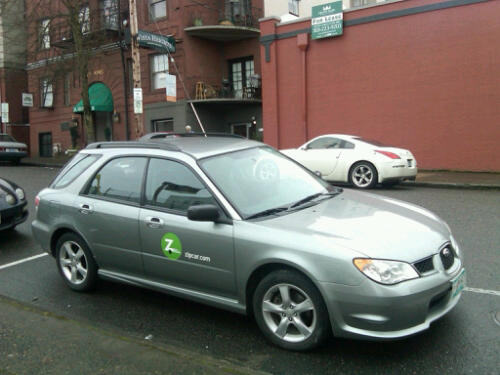


Making it that much easier not to own a car.
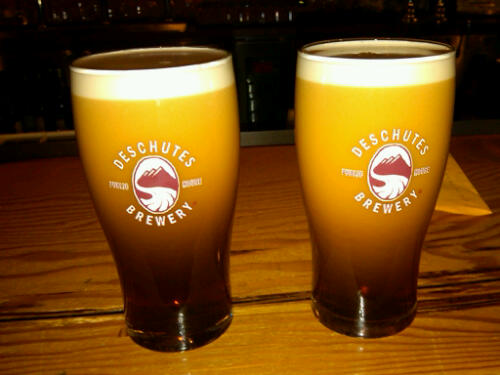


And finally the beer... my god the beer. A little nitro never hurt anyone... and anyway can't get this shit in the stores. Don't worry Kettlehouse, your still the beer I hold dear... though I think I'll miss Amnesia.

Tuesday, November 10, 2009

Complete Streets WIN

Complete Streets policy has been spreading for some time now thanks largely in part to groups like the National Complete Streets Coalition and local advocacy groups like Missoula's own BWAM and MIST. For the uninitiated, complete streets is a concepts and policy goal of designing streets that are accessible to all populations. This means a de-emphasis on moving at high rates of speed and making infrastructure improvements that make safety for pedestrians and bicyclist more of a priority.

Check out this map of America showing where complete streets are taking affect. And for those interested, Transportation for America has an online petition that asks DOT head LaHood to emphasize pedestrian safety.

And now it appears that we have some evidence that complete streets design is actually helping to make our most abundant of public spaces safer. Transportation For America recently released a long worked on report, Dangerous By Design, that highlights street design failings and success.

Columbia, MO seems to be a shinning example of complete streets policy at work.

This from an article at KOMU.com by Josh Frydman:

In 2004, Columbia passed a complete streets ordinance, which specified how streets should be designed. This included five-foot sidewalks on all streets as well as bicycle accommodations on certain streets, and that sent a very clear signal that Columbia is serious about encouraging people to walk and bike in Columbia.

Columbia's Pedestrian Danger Index scored four times lower than the national average. Columbia reported just two pedestrian fatalities from 2007 to 2008, and just 3.8% of the total traffic deaths during that time were pedestrians.

This is just a portion of the rethinking of street design that is slowly sweeping across our country. After more than half a century of placing almost all our efforts into moving more cars and seeing this strategy fail over and over change is finally snowballing. Bike paths/lanes, mass rapid transit, sidewalks, green streets, and the redesigning of intersections are the new fashionable strategies in many cities for dealing with transportation.

We are even importing a few good ideas from the Europeans, GASP! Hans Monderman's design concept of shared space is replacing the idea of traffic control with controlled chaos. This can be seen in the growing number of roundabouts and uncontrolled intersections that force different modes of transportation to actually interact and be cautious towards one another.

Each roundabout or transportation plan that includes complete streets is only a small step, but a decade of small steps takes you far from your starting point.

Monday, September 21, 2009

James Corless of Transportation for America

Photo via T4A

Last week was a big week in terms of both my class load and things happening that I want to write about. I hope I can catch up a little this week.

On Thursday, James Corless from Transportation for America (T4A) was in Missoula for a small conference on health. While he was here he also gave a short guest lecture at the University of Montana sponsored by ASUM Transportation.

What is T4A? Its a large non-profit organization geared toward campaigning and advocating for reworking America's national transportation system. A large coalition has been built around the need for reform of over 300 other non-profit, for-profit organizations, and government officials. As an organization, T4A is very much geared toward lobbying and policy, but have a wide range of resources available for partner groups to access.

Mr. Corless' speech covered the usual "why we need reform" points that most of the people in the audience had probably heard before; certainly preaching to the quire. But he had a lot of good points to pass along. He stressed the connection of land-use and transportation and that the two are so interrelated that they can not be treated separately.

Our current land-use patterns certainly don't promote people getting out of their cars and hopping on transit or a bike. The last 70 odd years have seen an erosion of our cities and public spaces to provide for vehicular traffic. And as this process has continued, the more cars are accommodated, the more cars are present on our roads and need to be stored somewhere, which then reinforces the need for more space for cars and more travel by cars.

The only way to stop such a process is to stop designing for ever more cars and design for more public space to be given over to transit, sidewalks, and cyclists; as demonstrated by the recent Park(ing) Day events that aimed to take public space back from vehicles. This strategy needs to be accompanied by a reorganization of our land-use practices. Putting a transit corridor down a an area of sprawl does little to alleviate traffic. But add in mixed-use zoning and Transit Oriented Development (TOD) along that corridor for several blocks on either side, and all of a sudden you have a game changing situation.

Another important factor is the cost of transportation, not just monetary, but time and convenience (as even Thomas Friedman knows and points out in his recent column). If transit can be made to be faster and easier to use, while var travel is made harder to use, people will naturally switch. This is what has happened for almost a century, but in reverse; making it harder for people to use transit or walk to where they need to go. And so people have intuitively made the switch by the millions to use of the SOV because other modes of transportation where so damn hard and confusing to use.

Once people see that transit or active transportation (biking/walking) can be enjoyable, easy to use, convenient, and cheap they will flock to it to reach there destinations. Vehicular traffic now creates so much of its own friction as people compete for limited road space and congestion builds, that people don't want to deal with the stress of driving. Give people an enjoyable experience on their way to a destination, as Phoenix is discovering with their new light-rail line, and people will flock to public transportation.

A long road to reform looms ahead, but already local and national organizations like BWAM and T4A are already working hard to make a difference. It will take a lot of collaborative effort to achieve T4A's vision for transportation. Thanks again to James Corless for talk with us here in Missoula.

Wednesday, September 9, 2009

Infrastructure Needs to be Factored in on Long-Term Transportation Cost/Carbon Emissions Calculations


Tracy White recently left a comment on an old blog post of mine that discussed the per-mile Carbon Dioxide emissions of different modes of travel. She brought up an excellent point that infrastructure costs and resource-use needs to be taken into account in cost-benefit analysis.

She even conveniently linked to an abstract of a research paper that indicated that adding such information to the analysis can significantly add to the lifetime energy use and greenhouse gas emissions (GHG). The study's abstract finds... "that total life-cycle energy inputs and greenhouse gas emissions contribute an additional 63% for onroad, 155% for rail, and 31% for air systems over vehicle tailpipe operation."

This seems like a a substantial impact... and I'm sure that it is. But the headline numbers touted in the abstract can be misleading. Now, I will admit that I have not taken a look at the full text of the study. Rail's impact on a per mile basis is much lower than that of cars, especially SOVs. It is because rail starts out at such a smaller GHG impact that the increase is so much higher when infrastructure is taken into account.

I'm sure that rail's lifetime environmental impacts are still much lower than that of vehicles, and from the research I have seen that is what people are finding. I'll have to dig into the study a little more when I have the time. Thanks Tracy for bringing up a great point that needs to be considered in these types of issues.

Monday, August 31, 2009

Complete Streets Comes to Missoula

Within the last week Missoula Montana has joined the likes of San Diego, Salt Lake City, Miami, and New York by passing a resolution that calls for Complete Streets. The resolution passed the Missoula City Council on Aug. 24th a wide margin. The resolution has been pushed for by local resident John Salmonson and its thanks to his hard work and many others including BWAM that we have this change in policy. More can be viewed here and the actual resolution can be found here.

The new policy calls for any new construction or reconstructed streets to be designed with all users in mind to create a safe environment for pedestrians, cyclists, motorists, and transit. Missoula is already a fairly friendly place for pedestrians and cyclists, but that usually only extends to certain neighborhoods such as those around campus and closer to downtown. There are currently many sidewalks badly in need of repair and even many places where sidewalks just abruptly end.

The Complete Streets measure won't change anything overnight; there are millions of dollars of projects spread around Missoula that need to be taken care of. This will be a decades long process to "complete our streets" here in Missoula. But this is still a major step forward for the bicycle and pedestrian organizations within Missoula. The hard work that many of these groups and the individuals volunteering their time to advocate the city, county, and state for better infrastructure over the last decade is finally legitimized in this resolution. The potential is great as the design process is now officially sanctioned to have Complete Streets designed in rather than as something that local groups have to push and fight for.

Monday, August 24, 2009

Missoula Roundabout Almost Ready to Ease Traffic Headaches


Missoula is getting its first single lane roundabout at the intersection of Higgins - Hill - Beckwith. This is completely different than the current traffic circles that can be found in our towns residential neighborhoods; which are meant to calm traffic at non-controlled intersections.

The roundabout has been under construction for about two months (more here) and is meant to make safer and more efficient a major intersection for traffic going to both the University of Montana and downtown. Pedestrian safety was a major design factor for the reconstructed intersection as the old intersection provided no safe or marked way for pedestrians to cross.

Roundabouts like the one about to open have been proven in numerous studies (here and here) have shown that roundabouts can reduce traffic accidents at intersections by anywhere from 30% to 70% depending on the prior intersection environment; this is mostly due to decreased speeds and the elimination of traffic crossing paths.


The Higgins - Hill - Beckwith roundabout will also feature some beautification with a park on one corner and the landscaping that can be seen in the photo below.

Tuesday, July 21, 2009

Week 15 Carfree Statistics

Salt Lake was a fun time, and I have plenty to write about in a few coming posts. Of course the bus was the low point of the trip. Salt Lake City was not what I expected... in a good way.

The bus trip probably didn't save as much carbon as I had originally thought. The bus going both east and west between Missoula and Butte was completely full; we almost had to leave people behind in Butte. The journey down to SLC from Butte and back was nowhere near as full, maybe only 1/4 full. So I'm just going going to guess that I saved 50% , which would be about 600 Ibs of carbon. Thats some solid methodology.

Week 15 Statistics
Miles Biked: 77.46
Miles on Bus : 1046
Gallons Saved: 46.81
Carbon Not Emitted: 630.44 Ibs

Wednesday, July 15, 2009

And I'm leaving On a Greyhound, Don't Know When I'll be Back Again

I'll be heading down to Salt Lake City this weekend, and no I'm not driving. I figured I would take the opportunity of visiting my fiance at her clinical site to try out the luxurious travel offerings of Greyhound where I can expect to be treated to warm-moist towels and foi gras, and by warm-moist towels I mean sticky, urine-stained bus station restroom floors and by foi gras I mean vending machine pretzels.

The round trip is a total of 1046 miles and by taking the bus I expect to save about $25 in gas compared to the cost of the bus ticket. Of course the travel time almost doubles when taking the bus vs. a car, but then again my time is cheap since I have no real marketable skills.

So other than money, what can I expect to be saving (and the answer is certainly not my dignity)? As you can see by the chart below, a 3/4 full Transit Bus - intercity - produces approximately .2 Ibs of CO2 per passenger mile vs. approximately 1.2 Ibs of CO2 per passenger mile in a single occupancy vehicle (SOV).

Over 1046 miles my share of the CO2 produced adds up to 209.2 Ibs of CO2 for the bus vs. 1255.2 Ibs of CO2 for a car. So on the bus, my trip should produce only about 16% of the GHGs of an equivalent car trip.

Plus... there is the added bonus of not having to worry about getting a speeding ticket. That should be the only arguement anyone needs to hear to convince them that the only way to travel... is by bus.

Friday, June 26, 2009

Republican John Mica on Alternative Transportation

This will be one of the rare times I quote a Republican congressman (unless its to disagree with them), but Representative Mica from Florida seems to have his head on straight when it comes to understanding transportation issues.

"Even if your a fiscal conservative, which I consider myself to be, you quickly see the benefits of transportation investment. Simply, I became a transit fan because its so much more cost effective than building a highway. Also, it's good for energy, it's good for the environment - and that's why I like it... seeing the cost of one person in a car. The cost for the environment. The cost of energy. You can pretty quickly be convinced that there's got to be a more cost effective way."

-Rep. John Mica, from a PBS interview

WOW, a conservative that actually advocates conservation of our resources, that's a novel concept. I feel like I'm living in the days of Teddy Roosevelt. My cynical side thinks he only expressed this view because he knew non of his fellow Republicans would be paying attention to PBS, but lets hope not.

Glad to have Rep. John Mica on our side, he's the type of Republican we need more of; to replace the fundamentalist types.
Bookmark and Share