Sunday, January 24, 2010
Winter Clean Up
And just because my car-free year is coming to an end doesn't mean that this blog's purpose will suddenly vanish. As many readers might have noticed, much of the content I have been writing isn't actually about my car-free experience, but rather about alternative transportation and urban design issues. This will not change.
And with that said... it is time to perform a little clean up and catch up with my car-free stats for the last two months.
Week 35
Miles Biked: 57.62
Gallons Saved: 3.60
CO2 Not Emitted: 22.62 Ibs
Week 36
Miles Biked: 8. 21
Gallons Saved: .513
CO2 Not Emitted: 3.223 Ibs
Month 9
Miles Biked: 123.14
Gallons Saved: 7.69
CO2 Not Emitted: 193.33 Ibs
Week 37
Miles Biked: 12.69
Gallons Saved: .793
CO2 Not Emitted: 4.98 Ibs
Week 38
Miles Biked: 9.23
Gallons Saved: .577
CO2 Not Emitted: 3.63 Ibs
Week 39
Miles Biked: 0.00
Gallons Saved: 0.00
CO2 Not Emitted: 0.00
Week 40
Miles Biked: 27.42
Gallons Saved: 1.72
CO2 Not Emitted: 10.76 Ibs
Month 10
Miles Biked: 49.34
Gallons Saved: 3.08
CO2 Not Emitted: 19.37 Ibs
Week 41
Miles Biked: 53.84
Gallons Saved: 3.37
CO2 Not Emitted: 21.13 Ibs
Week 42
Miles Biked: 62.76
Gallons Saved: 5.23
CO2 Not Emitted: 24.63 Ibs
Monday, January 11, 2010
Coeur d Alene: Safety Fail, No Saftey in Numbers for Bike/Peds
Let me setup what happened. I took the Greyhound from Missoula to Coeur d' Alene (CDA) Saturday morning to visit my folks. There is no physical transfer station in CDA, rather the bus drops you off at a gas station that sits at the corner of a large intersection (Ramesy and Appleway) where two four-lane arterials meet (total of 22 lanes at the intersection).
Anyway, the bus dropped me off at a different location than the Greyhound website gave for the (nonexistent) station. My father was coming to pick me up, but since he doesn't have a cell phone there was no way to get a hold of him, so I decided to walk north along the western side of Ramsey to find a good place to wave him down as he came to pick me up.
Two blocks later I was crossing the intersection below, which is an old picture as the intersection now has a four-way light, within the cross walk while a car was waiting for an opening to turn right-on-red. I walked out in front of his car, attempting to make eye contact because I could sense he was ready to hit the gas to make an opening, but he was looking the other direction. Needless to say he hit the gas and ran right into me. Luckily he immediately stopped and I wasn't hurt other than a small bruise on my leg.

This incident got me thinking how ridiculous the incident was. Living in Missoula, I have walked hundreds, perhaps even a thousand miles around town over the course of seven years. In that time I have never been hit by a car... I don't even remember having a close call. But here I am, back in the town I grew up in, and five minutes after stepping off the bus I am hit be a car.
The whole time I lived in CDA, I never once got around by walking or biking, rather the only real way to get around is by car. Seven years of walking in Missoula = no problem, five minutes of walking in CDA = getting hit by a car. Missoula and CDA are also fairly close in terms of population size.
Why is this? Because of not only the streetscape that dominates in CDA (suburban arterials with speeds above 35 mph) but also the development pattern that essentially forced those types of roadways to be built.
You can see these patterns at play in the photo of CDA below. I have highlighted all the four lane arterials (red corresponding to suburban arterial design and yellow representing four lane roads with an urban character). CDA is a maze of suburban subdivisions that are only connected to the wider community through the use of a lot of arterials. Only a small portion of CDA (which also includes the towns of Dalton Gardens, Hayden, and Hayden Lake) actually has a street network laid out in a grid. This pattern results in a very spread out population with very low densities (Dalton Gardens is zoned at 1 house/acre).

Because people have to drive everywhere and there are almost no pedestrians or cyclists, the motorists don't look out for these types of people. Those whom do walk or bike are mostly a working-poor underclass -except for the roadies - that most suburbanites don't spend any time thinking of between trips to Starbucks, work, and dropping the kids off at soccer practice.
Now contrast this with Missoula (a photo with the same types of streets highlighted can be seen below). The bulk of Missoula is based on a grid system and subdivisions with a suburban character only exist at the fringes of the town. Not only that, but the most of the four lane roads that Missoula does have exist within areas that are urban in character (higher densities, tree lined streets, sidewalks, smaller lot setbacks, and slower speeds). The four lane suburban arterials are located again mostly at the edges of Missoula and so cyclists and pedestrians can largely avoid these roads by choosing quieter streets.
Also consider the the geographic distance these two photos show. The photo of Missoula covers most of the town and most of the town's population. The photo is 3.5 miles x 3.5 miles while the photo of CDA shows an area 7.5 miles x 7.5 miles that leaves out a considerable amount of development to the north. Missoula's compact nature encourages alternative transportation simply through its shorter distances.

The higher densities, shorter distances, and more welcoming streetscape encourages people to walk and bike. In much of the central part of Missoula you can't go more than a couple of blocks without seeing another pedestrian or cyclist. Just the numbers of pedestrians and cyclists using Missoula streets makes motorists more aware of them and creates a situation where motorists must constantly be on the lookout. This creates a Safety in Numbers phenomenon whereby the more cyclists and pedestrians out on the roads, the less absolute fatalities and crash cars have with cyclists and pedestrians.
Describing what had happened, even my very conservative father understood the relationship between development patterns, streets, and mode of travel. In his opinion, and I have to agree with him, CDA is a town that will never see a lot of people walking, biking, or using transit simply because the towns infrastructure makes those options economically difficult and even dangerous.
Wednesday, January 6, 2010
Thwarted by Ice
It then proceeded to snow and rain alternatively all day and by the time my day was over the roads were covered in a thick layer of slush and lots of puddles filling the low spots in the road. Without any fenders on my mountain bike my three mile commute felt almost like I was swimming through some very brackish water.
As soon as I was warmed up I made sure to put on a rear fender. Unfortunately it was a futile gesture to try and keep me comfortable since the weather conspired to keep me off of my bike today. Over night all the rain and wetness had frozen solid into a sheet of ice up to several inches thick in places. This included covering all of my bikes in a shinny layer of ice.
The brakes were completely frozen and useless... the cables, calipers, and triggers were all useless. Ice covered the seats of both my road and fixie, while even the wheels and hubs on my fixie were covered in a layer of ice. Rather than spend 20 minutes trying to unfreeze all the components and then worrying about putting too much stress on the metal being so cold.
So thanks to Ashley for being gracious enough to provide me with a ride this morning.
Monday, November 16, 2009
Book Review: After The Car
At a mere 164 pages, After The Car, takes the reader through a handful of today's most pressing issues. The first chapter quickly explores the situation we find ourselves in today, including climate change, peak oil, the growth of the Internets, and the supremacy of urban areas. This quick overview sets the stage for the rest of the book and for how we got to the situation we find ourselves in today.
The heart of the book delves into how the car came to completely reshape our lives. At one time the automobile was a new and disruptive technology. At the beginning of the car's history it transformed the lives of millions of people and led to a huge leap in productivity. But after a century of the car's dominance it has come to signify, "...many of the most troubling aspects of human civilization."
The authors take the view that the dominance of the car is thanks to the convergence of various trends such as allowing for freedom of mobility, the huge increase in economic productivity it allowed, and the complete seepage of car culture into the fabric popular American culture. But this wholehearted acceptance of the car has led to unintended consequences. The car system's full adoption by society has come to mean high levels of pollution, possible climate change, economies that are held back by the maintenance of sprawling transportation networks, and the adverse social affects that come with being so spread out and disconnected from one's neighbor.
As for my aforementioned disappointment, once the book finally makes it to a diagnosis for our future, there is very little in the way of new thinking and rather mostly a simple summary of current trends that might come to partially supplant the current transportation system. The trends covered include denser living through new urban design, rapid personal transit, electrical vehicles (EVs), and green cities. The authors express great hope in the idea of green cities such as Dongtan China, even though most of the over hyped green trophies are still just nice drawings on some government official's desk.
The criticism I can't get out of my head is talk of how EVs and biofuels will be a part of the solution. For a book entitled After The Car it seems a bit of contradiction to propose that EVs and biofuels will really change anything. How many trillions of dollars will ultimately need to be spent on infrastructure to build generating capacity just to power our EVs and how little will that investment reduce our green house gas emissions? This is a question that the authors simply gloss over.
Overall, After The Car, does an excellent job of giving a concise overview of many of the issues that will shape our new century and how that could affect our transportation system. But there is little revolutionary thought held within the pages of the book, and despite the title, there is almost no vision of our future after the car.
Thursday, September 10, 2009
Missoula Roundabout Opening
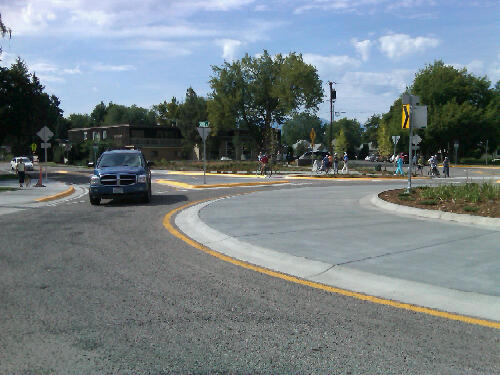
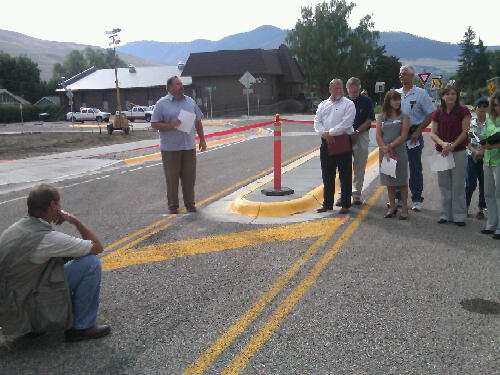
Last week Missoula's first roundabout opened to the public. It was a pretty large event for the opening of an intersection; maybe because it was built with stimulus money and was the first large project to be completed in the state of Montana. A lot of big political players sent people from their offices, such as Senators Tester and Baucus and all the local politicians were on hand for the ribbon cutting.
Before I get any farther along though, I would like to point people's attention to the photo above. Hopefully people can notice the abundance of signage present; 32 in all, even everyone in my Land Use Planning class thought that was a little excessive. I think Montana's DOT was a little scarred of stupid or distracted drivers driving through the middle.
Of course I believe the signage itself is a bit distracting, and even with all the signs people in cars still tried to blow through the intersection when it first opened. Most of these people were on cell phones and one even came close to running over city councilman Jason Wiener.
Here in America, traffic engineers like to tell the public exactly what type of behavior is expected of them, mostly through signs (but then we do things like have speed limits on wide, open, and straight roads that encourage speeding). Drivers are mostly o.k. with this, since it allows them not to have to think too much while simultaneously being on the phone.
But does having 32 signs at a roundabout do anything for safety, or does it fill a contractor's pockets? A roundabout is a perfect situation for "shared space," a concept first proposed by Hans Monderman. Essentially, shared space takes away all on road instructions and allows users of the road to "negotiate" with one another for road space. The intent is to slow traffic, increase safety, and allow all users to share the road more equitably. I can almost guarantee that most people's reaction to this idea in America would anger and puzzlement. There are places in America that already implement this principal, such as Savannah, GA as pointed out at the Proper Scale blog.

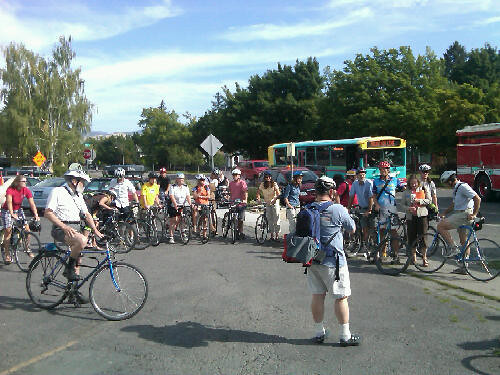
And what would the opening of a roundabout be without cyclists to test it out? As you can see in the photo below, we had a pretty good turnout. The MDOT was giving out pamphlets on how cyclists and pedestrians should behave in the roundabout. It called for cyclists to dismount and walk their bikes through the cross-walks. Lets just say that none of us cyclists performed that stunt.


Wednesday, September 9, 2009
Infrastructure Needs to be Factored in on Long-Term Transportation Cost/Carbon Emissions Calculations

Tracy White recently left a comment on an old blog post of mine that discussed the per-mile Carbon Dioxide emissions of different modes of travel. She brought up an excellent point that infrastructure costs and resource-use needs to be taken into account in cost-benefit analysis.
She even conveniently linked to an abstract of a research paper that indicated that adding such information to the analysis can significantly add to the lifetime energy use and greenhouse gas emissions (GHG). The study's abstract finds... "that total life-cycle energy inputs and greenhouse gas emissions contribute an additional 63% for onroad, 155% for rail, and 31% for air systems over vehicle tailpipe operation."
This seems like a a substantial impact... and I'm sure that it is. But the headline numbers touted in the abstract can be misleading. Now, I will admit that I have not taken a look at the full text of the study. Rail's impact on a per mile basis is much lower than that of cars, especially SOVs. It is because rail starts out at such a smaller GHG impact that the increase is so much higher when infrastructure is taken into account.
I'm sure that rail's lifetime environmental impacts are still much lower than that of vehicles, and from the research I have seen that is what people are finding. I'll have to dig into the study a little more when I have the time. Thanks Tracy for bringing up a great point that needs to be considered in these types of issues.
Thursday, September 3, 2009
Does Motorist Road Rage Against Cyclists Never End?

The first happened in Portland during the afternoon. Apparently a motorist in an SUV and cyclists got into an argument in a parking lot. The driver then proceeded to back his vehicle into the cyclist, a man in his fifties, at approximately 40 mph. "After impact the the victim appeared to be stuck to the back of the SUV." The cyclist was taken to the hospital in critical condition with his condition improving since the incident.
The second story I came across didn't end so well for the cyclist. Canadian politician Michael Bryant was arrested on on Tuesday for criminal negligence in the death of a cyclist. Witnesses say that Mr. Bryant and bicycle messenger were involved in a collision. When Mr. Bryant tried to flee the scene, the cyclist grabbed on to the driver side door and wouldn't let go. The car then accelerated and tried to knock the cyclist off the car by running into lampposts and mailboxes. Eventually he succeeded and the cyclist fell off after which he was taken to the hospital and died shortly after arriving.
These are both sad examples of how utterly unequally matched cyclists and motorists are. If a cyclist ever got pissed off and rammed an SUV the poor cyclist would probably walk away with a few broken bones.
These are WTF kind of moments. What is it that is causing all this road rage against cyclists? I can't believe that people on bicycles are behaving so badly as to warrant a lot of this behavior. And I also can't believe that these motorists are truly as big a set of assholes as these incidents seem to portray them as. I think its more to do with the situation society has built for itself in terms of our urban environment - we must really suck at providing a healthy urban environment that produces well adjusted adults.
These two incidents are just as bad as the man who shot at a cyclist for riding with his family on a busy street a few months back. In the end there is NO rational explanation for this kind of behavior other than that these people really need to get out of their cars more often.
I'm a big believer that cars kill communities; whether they be communities of people or wildlife, the car is not a force that brings people and places together, but divides them. Cars compete for a limited amount of road space usually at high speeds and a limited number of parking spots. This situation isn't conducive to cooperative community building, but I guess it is the American way; fighting to appropriate a limited resource, CAPITALISTIC social engineering at its best. The infrastructure needed to support cars even destroys whole neighborhoods, especially when building freeways, just so that better off suburbanites can get to their downtown office jobs a little faster.
When people get out of the car and walk or bike, they have time to appreciate their surroundings, they can meet their neighbors and have an in depth conversation, and generally interact with the world from a totally different perspective than from the protected-electronic cockpit of a car. But thats just the opinion of one carfree asshole, I'm sure a bunch of motorist assholes would wholly disagree with me and be willing to back over me to prove it.
Tuesday, July 14, 2009
Senate Bill Aimed at Alternative Transportation is Anything But Supportive of Alternative Transportation

Yesterday I read a short little blog post over at Eco Friendly Mag about a recently introduced Senate Bill (S. 1408) with the purpose of greatly expanding the incentives for investing in Natural Gas powered vehicles (NGV). The bill was introduced by Senator Robert Menendez, a Democrat from NJ.
The bill basically calls for huge tax credits to be lavished upon the buyers of NGVs. Credits would be available up to $80,000 for such vehicles while also giving a tax credit to the investment in new Natural Gas fueling stations. Thats a lot of money. The fact that the cap on the tax credit is so high makes me believe that this bill is mainly aimed at corporate fleets, which makes sense. Corporations with huge fleets incur correspondingly huge costs to maintain those fleets, and switching over to vehicles that pollute less - about 2/3 less smog and 1/3 less GHG - and get better gas mileage - although not much better - is a way to both save money and reduce the pollution coming out of millions of vehicles (in 2003 the 10 biggest fleet management companies managed 2.7 million vehicles).
We've all seen the T.V. ads by T. Boone Pickens, so we are most likely all familiar with the arguments in favor of NGVs. But is Natural Gas really a solution, or just an option that makes people feel like our Nation is working towards a solution without actually doing anything to alleviate our problems? And should we be listening to a guy with billions invested in the Natural Gas industry?
I would argue the former option. Based on the fact that American Natural Gas production - check out a great post at the Oil Drum - peaked back in the early 70's and prices have seen a dramatic increase in the last decade. A large increase of NGVs on the road would dramatically push prices higher and increase the speed with which Natural Gas supplies are depleted. Do we really want to go down another road similar to the one we went down with ethanol? We have spent billions investing in infrastructure to lesson our oil consumption and pollution only to find that it increases GHG and helps to contribute to food price inflation.

Can you even call Natural Gas an Alternative Fuel? While its not oil it is still a Fossil Fuel that is easily depleted, and once its gone, thats it. If we're truly looking for alternative fuels to lesson our dependence on oil, shouldn't we be looking for something that will have a lasting impact rather than a fuel that will only be available for a time span measured in decades?
Finally, the bill itself is titled "New Alternative Transportation to Give Americans Solutions." What about promoting NGVs make them a form of Alternative Transportation? Are they a form of Public Transportation? NO. Do they help to lesson traffic congestion? NO. Are they a predominately single occupancy vehicle that runs on fossil Fuels? YES.
The name of the of the bill is pure PR. Who the hell - besides me, I guess - actually reads through these things? All people are going to do is hear the name and think it promotes alternative transportation, which it doesn't. As I pointed out in a previous post, the term "alternative transportation" is one of those hot terms that has in the last few years seeped into our social conciseness, kind of like "synergy" invaded the business world about a decade ago.
Ultimately, are NGVs a solution? No. Are they one option in a myriad of options that must be explored and invested in so that we can overcome our Nation's oil dependence and transportation problems? Yes.
Sunday, June 28, 2009
Three Months of Being Carfree in Missoula
Week 12 Stats
Miles biked: 61.91
Gallons Saved: 3.87
CO2 Not Emitted: 24.3 Ibs
Month 3 Totals
Miles Biked: 253.26
Gallons Saved: 15.83
CO2 Not Emitted: 397.62 Ibs
Tuesday, June 23, 2009
What NOT to do With a Car Door and Stupid Bicycle Tricks
Warning: Sensitive subject mater
The above scene is a tragedy, and an awful example of what can happen when people in cars don't take people on Bicycles seriously. I saw this yesterday in the local bike shop and everyone watching couldn't believe what they saw. The automatic response was anger at the idiot that was trying to door the bicyclist. Obviously the kid doing the dooring realized he fucked up big time, but remorse for an action is not good enough.
Many motorists still feel that cycling is a joke, and that somehow they have the right to ostracize and harass bikers simply because we are not in a vehicle of equal size and killing power. At a recent group ride in San Jose that my cousin took part in, along with 1500 other bikers, participants were repeatedly spit on and had things thrown at them by motorists. That is the type of behavior that prompts cyclists to be agressive and militiristic in their approach to asserting their rights to the road; if motorists won't respect us and share the road, we'll take our share of the road.
The San Jose Bike Party:

Now for something lighter on the stomach: Spot the Lame video
Two videos I came across the other day, both involving fixed gear tricks, but very different styles. Both are kind of lame, but only one actually displays some crazy skills with a fixed gear.
The first video is pretty amazing to watch, but the music and the setting makes me feel like I'm watching Olympic gymnastics, which I can't stand. The second video seems to have all the elements of a sick video with some crazy tricks; urban setting, fixies, high speeds, and some catchy music. However, all you really see in the teaser is a bunch of kids braking on their fixies and balancing. If I remeber correctly from the time long ago when I learned how to ride a bike, those are the first two things you learn as a child. So, if the tricks in the first video could be combined with the style of the second, fixed gear tricks might be cool.
Thursday, June 18, 2009
Creating Bike/Pedestrian Friendly Neighborhoods
5 miles an hour doesn't seem like much, but it can be an important factor in changing the way motorists, pedestrians, and cyclists interact with each other on the street. Lowering the speed limit to 30 mph or lower can make a big difference by reducing traffic accidents and providing pedestrians with a higher level of safety.

Tuesday, May 26, 2009
View No Cars
Tuesday, May 19, 2009
Top Gear Antics - Trains, Planes, and Automobiles
While the car may have won (a sports car at that, if it had been a regular vehicle that most people can afford the mass transit guys would have won) this just shows that mass transit is competitive with vehicle travel and beats it by far if one is to consider the cost, both private and public) of the two transportation options.
I recall another such challenge the show put on between transportation options, this time through the heart of London during rush hour. The modes chosen were more numerous, including car, bicycle, bus, and by boat. Of course the car came in last. And finally to illustrate my point, another such race was between a car and a marathon runner over the course of the London marathon; the runner beat the car by more than twenty minutes.
Whats great about all this is the irony of a car being beaten consistently while featured on a show dedicated to cars. If three British car fanatics can honestly admit that in many situations mass transit is an easier and more efficient way to travel, why is it so hard for us Americans to accept?
Tuesday, March 17, 2009
Countdown to Car-free
But this also means that within two weeks I can give up my driving. Right now the workhorse of the move has been my '83 Toyota Landcruiser. I'm going to miss driving it, but am seriously considering selling it. To have it sit for a full year, and possibly more if I decide to keep going with a car-free existence, is a sad possibility. I know there are plenty of people out there that are Landcruiser enthusiasts that would take good care the cruiser. Since brining the cruiser here, many people in Missoula have complemented me on it, and wanted to know where I got it, so I think it would be easy to sell.
What would I replace it with? Well... I'm looking at purchasing a bike trailer. I've seen quite a few around town, and they seem to be multiplying in the last year. REI has a BOB Yak trailer that I can use my dividend on. If anyone has thoughts or suggestions on bike trailers I would love to hear them.
Thursday, February 19, 2009
Sorry David - A Statement of Belief
I guess this is a good time to write a brief statement of my beliefs regarding planning and why I have chosen to give up my car... most of which opposes Brooks' point of view.
It is true that as a future planner I would like to see American cities revitalized and become livable and walkable environments. Why? Because I believe that as a nation we have to change the way that we live and interact with one another and our environment for the future vitality of our country. We can't go on expanding suburbia ever outward, there aren't the resources, the oil isn't there to allow use to continue to increase our driving and our society can't take the pressure that sitting in a tin-can for three hours a day does to a person. Do we really want to pave over every acre of farm land, or meadow, or rid ourselves of the charms of small towns and replace these things with the monotony of cul-de-sacs and strip malls?
Not only is suburbia an aesthetic and culture sink hole, but the economics can't last. I know the American economy is built upon the ever expanding binge-consumption of useless plastic crap, but for the health of ourselves, our communities, and our environment we need to consume and want less. Its a difficult transition to make, because almost everything in our American culture tells us that consumption is good, your not a good American if you don't consume. Our last president even told us that the most patriotic thing, as Americans, that we could do was to go to the mall.
The car and the physical infrastructure that is required to maintain the aoutocentric, mobile lifestyle of Americans is becoming to big, to destructive, and to costly. Living a life in which alternative transportation plays a large part consumes less, pollutes less, costs less, and has the added benefit of allowing face-to-face interactions with those individuals that you call neighbors. We need community right now, to get use through tough times, and that can't be fostered sitting in a car competing for lane space.