Showing posts with label driving. Show all posts

Tuesday, February 2, 2010

Stupid Inflammatory Comment of the Day

This quote comes from Sgt. Tom O'Brien up in Ontario Canada in a recent op-ed.

"
...bicycles in London should generally disappear after the first few days of snow and not reappear until the drains are filling with melt water... I am amazed why anyone would jeopardize their lives by riding on icy, slippery roads where any miscue could lead to a nasty fall or worse."

Thanks for the concern officer, I just hope you don't start enforcing that opinion like officers have started enforcing imaginary laws in Texas to get cyclists off the street.

Thursday, January 28, 2010

I Don't Usually Reference Hitler, But... Random Bicycle Crap Fridays

Hitler has finally weighed in on the "bicycles as traffic debate." Of course I don't mean the real Hitler, but the fairly random "Hitler rants about..." clips floating around the internet. There are some pretty funny ones, with topics ranging from Brett Farve, Healthcare Reform, Obama, Xbox Live, and WoW. But now someone has finally given Hitler an opinion on bycling.


Wednesday, January 13, 2010

Walkscore: Something seems a little off

What do I do with my free time? Play around with Missoula's Walk Score of course... and find that it is broken.

For those who have never been to the Walk Score website, the purpose is to calculate the friendliness of different neighborhoods based on the proximity of amenities such as services, restaurants, etc. According to the Walk Score website, the algorithm used assigns the maximum number of points for amenities that are within a 1/4 mile of the location entered. While this is a good measure of walkability, I would argue that factors such as street design, traffic volume, speed limits, and neighborhood character would make the model Walk Score uses much more accurate and relevant.

To illustrate my point you can see below the streetscape of Phillips, the street on which I live. My address received a 69, meaning that only 27% of locations had higher walkscores than my house.


Now contrast my neighborhood's Walk Score with the one received by the location seen below. I randomly typed in an address along Brooks, a four lane arterial with speeds ranging from 35-45 with lots of traffic, congestion, business activity, and almost no cyclists or pedestrians.


This section of Brooks received a Walk Score of 83, 14 points higher or about 20% more "walkable" than where I live. I think its pretty intuitive just from the pictures of the two different locations which one would be more friendly to active transportation... and its not the one Walk Score recommends.


There is a lot more to getting people walking than just how close they live to given amenities or their job. Paramount is safety, or at least the perception of safety along design aesthetics. I would venture to guess most people would rather walk down a tree lined, quiet street with on street parking acting as a buffer, than a busy, loud arterial surrounded by parking lots and neon lights.

I think Walk Score might be broken.

Monday, January 11, 2010

Coeur d Alene: Safety Fail, No Saftey in Numbers for Bike/Peds

Over the weekend I was hit by a car, and it provides me with a good opportunity to talk about safety in numbers that cyclists and pedestrians create and how streetscapes and development patterns contribute to safety.

Let me setup what happened. I took the Greyhound from Missoula to Coeur d' Alene (CDA) Saturday morning to visit my folks. There is no physical transfer station in CDA, rather the bus drops you off at a gas station that sits at the corner of a large intersection (Ramesy and Appleway) where two four-lane arterials meet (total of 22 lanes at the intersection).

Anyway, the bus dropped me off at a different location than the Greyhound website gave for the (nonexistent) station. My father was coming to pick me up, but since he doesn't have a cell phone there was no way to get a hold of him, so I decided to walk north along the western side of Ramsey to find a good place to wave him down as he came to pick me up.

Two blocks later I was crossing the intersection below, which is an old picture as the intersection now has a four-way light, within the cross walk while a car was waiting for an opening to turn right-on-red. I walked out in front of his car, attempting to make eye contact because I could sense he was ready to hit the gas to make an opening, but he was looking the other direction. Needless to say he hit the gas and ran right into me. Luckily he immediately stopped and I wasn't hurt other than a small bruise on my leg.


This incident got me thinking how ridiculous the incident was. Living in Missoula, I have walked hundreds, perhaps even a thousand miles around town over the course of seven years. In that time I have never been hit by a car... I don't even remember having a close call. But here I am, back in the town I grew up in, and five minutes after stepping off the bus I am hit be a car.

The whole time I lived in CDA, I never once got around by walking or biking, rather the only real way to get around is by car. Seven years of walking in Missoula = no problem, five minutes of walking in CDA = getting hit by a car. Missoula and CDA are also fairly close in terms of population size.

Why is this? Because of not only the streetscape that dominates in CDA (suburban arterials with speeds above 35 mph) but also the development pattern that essentially forced those types of roadways to be built.

You can see these patterns at play in the photo of CDA below. I have highlighted all the four lane arterials (red corresponding to suburban arterial design and yellow representing four lane roads with an urban character). CDA is a maze of suburban subdivisions that are only connected to the wider community through the use of a lot of arterials. Only a small portion of CDA (which also includes the towns of Dalton Gardens, Hayden, and Hayden Lake) actually has a street network laid out in a grid. This pattern results in a very spread out population with very low densities (Dalton Gardens is zoned at 1 house/acre).


Because people have to drive everywhere and there are almost no pedestrians or cyclists, the motorists don't look out for these types of people. Those whom do walk or bike are mostly a working-poor underclass -except for the roadies - that most suburbanites don't spend any time thinking of between trips to Starbucks, work, and dropping the kids off at soccer practice.

Now contrast this with Missoula (a photo with the same types of streets highlighted can be seen below). The bulk of Missoula is based on a grid system and subdivisions with a suburban character only exist at the fringes of the town. Not only that, but the most of the four lane roads that Missoula does have exist within areas that are urban in character (higher densities, tree lined streets, sidewalks, smaller lot setbacks, and slower speeds). The four lane suburban arterials are located again mostly at the edges of Missoula and so cyclists and pedestrians can largely avoid these roads by choosing quieter streets.

Also consider the the geographic distance these two photos show. The photo of Missoula covers most of the town and most of the town's population. The photo is 3.5 miles x 3.5 miles while the photo of CDA shows an area 7.5 miles x 7.5 miles that leaves out a considerable amount of development to the north. Missoula's compact nature encourages alternative transportation simply through its shorter distances.


The higher densities, shorter distances, and more welcoming streetscape encourages people to walk and bike. In much of the central part of Missoula you can't go more than a couple of blocks without seeing another pedestrian or cyclist. Just the numbers of pedestrians and cyclists using Missoula streets makes motorists more aware of them and creates a situation where motorists must constantly be on the lookout. This creates a Safety in Numbers phenomenon whereby the more cyclists and pedestrians out on the roads, the less absolute fatalities and crash cars have with cyclists and pedestrians.

Describing what had happened, even my very conservative father understood the relationship between development patterns, streets, and mode of travel. In his opinion, and I have to agree with him, CDA is a town that will never see a lot of people walking, biking, or using transit simply because the towns infrastructure makes those options economically difficult and even dangerous.

Thursday, December 17, 2009

Parking Wars in Downtown Missoula


Missoula's downtown faces many of the same problems that most downtowns in America face. One of those problems is dealing with parking. Our cities long term planning envisions big growth for our little city over the next 20 years, especially in our urban core (seen above) where a lot more people will not only come to shop and eat lunch, but also increasingly come to live. To deal with this growth and the subsequent need to accommodate more cars downtown, Missoula's Downtown Master Plan calls for the building of seven new publicly owned multi-story parking structures at the cost of tens of millions of dollars to tax payers and using up precious real estate for the storage of our communities vehicles.

Recently this issue came up in Missoula's city council and discussed further in a great local list serve updated by one of our council members to keep Missoula citizens informed. A possible update to Missoula's parking meter system erupted into the biggest debate I have yet to witness occur over the email list serve. Over 30 emails went back and forth detailing almost all points of view people have on parking downtown.

Friend and colleague Jordan Hess made some very succinct point about the absurdity of spending public money to subsidize parking downtown. Jordan had this too say:

There is no such thing as free parking. Ever. Even the parking at Walmart is highly
subsidized in the form of infrastructure improvements the the city has to foot the bill for (such
as the idea of adding a second left turn lane from Reserve to Mullan).


If parking in the urban core is free, than it will be taken up by people parking for a long period
of time, such as employees or area residents and it won't be available for customers of
downtown businesses or for folks stopping by government offices. There are many ways to
properly price downtown parking to make it hassle-free and affordable. If parking were free, I
believe it would actually be a strain on downtown businesses because less would be available
to their customers. It would certainly be a strain on city budgets.

Building new parking structures is far more expensive than providing premier transit. At
$50,000+ per space
(I've seen figures more in line with $15,000 - $30,000 per space),
parking structures are an extremely expensive way to get people downtown. It is absurd to
imply that Missoula can't have a good transit system because we are not a large city full of
wealthy people. There are solutions for our size of community.


I'm going to use the University (of Montana) as an example, because I am more familiar with
it than with downtown in terms of parking and transportation, but the two function similarly in
these regards. On campus, ASUM spends about $0.65 per ride provided on the Park and Ride.
While this may seem like a lot, in order to provide parking for the same amount of money, a
parking space would have to turn over more than 5 times a day, 365 days a year for 40 years
(a rather generous lifespan for a parking garage). This doesn't take into account the cost of
maintaining the garage (about $1,000 per space per year).


Consider this: paying for one person to NOT use a parking space is the exact same thing as
building one new parking space. If by providing better bus service, I opt not to use an
on-campus parking space, it is functionally identical to the university building one additional
parking space, but the difference is that it cost the university a fraction of the cost.


We need to use this model downtown. Do not build any additional parking. Instead, spend this
money on increasing transit into downtown. This WILL free up parking used by people who
find the current level of transit service to be inconvenient. This newly available parking can be
used by folks who cannot or simply choose not to ride transit.


I couldn't agree more. Providing alternatives to driving and parking is a much more cost effective way to use a communities limited resources. Missoula's zoning regulations allow for business to replace one parking spot with 8 bike parking spots. Even if you figure that surface parking costs between $5,000 - $10,000 per spot then exchanging one parking space for 8 is a great value. Not only does a developer save money, but the city saves from reduced impacts on city streets from encouraging people to ride bicycles, and everyone wins when congestion is reduced. Eight bicycle parking spots would probably cost between $500 - $800 while an equivalent number of surface parking spots for vehicles would cost at least $40,000. Big difference.

Planners and urban design theorists are starting to come around to the idea that "if you build it, they will come." One commenter on the list serve said
so long as personal vehicles remain the preferred and affordable means for people to go to and from Downtown, it is necessary to accommodate vehicles. This is the standard argument used for everything from road expansion to our current federal transportation spending.

If you build a large 6 lane expressway, it will encourage people to drive and if you design cities to sprawl and build large box stores with large parking lots then people will largely be forced to drive. Building more roads will not reduce traffic and building more parking spaces will not reduce parking problems, but in fact induce people to drive and use those extra spaces. This situation is called the Jevons Paradox in which gains in efficiency actually encourages more consumption. Homes built today are more energy efficient than those built 40 years ago, but they are also so much bigger to the point that the average house uses more energy than 40 years ago.

This works just as well in reverse. If you reduce road capacities, congestion is actually reduced as people find better and easier ways to get around that doesn't require driving. At the same time, if bicycle infrastructure is invested in and mass transit increased this will induce demand for these services as it becomes more convenient. Not only does a community spend less money to accommodate locally focused transportation but it frees up real estate when fewer roads need to be expanded and fewer parking structures built. This extra real estate can be invested in, creating wealth and jobs in the local community rather than creating a larger tax bill for city residents.

Fewer roads and parking spaces and more transit, bicycle infrastructure, and buildable real estate = lower tax payer costs, more wealth, more investment, more jobs, and a more vibrant, resilient, and livable community.

Tuesday, December 15, 2009

Solutions to Climate Change must focus more on behavior and less on technology

Much of the focus this week in the media has been centered around the summit in Copenhagen focusing on climate change and the pledges of governments to cut emissions. But the media misses half of the solution in many cases; only focusing narrowly on technologies that can combat global warming and largely ignoring how people's behaviors are the true culprits of green house gas emissions. While a hybrid vehicle might be better than a regular SUV, a bike is even better and a person changing their behavior from driving to biking will do more for the environment than simply changing the tool that people use to express their everyday behavior.

An article in the Mother Nature Network by Ken Edelstein got me thinking about this subject. Even so called "Green" media outlets such as Treehugger and EcoGeek, when covering a topic such as transportation, usually discuss the latest hybrid or electric vehicle rather than the much more green option of not driving at all. Four out of seven of today's top articles in the transportation section of Treehugger are about cars. As Ken points out in his MNN article, stories about the latest in vehicular technologies provide a Wow factor that connects with American's love affair with the car

But I think it goes deeper than that and our current economic downturn can provide a little bit of insight. With the economic downturn everyone is suffering, not least of all the media industry and people don't like change. There is a big emphasis on the need for recovery and for things to get "back to normal." By normal I mean more cars sold, more vehicle miles traveled, more consumption, and a bigger than last year holiday sales season. Media outlets especially want this so that their advertising revenue can return to normal. I'm not claiming this is some conspiracy, it is just that people and media outlets perceive "back to normal" as being in their interest.

Thats why we have a government that wants us to go out and spend and a stimulus package that is designed to inject money back into the system. In Obama's opinion it is better to saddle us with debt so that we can spend now than it is to be frugal and let creative destruction take affect and reorganize our economic system. Its the same policy Bush put in place after the Dotcom bubble and 9/11; lower taxes, borrow more, and take out your credit cards and go to the mall.

Rather than learn lessons from my grandparents generation that had frugality and self reliance forced on them by the Great Depression, we are trying to spend our way out of the mess we created when we borrowed and spent too much in the first place. We are attempting to prop up an outdated economic system, one based on perpetual growth, consumption of ever more resources, and unlimited sprawl.

As Ken points out:

Even though repair backlogs can stretch years or decades into the future, nearly one-third of (stimulus)
money, $6.6 billion, went towards roadway new capacity projects. At a time when public
transportation ridership is hitting all-time highs and the budget crunch is causing transit agencies to cut
routes, service and jobs, an abysmal 0.9% was spent on public transportation. Only 2.8% percent was spent
on non-motorized projects (i.e., bike and pedestrian projects).


And that brings me back to our behavior. We can thrive on producing and consuming less because by doing so there is the potential to unleash previously locked up resources to create whole new business models, local economies, and industries. Economists for the longest time worried about the loss of union jobs in manufacturing because the jobs that replaced those lost usually payed less. William Travis in his book, New Geographies of the American West, cites two University of Montana economists, Thomas Powers and Richard Barret, who found that supporting such "old economy" industries such as manufacturing and resources extraction actually held back the Montana economy from developing faster and better allocating scarce resources of capital and labor. While manufacturing and union jobs have constantly declined since the '70s America is rich not poorer because of it.

Part of the problem is obviously design, as our cities, road networks, and economic connections are all designed to work toward moving vehicles, goods, and money through the system as fast as possible. Thats why the financial collapse happened. All of a sudden when a banks payment of a loan was held up by a second bank's inability to pay the first bank, the whole system came crashing down in a matter of days. Its the same with our cities, if we only connect communities with roads designed for cars, there will be no opportunity for a community to connect through walking and biking and that community will miss out on an opportunity to organize itself and social and economic activities around such activities

By changing behavior, i.e. consuming less, driving less, working less, we don't have to sacrifice our quality of life and can actually improve it while at the same time lessening our impact on the environment. Change can be a scary thing for many people because of the uncertainty that it fosters. But if people are serious about combating climate change and at the same time developing more resilient economies that offer opportunities for the future we have to focus on behavior and not just the technology.


Monday, November 16, 2009

Book Review: After The Car

Full Disclosure: I received a free copy in return for this review

Despite the provocative title and front cover of the book, After The Car by authors Kingsly Dennis and John Urry, there is little radical thought or ideas that give a blueprint on how our society will organize after the decline of the personal automobile. That said, if you are new to how personal transportation issues relate to global climate change, economics, social organization, and urban design, than this book gives a short and concise summary that provides a good overview of all these issues. Overall After The Car is a well-written and well-thought out book that is concise and covers a lot of ground in a very small package.

At a mere 164 pages, After The Car, takes the reader through a handful of today's most pressing issues. The first chapter quickly explores the situation we find ourselves in today, including climate change, peak oil, the growth of the Internets, and the supremacy of urban areas. This quick overview sets the stage for the rest of the book and for how we got to the situation we find ourselves in today.

The heart of the book delves into how the car came to completely reshape our lives. At one time the automobile was a new and disruptive technology. At the beginning of the car's history it transformed the lives of millions of people and led to a huge leap in productivity. But after a century of the car's dominance it has come to signify, "...many of the most troubling aspects of human civilization."

The authors take the view that the dominance of the car is thanks to the convergence of various trends such as allowing for freedom of mobility, the huge increase in economic productivity it allowed, and the complete seepage of car culture into the fabric popular American culture. But this wholehearted acceptance of the car has led to unintended consequences. The car system's full adoption by society has come to mean high levels of pollution, possible climate change, economies that are held back by the maintenance of sprawling transportation networks, and the adverse social affects that come with being so spread out and disconnected from one's neighbor.

As for my aforementioned disappointment, once the book finally makes it to a diagnosis for our future, there is very little in the way of new thinking and rather mostly a simple summary of current trends that might come to partially supplant the current transportation system. The trends covered include denser living through new urban design, rapid personal transit, electrical vehicles (EVs), and green cities. The authors express great hope in the idea of green cities such as Dongtan China, even though most of the over hyped green trophies are still just nice drawings on some government official's desk.

The criticism I can't get out of my head is talk of how EVs and biofuels will be a part of the solution. For a book entitled After The Car it seems a bit of contradiction to propose that EVs and biofuels will really change anything. How many trillions of dollars will ultimately need to be spent on infrastructure to build generating capacity just to power our EVs and how little will that investment reduce our green house gas emissions? This is a question that the authors simply gloss over.

Overall, After The Car, does an excellent job of giving a concise overview of many of the issues that will shape our new century and how that could affect our transportation system. But there is little revolutionary thought held within the pages of the book, and despite the title, there is almost no vision of our future after the car.

Thursday, October 1, 2009

Pet Peeve Regarding Motorists Number 1


Throughout my time being carfree there is one nagging behavior that keeps popping up among motorists that really annoys me. The complete disregard certain drivers (assholes) display for a cyclist waiting at an intersection. Here I am in these situations trying to obey traffic laws and be a good little cyclist when some asshole acts like an asshole. Maybe assholes just don't view people on bikes as real people, and therefore they can ignore and marginalize us. We are less then them, we are... sub-asshole. For more on the subject of assholes, cars, and the cyclists they hate, you should read this blog post from the Boston Biker Blog, explaining how to deal with assholes.

Over and over again while I wait patiently at intersections, a vehicle will come from behind and not stop after me, but pass and stop in front of me at an intersection. It happened again yesterday and seems to happen regardless of whether I have taken the lane or am waiting behind another vehicle.

At the intersection of Scott and Toole, I stopped behind an SUV turning left, about ten seconds later a Chevy truck pulled up and rather than acknowledge me, nudged in behind the SUV. When I waved at the driver to get his attention and using my hands to explain, not the middle finger, that I was there before him, he just looked at me and shook his head in apparent disgust. At which point, when the SUV got an opening to go, I quickly moved forward to block the asshole from moving forward.

At the same spot a month back I was the only one at the intersection trying to take a left but cross traffic was to heavy to find an opening when an Eclipse pulled up, passed me, and without stopping peeled-out into traffic. Of course I learned a valuable lesson then... Eclipse are officially cool again now that I know they can peel-out.

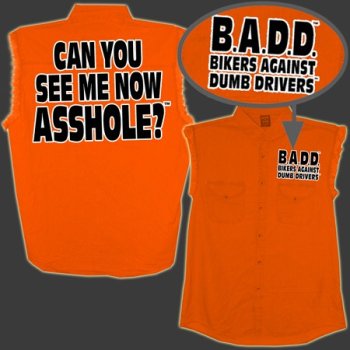
These incidents seem to happen mostly at stop signs. But still, in the 6 months I've been carfree, this has happened 6 or 7 times. Maybe I need something like the clothing below to fend off assholes:


Sunday, September 13, 2009

Week 23 Carfree Stats

Calculate your carbon emissions @http://www.carbonify.com/carbon-calculator.htm

Miles Biked: 61.23
Gallons Saved: 3.83
CO2 Not Emitted: 24.03 IBS

Friday, September 11, 2009

Fridays Random Bicycle Crap

Today's post is dedicated to my lovely fiance, Ashley. Thanks for being there with me on this long and convoluted journey.


I'm going to veer off my usual course for this Friday's post and subject people to some of my thoughts. Plus... I really don't feel like wading through all the stupid stuff out there on the intertubes.

When I first started this carfree experiment, Ashley was pretty insistent that I try it out for a month or so, and depending on how that went I could expand it. She was also pretty upset about me not driving and how that would affect her life, as she felt it would be an unfair burden; plus no more DD at 2 am. I figured that a month was a pretty puny goal and held strong on the full year idea. Now I'm just about half way through and Ashley's attitude has changed just slightly.

Now within the last few weeks Ashley has expressed different opinions about cars and bicycles. She has repeatedly said how frustrating driving anywhere can be, how crazy and inconsiderate other drivers are, and how long it takes to get anywhere with congestion - and all this in a town of about 70,000.

At the same time she has discovered how fast a simple bicycle ride can be to get to places and how enjoyable it can be as well. Recently she has been coming home and asking me how long I think it took her to get somewhere and when I'm wrong she proudly exclaims her time.

I must say that I'm proud she is finding bicycling so convenient and fun. She has significantly increased the amount of trips she does by bicycle and she is getting more comfortable riding around town. One of my goals of this experiment was not only to see if I could not operate a vehicle for a year, but to hopefully inspire other people to do the same. I didn't have any naive idea that this blog would reach people and they would get my message, but I was mainly hopping that people close to me might make small changes in their daily habits.
I guess I've succeeded in that small goal. Have a good weekend everyone.

Thursday, September 10, 2009

Missoula Roundabout Opening


Last week Missoula's first roundabout opened to the public. It was a pretty large event for the opening of an intersection; maybe because it was built with stimulus money and was the first large project to be completed in the state of Montana. A lot of big political players sent people from their offices, such as Senators Tester and Baucus and all the local politicians were on hand for the ribbon cutting.

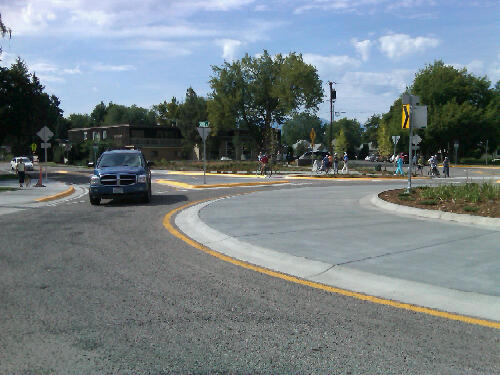
Before I get any farther along though, I would like to point people's attention to the photo above. Hopefully people can notice the abundance of signage present; 32 in all, even everyone in my Land Use Planning class thought that was a little excessive. I think Montana's DOT was a little scarred of stupid or distracted drivers driving through the middle.

Of course I believe the signage itself is a bit distracting, and even with all the signs people in cars still tried to blow through the intersection when it first opened. Most of these people were on cell phones and one even came close to running over city councilman Jason Wiener.

Here in America, traffic engineers like to tell the public exactly what type of behavior is expected of them, mostly through signs (but then we do things like have speed limits on wide, open, and straight roads that encourage speeding). Drivers are mostly o.k. with this, since it allows them not to have to think too much while simultaneously being on the phone.

But does having 32 signs at a roundabout do anything for safety, or does it fill a contractor's pockets? A roundabout is a perfect situation for "shared space," a concept first proposed by Hans Monderman. Essentially, shared space takes away all on road instructions and allows users of the road to "negotiate" with one another for road space. The intent is to slow traffic, increase safety, and allow all users to share the road more equitably. I can almost guarantee that most people's reaction to this idea in America would anger and puzzlement. There are places in America that already implement this principal, such as Savannah, GA as pointed out at the Proper Scale blog.


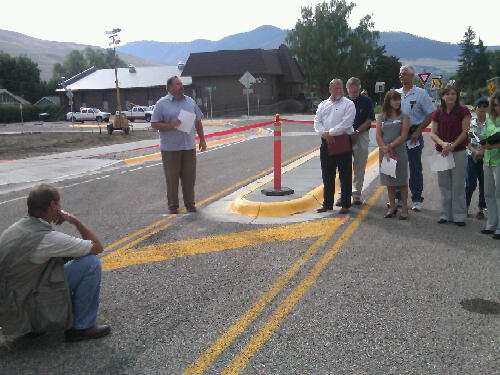
Anyway... back to the opening ceremony. Below is the ribbon cutting ceremony performed by our mayor, John Engen and Jim Lynch, head of the MDOT.


And what would the opening of a roundabout be without cyclists to test it out? As you can see in the photo below, we had a pretty good turnout. The MDOT was giving out pamphlets on how cyclists and pedestrians should behave in the roundabout. It called for cyclists to dismount and walk their bikes through the cross-walks. Lets just say that none of us cyclists performed that stunt.

Missoula's own bicycle ambassadors, where there to educate the riding public about proper on street behavior. Ben even had a hand painted helmet on, go Vikings!
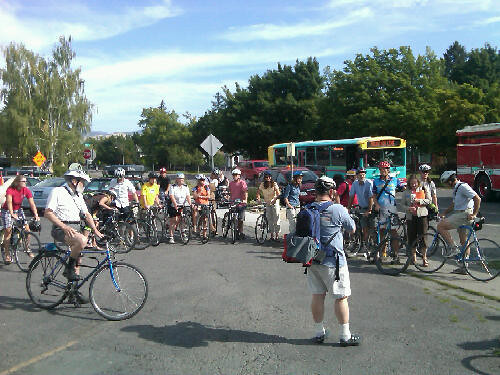
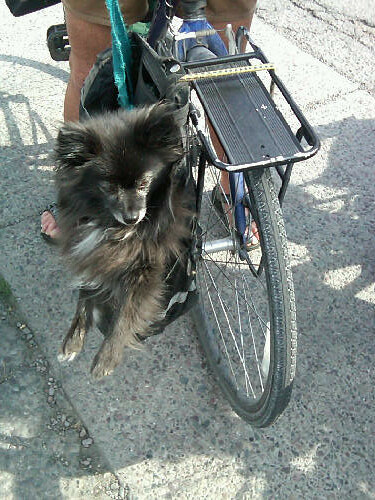
Dogs even came out to participate in such a monumental moment. Below is a BWAM member's dog along for the first ride through the roundabout.

Thursday, September 3, 2009

Does Motorist Road Rage Against Cyclists Never End?


Yesterday I came across two stories describing extremely disturbing examples of road rage against cyclists. Thanks to BikePortland and Cyclicious for covering the incidents.

The first happened in Portland during the afternoon. Apparently a motorist in an SUV and cyclists got into an argument in a parking lot. The driver then proceeded to back his vehicle into the cyclist, a man in his fifties, at approximately 40 mph. "After impact the the victim appeared to be stuck to the back of the SUV." The cyclist was taken to the hospital in critical condition with his condition improving since the incident.

The second story I came across didn't end so well for the cyclist. Canadian politician Michael Bryant was arrested on on Tuesday for criminal negligence in the death of a cyclist. Witnesses say that Mr. Bryant and bicycle messenger were involved in a collision. When Mr. Bryant tried to flee the scene, the cyclist grabbed on to the driver side door and wouldn't let go. The car then accelerated and tried to knock the cyclist off the car by running into lampposts and mailboxes. Eventually he succeeded and the cyclist fell off after which he was taken to the hospital and died shortly after arriving.

These are both sad examples of how utterly unequally matched cyclists and motorists are. If a cyclist ever got pissed off and rammed an SUV the poor cyclist would probably walk away with a few broken bones.

These are WTF kind of moments. What is it that is causing all this road rage against cyclists? I can't believe that people on bicycles are behaving so badly as to warrant a lot of this behavior. And I also can't believe that these motorists are truly as big a set of assholes as these incidents seem to portray them as. I think its more to do with the situation society has built for itself in terms of our urban environment - we must really suck at providing a healthy urban environment that produces well adjusted adults.

These two incidents are just as bad as the man who shot at a cyclist for riding with his family on a busy street a few months back. In the end there is NO rational explanation for this kind of behavior other than that these people really need to get out of their cars more often.

I'm a big believer that cars kill communities; whether they be communities of people or wildlife, the car is not a force that brings people and places together, but divides them. Cars compete for a limited amount of road space usually at high speeds and a limited number of parking spots. This situation isn't conducive to cooperative community building, but I guess it is the American way; fighting to appropriate a limited resource, CAPITALISTIC social engineering at its best. The infrastructure needed to support cars even destroys whole neighborhoods, especially when building freeways, just so that better off suburbanites can get to their downtown office jobs a little faster.

When people get out of the car and walk or bike, they have time to appreciate their surroundings, they can meet their neighbors and have an in depth conversation, and generally interact with the world from a totally different perspective than from the protected-electronic cockpit of a car. But thats just the opinion of one carfree asshole, I'm sure a bunch of motorist assholes would wholly disagree with me and be willing to back over me to prove it.

Wednesday, August 26, 2009

Bicycle & Transit Infrastructure More Efficient Than Car - Road Combo

Classes start up again within a week, and what am I doing for my last week of summer? Why... reading a book titled Sustainability and Cities by two professors, Peter Newman & Jeffrey Kenworthy.

The book lays out how the automobile city is an extremely inefficient method of moving both people and goods in an urban setting. The freedom that has seduced so many people into buying a car in the belief that all roads are empty like in car commercials is questioned and proven to have been a very short transitory state. Sustainability and Cities is full of great data compiled from academic studies - admittedly a little old at this point, as most were undertaken in the '80s and '90s -but still very useful.

Again and again the bicycle and transit come out on top of all other types of transportation. For example, a study (Aschauer 1989) of transportation costs associated with moving around the Boston urban area shows that on a per mile basis, cycling is the cheapest form of transportation. In the study cycling costs $.13-.14 per mile compared with a single occupancy vehicle (SOV) at $.81-.94 per mile while rail operated at $.29 per mile.

The costs associated with personal vehicles is something that most people dealing with transportation and alternative transportation are well aware of. Even so, it can be a very contentious issue as promoters of laissez faire will point out that cars promote economic activity, provide freedom of movement, and are what the public wants, and so roads are needed because the demand is present; this, of course, discounts the fact that roads are a government provided service, that externalities are discounted, and the billions of dollars spent convincing people that they aren't good Americans without a car.

In five studies conducted in the early '90s the average external costs of operating a vehicle came to $3,063 per year (those costs not taken into account and not paid for by the individual). In 2007, there were roughly 250 million registered vehicles on the road in America. That comes to $765 billion in external costs that are not factored into our conscience decision to operate a motor vehicle (very rough estimate, probably higher at this point). Externalities in this case include pollution, loss of productivity from congestion, traffic accidents, etc.

This doesn't even begin to take into account all the myriad costs associated with the build out of auto-centric cities. Dependence on auto use forces other urban systems to change - we need a place to park all those cars - and each one, sprawl, parking lots, land paved over for roads, congestion, adds to the inefficiencies of automobile use.

This point can be visualized in the following graph (sorry for the low quality), which displays the relationship between density and private transportation energy use. The graph shows per capita energy use - basically how efficiently we use our wealth to accomplish our daily needs - and America scores very badly - with our cities hovering around 60,000 megajoules (MJ) expended for transportation on a per capita basis. One MJ is equal to 947 BTUs, 1 million joules, 238 kilocalories or .277kilowatt hrs - thats a lot of energy. 60,000 MJs are equal to 56 million BTUs.


Every other region of the world is more efficient in moving people and goods around their cities than America, with Asia being the most efficient. Pretty straightforward, the more dense a city, the less one has to travel to take care of their daily needs and trips to work. Why drive when most things are within a mile of your residence.

America has, for a long time, believed that economic and ecological constraint do not apply to how we organize our society. We could always develop land on the urban fringe to create jobs and housing for our growing population while ignoring the costs. This worked well for the first half of the experiment, but now the costs have so exceeded the benefits of low density sprawl that we are seeing major environmental, economic, health, and even moral consequences from our arrangement of cities. Suburbs aren't going away, and neither is the car or the detached single family house, but its important that these things are re-envisioned to meet America's needs and challenges in the 21st century.

Monday, August 24, 2009

Missoula Roundabout Almost Ready to Ease Traffic Headaches


Missoula is getting its first single lane roundabout at the intersection of Higgins - Hill - Beckwith. This is completely different than the current traffic circles that can be found in our towns residential neighborhoods; which are meant to calm traffic at non-controlled intersections.

The roundabout has been under construction for about two months (more here) and is meant to make safer and more efficient a major intersection for traffic going to both the University of Montana and downtown. Pedestrian safety was a major design factor for the reconstructed intersection as the old intersection provided no safe or marked way for pedestrians to cross.

Roundabouts like the one about to open have been proven in numerous studies (here and here) have shown that roundabouts can reduce traffic accidents at intersections by anywhere from 30% to 70% depending on the prior intersection environment; this is mostly due to decreased speeds and the elimination of traffic crossing paths.


The Higgins - Hill - Beckwith roundabout will also feature some beautification with a park on one corner and the landscaping that can be seen in the photo below.

Wednesday, August 19, 2009

Confirmation - More Bicycles on the Road = Safer Cycling Environment

My neighbor, Hank Green of EcoGeek.org, came across an interesting graph courtesy of Treehugger. In this short article here Treehugger shows the relationship between the number of people taking to the road on bicycles and the number of annual injuries and fatalities.

Essentially, the graph shows that between 1998 and 2008 the number of cyclists on New York City streets roughly doubled while annual casualties dropped from roughly 5,000 to under 3,000. This is something that many bicycle advocates have been arguing for some time now. The original article out of The Atlantic Magazine is conformation of this relationship.

Now... there is more going on here than just increased numbers bringing about increased safety for cyclists. The increased demand from bicycle commuters has corresponded to an increased supply of bicycle facilities on NYC streets and the inclusion in the design process of road features that makes cycling a more attractive and safe option.

Whatever other factors contribute to the decrease in cyclist fatalities, the situation in NYC is something that all bicycle and alternative transportation supporters should take note of. Just from my own and other people's experiences in the parts of Missoula - where cyclists have become normal and even clog the bike lanes at certain times of day - there is an increased awareness of and respect for cyclists coming from motorists. However, in parts of town where cyclists rarely venture, the slaughter continues, on streets like Reserve - a five lane expressway.

Monday, March 9, 2009

Monday Morning Rethink

Something that I realized this weekend that for some reason never crossed my mind about going car-free is access to our great public lands of Montana. Hiking and fishing are two things that I love to do, there are plenty of hiking opportunities within easy biking distance of Missoula, but the fishing is always better the farther you get from lots of people. Rock Creek is 21 miles from Missoula, and the area I grew up fishing at in the Bitterroot is south of Hamilton. Lolo Peak, a great place to hike into during the summer months is another place that seems a little daunting in getting to without a vehicle.

My original plan was to not even ride in a vehicle other than mass transit. I might have to amend my plans and include the ability to ride in a van/carpool or hitchhike to get to some of these places that would be hard to stay away from for a whole year. I honestly don't think I will be riding my bike and carrying my fishing pole all the way to Rock Creek. Montana's public lands and the almost unlimited access that people have is part of what makes this state so great and I would hate to miss out on whats out there.

Thursday, February 26, 2009

This Guy Gets It, The Senator However...

Figure I would test embedding video today. Thanks goes to Twin Cities Streets for People blog for finding this little nugget of American ignorance, arrogance, and good old government incompetence.


Tuesday, February 24, 2009

Difinitive Start Date

I have a start date for going car-free. I have been waiting to start because we have been looking for a new place to live, and now we have found one. Personally, I didn't want to stress test my current relationship by trying to make the move while only using a bike. The new place is on the west side of Missoula, a nice neighborhood with lots of charm. It used to be a blue collar neighborhood back when the mills still operated in town, once the mills closed that part of town went into decline. However, over the past decade it has come back with lots of renovations, new construction, and lots of young families moving in to the area.

It's a great central location that provides easy access to much of Missoula. Doing a little work with Google maps, I figured that its 2 miles to Costco, the new light at Palmer St should make crossing Broadway much easier and safer, though I don't know if Costco has a bike rack. Some other important points in Missoula include; downtown (less than a mile), half a mile to the new Safeway, less than 2 miles to the North Hills trail system, 2.5 miles to campus, and 1 mile or 2.5 miles to Bayern and Kettlehouse Brewries.

So, by the first week of April we should be all moved in and I can give up driving.

Friday, February 20, 2009

Less Driving, Wrong reason

An article from Rueters, here, states that for the 14th month in a row, Americans are driving less. The drop in driving, however, is slowing because of lower gas prices. While this could be seen as a good thing, I'll be cynical here and view this for what it most likely is. People are only driving less because they are losing their jobs; no job means no commuting. It also means less money for consumer goods, so less trips to the mall. People probably aren't changing their behavior, they just have nowhere to go, and less money to spend.

Ironically, this also means that state and local government are generating less money from gas taxes, exacerbating the budget crunch.
Bookmark and Share