Showing posts with label alternative transportation. Show all posts

Sunday, April 4, 2010

A Year Well Spent: One Year Spent Carfree


Its been a year of carfree living and I must say that I'm surprised at how fast the time went by and how relatively easy it was to get through the last year. There is no party or press release to send out, just a sense of accomplishment in knowing that I stuck to a goal I set for myself and in the knowledge that that I have grown as a person and learned many things about myself and the world us humans have built for ourselves.

I started this little project to see just how much of a difference one person could make on a bicycle and it seems that I have accomplished more than collecting stats. Ashley informed me that she feels my commitment had challenged her to think about getting around town in a different way and inspired her and her family to hop on a bike or walk more often. I even got her cousin Katie from Houston to ride a bike after more than three years of missing out on such joy. Katie let me know that, "you just don't ride a bike in Houston."

I also wanted to experiment with carfree living in a small city. Many of the online discussions encouraging mass transit or active transportation featured the same old argument that in many American cities it just isn't possible to live without a car and that such a lifestyle is only for those elitists from the coast. Well I did it in the middle of Montana in a town with limited bus service. After a year I'm convinced that most of the barrier to people getting out of their cars is in fact psychological in nature.

Of course Missoula certainly isn't the worst place to ride a bike as your main transportation and I would even challenge towns such as Boulder, CO and Davis, CA to try harder because Missoula is catching up on these bicycling paradises. Missoula's grid system of streets sure helps, allowing cyclists to skirt around heavy traffic if they wish, and the strong emphasis on outdoor activities doesn't hurt either. Hell, people around here have such a hard time waiting out the winter that the first day in the 50s brings out shorts and Chacos. There were barriers and adjustments that I had to make. I missed out on a lot of the great outdoors that Montana is famous for. I was certainly confined to the Missoula urban area much more than a would have been normal, but I made the most of it given the great culture that Missoula has to offer.

I didn't get through this year alone and have many people that helped out in different circumstances. Ashley, my fiance, turned around from her initial skepticism and supported me till the end; Troy, a friend, never stopped offering me car rides and was there when I truly needed them, and Free Cycles allowed me to learn how to maintain my lowly fleet.

So how much of a difference did I make? Over the course of the year I logged 2,932.92 miles on my bike running errands and commuting. All those miles add up to 226.8 gallons of gas saved, and @ $3.00/gallon that adds up to $680.56 saved. Add in $1800 saved from not needing car insurance and $360/month, for a total of $4320/year, from car payments I no longer had to make and I saved a total of $6800.56 over the course of the year. Thats $6800.56 that I'm certain I spent elsewhere supporting Missoula business. I also saved 1750.98 Ibs of CO2 from entering the atmosphere just by using a bicycle as my main form of transportation.

Where are the keys? ... I'm going for a drive. That last part is a joke.

Tuesday, March 9, 2010

Just as I Finish Up... Another Person Shares Their Carfree Experience

Meet the "Average Joe" over at Carfree.us. As of January he started a year long carfree experiment to, "highlight the challenges and choices I will face in my every day life and the impact they will have on me as I live this (sadly) “alternative lifestyle.”

"It’s important to understand I am an average Joe, in my thirties, working a 9-5 desk job. I have a wife and a one year old son. I live in an average size city, with an average public transportation infrastructure, and I live 7 miles from the city center. My wife is not a zealous bicyclist, and truthfully, not very supportive of this project! My wife does own a car and I will probably occasionally drive it with my family in the car."

Good luck Mr. Average Joe and have fun with the journey.

Tuesday, March 2, 2010

Federal Gov't FAIL: US DOT Set to Shut Down


As we've become so accustomed to hearing from D.C... the game of politics is getting nothing done and now the United States Department of Transportation is facing a temporary shutdown. A "Jobs Bill" meant to extend unemployment benefits has been blocked by a single U.S. Senator Jim Bunning (R., Ky.). According to the Wall Street Journal the bill included a funding extension for Highway Trust Fund which has now expired, causing 2,000 USDOT employees to be furloughed and potentially $768 million in infrastructure projects to be halted.

This is causing many strains, including on state governments which are faced with losing approximately $150 million per day in federal reimbursement payments. At a time when many states are already on the edge of financial insolvency this is just one more headache to deal with. This is even trickling down to local Public Works type agencies that were relying upon federal funding and cost sharing for projects.

This shouldn't be much of a surprise since the Federal Government's continued failing to pass a new transportation bill has had a similar effect and has forced states and municipalities to make hard choices about what projects to try to fund (in stark contrast to the effect of the Stimulus where many projects went ahead with little oversight).

Missoula makes great use of the Congestion Mitigation and Air Quality Improvement Program (CMAQ) which is part of Federal transportation funding. CMAQ funding helps pay for pedestrian and bicycle facilities as well as the purchase of buses for both Mountain Line and ASUM Transportation, the student funded bus service to the UM campus. Lack of CMAQ funding has meant that ASUM Transportation cant replace marginally safe buses that are over 20 years old rather than being able to purchase new buses that meet the strictest federal safety regulations. Because of the Federal Government's flaccid ability to actually get anything done ASUM Transportation is facing a hard choice between continuing to run old buses that pollute heavily (compared to a new bus) and breakdown constantly, or cut the budget by about 15%, consequently eliminating 4 or 5 student positions, to be able to attempt to purchase new buses using only ASUM funds.

Some people will undoubtedly rejoice in the gridlock in Washington, but when people and local governments have no idea what direction the Federal Government will take... it makes it just a little hard to plan for the long term or to invest in equipment or infrastructure.

Friday, February 19, 2010

Ecotopia... Random Bicycle Crap Fridays

I recently started reading the classic environmental polemic Ecotopia written by Ernest Callenbach. Its got a lot of amazing ideas and innovative design techniques for urban centers. I'll get into those in longer posts later, but for now I'll just give a teaser related to bicycles.

"Ecotopians setting out to go more than a block or two usually pick up one of the sturdy white-painted bicycles that lie about the streets by the hundreds and are available free to all. Dispersed by the movements of citizens during the day and evening..."

Thursday, February 18, 2010

Let Your Voice be Heard... Support Additional Rail Lines


An online version of the Restore the North Coast Hiawatha petition created by students at The University of Montana is now available on MontPIRG’s website. The petition was started in support of Amtrak’s passenger rail study and Senator Jon Tester’s push for reinstatement of the line. The original petition garnered over 1200 signatures in a matter of only a few weeks of gathering in Missoula. The first set of petitions will shortly be delivered to Senator Tester in Washington D.C.

It is the purpose of the online version to garner wider support for the rail line outside of Montana and to let our United States Senators know that the people demand more transportation options. The line connects many important cities in the region including Seattle, Spokane, Sandpoint, Missoula, Helena, Bozeman, Billings, Bismarck, Forgo, and many more. The restored line would be an important step in reducing green house gas emissions, providing transportation options, and offering vital economic infrastructure.

Wednesday, February 17, 2010

No TIGER Money for Missoula

The US Department of Transportation just released the winners of the TIGER (Transportation Investment Generating Economic Recovery) grants and Missoula was not on the list. For a look at the full document and listing of all the winners click here.

Montana didn't completely lose out on the funding however, as two projects in Western Montana are getting the go ahead. The projects in Whitefish and Lake County are recieving a combined $15.5 million in federal grant dollars.

Accord to @T4America there were a total of 1400 applications and $60 billion in funding requests. Missoula had applied to use the money mainly for investment in sidewalk, river trail, non-motorized road crossings, and intersection safety infrastructure improvements that would have taken care of several years worth of improvement projects.

Monday, February 15, 2010

The view from Portland

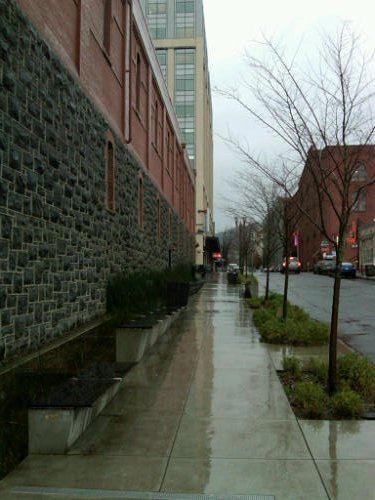
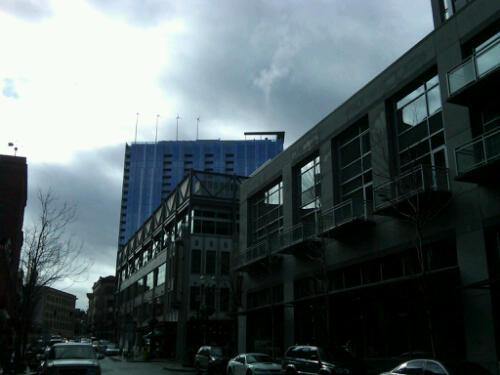
My feet hurt... thank you Portland. Four days of a carfree mini vacation using a walking/transit combo put a lot of miles on the feet. Still tired from traveling today and then immediately diving into work back in Missoula so this post will be short and quick... for some great thought provoking writing check out @Urbanophile's arguement for fare-free transit, which would be perfect for Portland, and this article that shows that being sighted close to transit is saving homes from entering foreclosure.

Enjoy the pictures... I'll write more on Portland later... especially the Hipster economy.


Plane from Seattle --> Portland. A little greenwashing? I think so


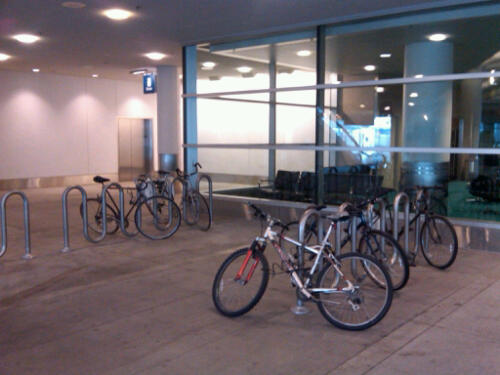
You know your entering a different world when there is bicycle parking at the airport terminal.


My ride from the airport awaits.


On-street Bicycle parking at Powell's Books


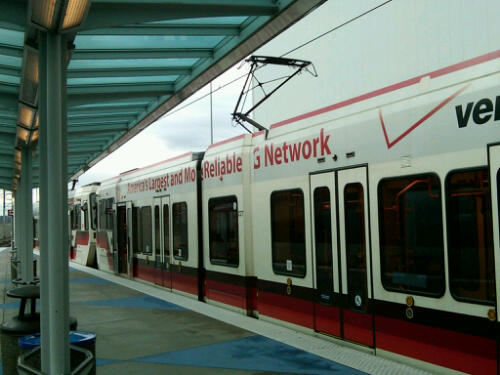
Portland does a great job of using public (park) space to accentuate the utility and connectivity of the various rail lines.


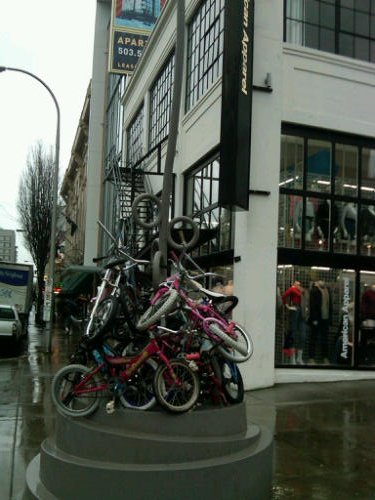
Only in Portland


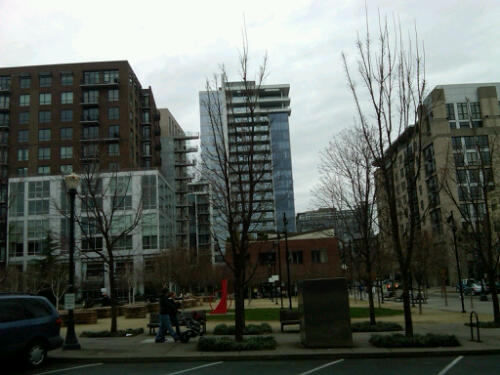
Another innovative urban design... this time add green infrastructure and reduce rain water runoff.


Building with both wind turbines and solar on the roof.


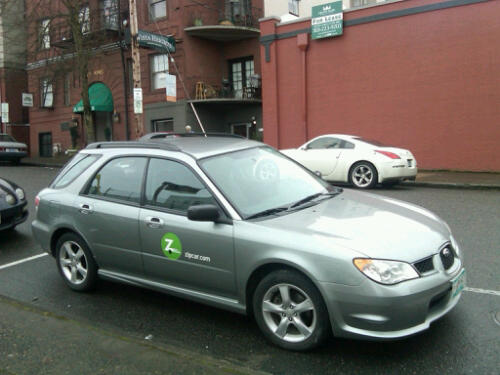
Making it that much easier not to own a car.


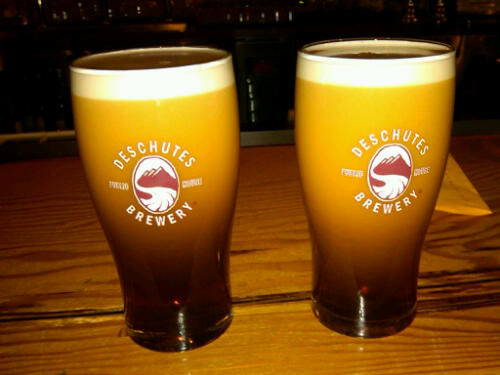
And finally the beer... my god the beer. A little nitro never hurt anyone... and anyway can't get this shit in the stores. Don't worry Kettlehouse, your still the beer I hold dear... though I think I'll miss Amnesia.

Wednesday, February 10, 2010

Missoula Residents Show Up to Support Active Transportation

Missoula has started the long and arduous bureaucratic process of updating one of its many long term plans. And this time its an update to the non-motorized transportation plan and recently Missoula's Office of Planning and Grants (OPG) held a community workshop to get input from Missoula citizens. And the general message from the good people of Missoula was for the city to finish the trail/sidewalk/bike lane system.


Missoula's planning apparatus (and I use that term half jokingly because we are a small community that gets a lot of planning done on limited resources) has in recent years really integrated collaborative planning into the process and this time is no different. Collaborative planning aims to be as open and inclusive of different interests and community groups as possible to allow a wide variety of input to be included in the planning process.

And from the parts of the process I have been involved in... there is a lot of input coming in. Transportation is one of those topics in Missoula that really brings out a lot of people and groups. The advisory committee alone has close to thirty people (from various city/county departments, nonprofits, community groups, and business organizations) in attendance guiding the process.

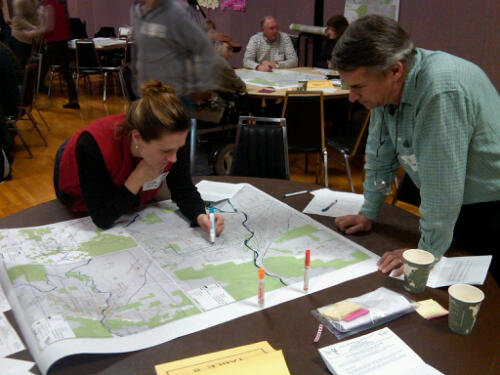
The community workshop was pretty interesting to watch play out. The night it was held was cold and snowy, yet about 2/3 of people biked and most of the rest walked. With perhaps upwards of 60 or 70 people in attendance, everyone worked through a series of group oriented activities. Of course everyone's favorite involved drawing on a map of Missoula.


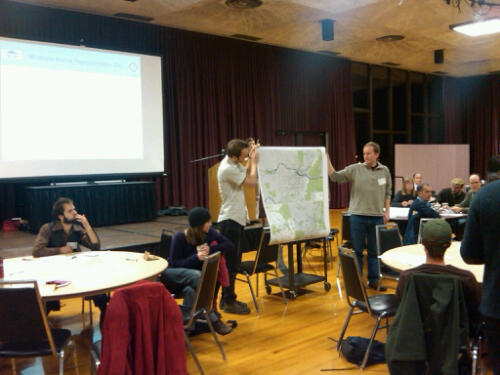
And once the individual groups had finished their discussion and mapping each shared their results with the entire workshop.


Out of this event came a lot different input but the general themes included:
- improved connectivity
- finish the trail/sidewalk/bike lane network
- reduce posted speed limits, at most 35 mph
- improve street lighting
- implement our complete streets policy
- focus transportation more on safety than traffic flow

Tuesday, February 2, 2010

Stupid Inflammatory Comment of the Day

This quote comes from Sgt. Tom O'Brien up in Ontario Canada in a recent op-ed.

"
...bicycles in London should generally disappear after the first few days of snow and not reappear until the drains are filling with melt water... I am amazed why anyone would jeopardize their lives by riding on icy, slippery roads where any miscue could lead to a nasty fall or worse."

Thanks for the concern officer, I just hope you don't start enforcing that opinion like officers have started enforcing imaginary laws in Texas to get cyclists off the street.

Thursday, January 28, 2010

I Don't Usually Reference Hitler, But... Random Bicycle Crap Fridays

Hitler has finally weighed in on the "bicycles as traffic debate." Of course I don't mean the real Hitler, but the fairly random "Hitler rants about..." clips floating around the internet. There are some pretty funny ones, with topics ranging from Brett Farve, Healthcare Reform, Obama, Xbox Live, and WoW. But now someone has finally given Hitler an opinion on bycling.


Tuesday, January 26, 2010

"Riding a Bicycle on a Roadway" Now Illegal (in Texas)

For days I have been enthralled by the slowly unraveling story of fellow cyclist and carfree blogger ChipSeal who has been arrested - more than once - for driving his bike on a public roadway (in Texas) in the last week. Each day he reveals more details or more of his inner thoughts on the utter stupidity of the situation.

I won't cover the whole story, since ChipSeal does it so well with very well timed wit, for the real thing go to his blog, or visit Commute Orlando for a great commentary largely inspired by ChipSeal's ordeal and the ordeals of other cyclist's in similar situations.

Essentially he is being harassed by law enforcement at the behest of whinny motorists for obstructing their right to go fast without any impediments to their forward progress. In his last post ChipSeal prods bicycle advocates to give a shit and show it by doing something other than lobbying for laws and infrastructure and get down to something that will be real and solid in protecting/enforcing cyclist rights in Texas.

I might be a long way from Texas... but it sounds like small town Texas could be infused with some of the enthusiasm for theme rides that the cyclists of Portland are infected with. Seems to me that a "Solidarity Ride" needs to be organized to bring cyclists from all over Texas (or the nation) to ride through these small towns that are trying to restrict cyclist's rights, or harassing the few cyclists present on the road, as a show of solidarity and numbers.

But what do I know about Texas from my perch in the snowy mountains of Montana.

And I was going to do a short post on the little parking ticket I received on campus yesterday... though I still managed to slip it in there.

Sunday, January 24, 2010

Winter Clean Up

Spring is fast approaching, or it could even be here already considering the warm weather we have been having here in Missoula, and with the coming of spring it means that my year of car-free existence is coming to an end. Come April my year will be over, but that doesn't mean that I will suddenly end my commitment to alternative transportation and turn into a car-crazed American.

And just because my car-free year is coming to an end doesn't mean that this blog's purpose will suddenly vanish. As many readers might have noticed, much of the content I have been writing isn't actually about my car-free experience, but rather about alternative transportation and urban design issues. This will not change.

And with that said... it is time to perform a little clean up and catch up with my car-free stats for the last two months.

Week 35

Miles Biked: 57.62
Gallons Saved: 3.60
CO2 Not Emitted: 22.62 Ibs

Week 36

Miles Biked: 8. 21
Gallons Saved: .513
CO2 Not Emitted: 3.223 Ibs

Month 9

Miles Biked: 123.14
Gallons Saved: 7.69
CO2 Not Emitted: 193.33 Ibs

Week 37

Miles Biked: 12.69
Gallons Saved: .793
CO2 Not Emitted: 4.98 Ibs

Week 38

Miles Biked: 9.23
Gallons Saved: .577
CO2 Not Emitted: 3.63 Ibs

Week 39

Miles Biked: 0.00
Gallons Saved: 0.00
CO2 Not Emitted: 0.00

Week 40

Miles Biked: 27.42
Gallons Saved: 1.72
CO2 Not Emitted: 10.76 Ibs

Month 10

Miles Biked: 49.34
Gallons Saved: 3.08
CO2 Not Emitted: 19.37 Ibs

Week 41

Miles Biked: 53.84
Gallons Saved: 3.37
CO2 Not Emitted: 21.13 Ibs

Week 42

Miles Biked: 62.76
Gallons Saved: 5.23
CO2 Not Emitted: 24.63 Ibs

Tuesday, January 19, 2010

Winter Riding Update

Temperatures have risen to a balmy 40 F the last two days. It actually been a fairly warm week in general with temps hovering just above freezing most days. And to give you an idea of just how bad the ice was the last couple of weeks... there is still ice in places on the road after a week of melting. Now that temperatures are back up I'm no longer the lone cyclists out there and even with rain today there are a number of people out on their bikes.

I really felt unsafe in many situations over the course of the worst road conditions here in Montana. My usual routes along neighborhood side streets were often completely un-ridable from the thick coating of undulating ice. Which forced me onto many main streets where the roads were clear but the traffic was heavy. I never had a close call, but it was still very unsettling to to be forced onto busy roads that had become constricted because of plowed snow piling up on the roadway. Just from a personal perspective, the perception that an auto is safer in such conditions really does make them much more utilitarian than a bike.

As for the score so far this winter... Ice - 2, Me - 0. And yes, to all those family reading this... I had a helmet on both times I took a spill on the ice.

Wednesday, January 13, 2010

Walkscore: Something seems a little off

What do I do with my free time? Play around with Missoula's Walk Score of course... and find that it is broken.

For those who have never been to the Walk Score website, the purpose is to calculate the friendliness of different neighborhoods based on the proximity of amenities such as services, restaurants, etc. According to the Walk Score website, the algorithm used assigns the maximum number of points for amenities that are within a 1/4 mile of the location entered. While this is a good measure of walkability, I would argue that factors such as street design, traffic volume, speed limits, and neighborhood character would make the model Walk Score uses much more accurate and relevant.

To illustrate my point you can see below the streetscape of Phillips, the street on which I live. My address received a 69, meaning that only 27% of locations had higher walkscores than my house.


Now contrast my neighborhood's Walk Score with the one received by the location seen below. I randomly typed in an address along Brooks, a four lane arterial with speeds ranging from 35-45 with lots of traffic, congestion, business activity, and almost no cyclists or pedestrians.


This section of Brooks received a Walk Score of 83, 14 points higher or about 20% more "walkable" than where I live. I think its pretty intuitive just from the pictures of the two different locations which one would be more friendly to active transportation... and its not the one Walk Score recommends.


There is a lot more to getting people walking than just how close they live to given amenities or their job. Paramount is safety, or at least the perception of safety along design aesthetics. I would venture to guess most people would rather walk down a tree lined, quiet street with on street parking acting as a buffer, than a busy, loud arterial surrounded by parking lots and neon lights.

I think Walk Score might be broken.

Monday, January 11, 2010

Coeur d Alene: Safety Fail, No Saftey in Numbers for Bike/Peds

Over the weekend I was hit by a car, and it provides me with a good opportunity to talk about safety in numbers that cyclists and pedestrians create and how streetscapes and development patterns contribute to safety.

Let me setup what happened. I took the Greyhound from Missoula to Coeur d' Alene (CDA) Saturday morning to visit my folks. There is no physical transfer station in CDA, rather the bus drops you off at a gas station that sits at the corner of a large intersection (Ramesy and Appleway) where two four-lane arterials meet (total of 22 lanes at the intersection).

Anyway, the bus dropped me off at a different location than the Greyhound website gave for the (nonexistent) station. My father was coming to pick me up, but since he doesn't have a cell phone there was no way to get a hold of him, so I decided to walk north along the western side of Ramsey to find a good place to wave him down as he came to pick me up.

Two blocks later I was crossing the intersection below, which is an old picture as the intersection now has a four-way light, within the cross walk while a car was waiting for an opening to turn right-on-red. I walked out in front of his car, attempting to make eye contact because I could sense he was ready to hit the gas to make an opening, but he was looking the other direction. Needless to say he hit the gas and ran right into me. Luckily he immediately stopped and I wasn't hurt other than a small bruise on my leg.


This incident got me thinking how ridiculous the incident was. Living in Missoula, I have walked hundreds, perhaps even a thousand miles around town over the course of seven years. In that time I have never been hit by a car... I don't even remember having a close call. But here I am, back in the town I grew up in, and five minutes after stepping off the bus I am hit be a car.

The whole time I lived in CDA, I never once got around by walking or biking, rather the only real way to get around is by car. Seven years of walking in Missoula = no problem, five minutes of walking in CDA = getting hit by a car. Missoula and CDA are also fairly close in terms of population size.

Why is this? Because of not only the streetscape that dominates in CDA (suburban arterials with speeds above 35 mph) but also the development pattern that essentially forced those types of roadways to be built.

You can see these patterns at play in the photo of CDA below. I have highlighted all the four lane arterials (red corresponding to suburban arterial design and yellow representing four lane roads with an urban character). CDA is a maze of suburban subdivisions that are only connected to the wider community through the use of a lot of arterials. Only a small portion of CDA (which also includes the towns of Dalton Gardens, Hayden, and Hayden Lake) actually has a street network laid out in a grid. This pattern results in a very spread out population with very low densities (Dalton Gardens is zoned at 1 house/acre).


Because people have to drive everywhere and there are almost no pedestrians or cyclists, the motorists don't look out for these types of people. Those whom do walk or bike are mostly a working-poor underclass -except for the roadies - that most suburbanites don't spend any time thinking of between trips to Starbucks, work, and dropping the kids off at soccer practice.

Now contrast this with Missoula (a photo with the same types of streets highlighted can be seen below). The bulk of Missoula is based on a grid system and subdivisions with a suburban character only exist at the fringes of the town. Not only that, but the most of the four lane roads that Missoula does have exist within areas that are urban in character (higher densities, tree lined streets, sidewalks, smaller lot setbacks, and slower speeds). The four lane suburban arterials are located again mostly at the edges of Missoula and so cyclists and pedestrians can largely avoid these roads by choosing quieter streets.

Also consider the the geographic distance these two photos show. The photo of Missoula covers most of the town and most of the town's population. The photo is 3.5 miles x 3.5 miles while the photo of CDA shows an area 7.5 miles x 7.5 miles that leaves out a considerable amount of development to the north. Missoula's compact nature encourages alternative transportation simply through its shorter distances.


The higher densities, shorter distances, and more welcoming streetscape encourages people to walk and bike. In much of the central part of Missoula you can't go more than a couple of blocks without seeing another pedestrian or cyclist. Just the numbers of pedestrians and cyclists using Missoula streets makes motorists more aware of them and creates a situation where motorists must constantly be on the lookout. This creates a Safety in Numbers phenomenon whereby the more cyclists and pedestrians out on the roads, the less absolute fatalities and crash cars have with cyclists and pedestrians.

Describing what had happened, even my very conservative father understood the relationship between development patterns, streets, and mode of travel. In his opinion, and I have to agree with him, CDA is a town that will never see a lot of people walking, biking, or using transit simply because the towns infrastructure makes those options economically difficult and even dangerous.

Friday, January 8, 2010

Random Bicycle Crap Fridays: Sub-Zero Edition


I need one of these to get some traction on the three-inches of ice we have on some of our Missoula roads.

Completed my first sub-zero bicycle commute this morning with the temperature reading -8 when I left the house with windchill making it more like -15 or -20. I was actually never really cold along my three miles... but it sure was the most miserable bicycle commute I've experienced. Can't wait to do it again.

Wednesday, January 6, 2010

Thwarted by Ice

The last two days Missoula has seen some Hellish weather. Yesterday started out nicely enough with a light snow falling on my morning commute. The little bit of ice on the roadways forced me to go a bit slower than normal. By the time I made it to the campus however, the temperature had increased enough to turn the light snow into a wet mess of sleet in the air and slush on the road.

It then proceeded to snow and rain alternatively all day and by the time my day was over the roads were covered in a thick layer of slush and lots of puddles filling the low spots in the road. Without any fenders on my mountain bike my three mile commute felt almost like I was swimming through some very brackish water.

As soon as I was warmed up I made sure to put on a rear fender. Unfortunately it was a futile gesture to try and keep me comfortable since the weather conspired to keep me off of my bike today. Over night all the rain and wetness had frozen solid into a sheet of ice up to several inches thick in places. This included covering all of my bikes in a shinny layer of ice.

The brakes were completely frozen and useless... the cables, calipers, and triggers were all useless. Ice covered the seats of both my road and fixie, while even the wheels and hubs on my fixie were covered in a layer of ice. Rather than spend 20 minutes trying to unfreeze all the components and then worrying about putting too much stress on the metal being so cold.

So thanks to Ashley for being gracious enough to provide me with a ride this morning.

Monday, January 4, 2010

Second Thoughts on the Copenhagen Wheel


The last week of the Copenhagen Climate Conference saw a lot of buzz for something completely unrelated to climate change. While world leaders tried and failed to put together a sensible plan on climate change (who am I kidding, there is nothing sensible about anything related to politics) an announcement out of MIT's SENSEable City Lab basically stole the show for many in the bicycle community. The Copenhagen Wheel combines hybrid technology (think Prius), connectivity through the use of a smart phone, and the best, most reliable, and technologically simple form of transportation to yet exist... the bicycle.

This really is a great idea, for more information watch the video here, but after my initial WOW reaction to reading about this invention, I started to think about how I would find the Copenhagen Wheel practical to use in my everyday journey by bike and I came instead came away with two concerns.

First, the Wheel main means of generating energy to be stored is when a rider uses the coaster brake. This goes against the basic operation of a bicycle where a person attempts to conserve as much forward momentum as possible and braking makes up a very small portion of a person's time on a bike. In the attempt to conserve forward momentum cyclists blow through stop signs and even red lights (I'll admit to doing exactly that when there is no traffic to worry about).

It's highly doubtful that people would significantly change their behavior just to get a little charge. Unlike with a hybrid vehicle, whereby people changing their driving behavior to fit the dynamics of a hybrid and thus driving becomes more efficient, changing behavior to fit the mechanics of the Copenhagen Wheel would seem to make a ride less efficient.

However, Christine Outram, a research associate at the SENSEable City Lab informed me that the Copenhagen Wheel does take these facts into account having an additional "exercise" mode that can be switched on. In this mode, excess energy from pedaling is used to charge the batteries. Of course, this mode is meant for those who like to ride at a fast clip and so may not be of much utility to those cyclists whom prefer to take a leisurely ride.

The second concern is the distraction of operating everything through a smart phone. A large debate surfaced this summer surrounding the safety implications of texting and driving, and I see no difference here just because the bicycle is a few thousand pounds less. Texting or talking on a cell phone while biking is extremely distracting and dangerous, I can attest to this by witnessing plenty of people attempting such feats and thereby swerving all over the place, losing their balance, and generally becoming unaware of their surroundings.

While the Copenhagen Wheel smart phone interface is integrated into the handlebars of a bicycle, this system still requires that a ride look down and take one hand off the handlebars to operate; creating a distraction and making the bicyclist take their eyes off the road. Its not hard to imagine someone fiddling with their smart phone and wondering into a busy intersection.

Sunday, December 27, 2009

Riding in a Winter Wonderland


The snow has finally accumulated sufficiently in Missoula to have made the last month of getting around town a little more difficult on a bicycle. Snow, ice, freezing fog, slush, gravel, and de-icer all combine to make the roads just that much more treacherous, not to mention the limited amount of day time light and the confined roadways from piled snow that force cars to basically take over the bicycle lane on certain streets.

I have given up riding the fixie for now and switched to the used mountain bike I purchased this summer. The wide, aggressively treaded tires work great on the snow, ice, and had pack that dominates most of the side streets in Missoula ( you must understand that Missoula, being a town with not much money to spend on snow removal, concentrates on the main roads with the most traffic that are critical to moving people around and so the side streets are left to be turned into hard-packed public ice hockey rinks).

The only problem comes when my tires hit a patch of semi-packed snow that has warmed above freezing. This stuff is not yet wet slush and still has the consistency of snow, but when the front tire hits a patch of it, the weight of the bike pushes the snow away from the tire and your then forced to quickly try and regain your balance before your front tire goes out from under you. In these conditions I talked to a lot of people or heard conversations that involved "my hip hurts" or "I ate it hard around a corner." Luckily I have yet to fall, though I have been forced to put my foot down more than a few times.

Predictably the miles I'm putting on my bicycle have plunged (I'll have an updated millage figure within a week) as I have switched to the bus in the most horrid of weather - below zero - and have cut out trips from just not wanting to deal with riding other than for essentials, such as commuting and to get to the grocery store. And of course I haven't been on a bike for the last week since Ashley and I made our way up to her parents for the holidays; I couldn't imagine a better time to be on a bike getting in some exercise than during this food heavy time of year.

However, with all the extra hazards that you face as a cyclist during the winter, there is nothing quite like riding through a few inches of freshly fallen snow. The soft crunch the snow makes under the bicycle tire and the muffled silence of the world newly peaceful really does create a different and wonderful world to be riding through.
Bookmark and Share