Showing posts with label bus. Show all posts

Tuesday, March 2, 2010

Federal Gov't FAIL: US DOT Set to Shut Down


As we've become so accustomed to hearing from D.C... the game of politics is getting nothing done and now the United States Department of Transportation is facing a temporary shutdown. A "Jobs Bill" meant to extend unemployment benefits has been blocked by a single U.S. Senator Jim Bunning (R., Ky.). According to the Wall Street Journal the bill included a funding extension for Highway Trust Fund which has now expired, causing 2,000 USDOT employees to be furloughed and potentially $768 million in infrastructure projects to be halted.

This is causing many strains, including on state governments which are faced with losing approximately $150 million per day in federal reimbursement payments. At a time when many states are already on the edge of financial insolvency this is just one more headache to deal with. This is even trickling down to local Public Works type agencies that were relying upon federal funding and cost sharing for projects.

This shouldn't be much of a surprise since the Federal Government's continued failing to pass a new transportation bill has had a similar effect and has forced states and municipalities to make hard choices about what projects to try to fund (in stark contrast to the effect of the Stimulus where many projects went ahead with little oversight).

Missoula makes great use of the Congestion Mitigation and Air Quality Improvement Program (CMAQ) which is part of Federal transportation funding. CMAQ funding helps pay for pedestrian and bicycle facilities as well as the purchase of buses for both Mountain Line and ASUM Transportation, the student funded bus service to the UM campus. Lack of CMAQ funding has meant that ASUM Transportation cant replace marginally safe buses that are over 20 years old rather than being able to purchase new buses that meet the strictest federal safety regulations. Because of the Federal Government's flaccid ability to actually get anything done ASUM Transportation is facing a hard choice between continuing to run old buses that pollute heavily (compared to a new bus) and breakdown constantly, or cut the budget by about 15%, consequently eliminating 4 or 5 student positions, to be able to attempt to purchase new buses using only ASUM funds.

Some people will undoubtedly rejoice in the gridlock in Washington, but when people and local governments have no idea what direction the Federal Government will take... it makes it just a little hard to plan for the long term or to invest in equipment or infrastructure.

Sunday, December 27, 2009

Riding in a Winter Wonderland


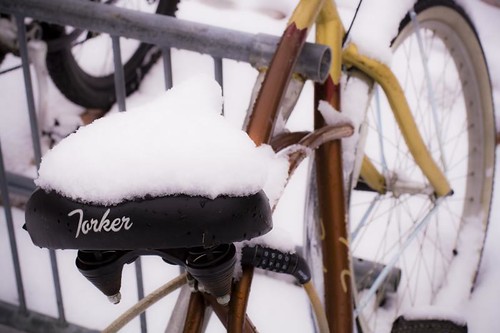
The snow has finally accumulated sufficiently in Missoula to have made the last month of getting around town a little more difficult on a bicycle. Snow, ice, freezing fog, slush, gravel, and de-icer all combine to make the roads just that much more treacherous, not to mention the limited amount of day time light and the confined roadways from piled snow that force cars to basically take over the bicycle lane on certain streets.

I have given up riding the fixie for now and switched to the used mountain bike I purchased this summer. The wide, aggressively treaded tires work great on the snow, ice, and had pack that dominates most of the side streets in Missoula ( you must understand that Missoula, being a town with not much money to spend on snow removal, concentrates on the main roads with the most traffic that are critical to moving people around and so the side streets are left to be turned into hard-packed public ice hockey rinks).

The only problem comes when my tires hit a patch of semi-packed snow that has warmed above freezing. This stuff is not yet wet slush and still has the consistency of snow, but when the front tire hits a patch of it, the weight of the bike pushes the snow away from the tire and your then forced to quickly try and regain your balance before your front tire goes out from under you. In these conditions I talked to a lot of people or heard conversations that involved "my hip hurts" or "I ate it hard around a corner." Luckily I have yet to fall, though I have been forced to put my foot down more than a few times.

Predictably the miles I'm putting on my bicycle have plunged (I'll have an updated millage figure within a week) as I have switched to the bus in the most horrid of weather - below zero - and have cut out trips from just not wanting to deal with riding other than for essentials, such as commuting and to get to the grocery store. And of course I haven't been on a bike for the last week since Ashley and I made our way up to her parents for the holidays; I couldn't imagine a better time to be on a bike getting in some exercise than during this food heavy time of year.

However, with all the extra hazards that you face as a cyclist during the winter, there is nothing quite like riding through a few inches of freshly fallen snow. The soft crunch the snow makes under the bicycle tire and the muffled silence of the world newly peaceful really does create a different and wonderful world to be riding through.

Friday, December 18, 2009

Random Bicycle Crap Fridays

Usually I post things relating to the ridiculous on Fridays, but today I want to highlight something inspirational, something that could utterly transform the usefulness and practicality of bicycles, and a few things seen around Missoula. Enjoy.

First, the Revolution:


Second, the Inspirational: A group of High School students in Florida have started their own "bike Bus" to school with amazing results.

High School Bike Bus from Keri Caffrey on Vimeo.


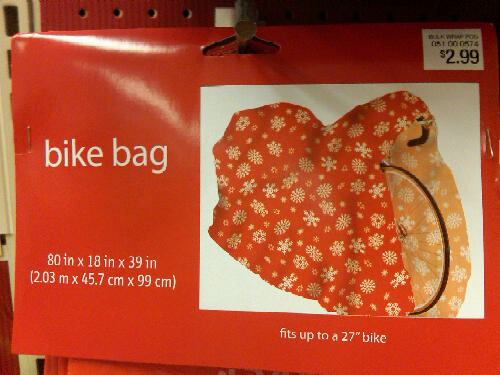
Third, something seen at Target:


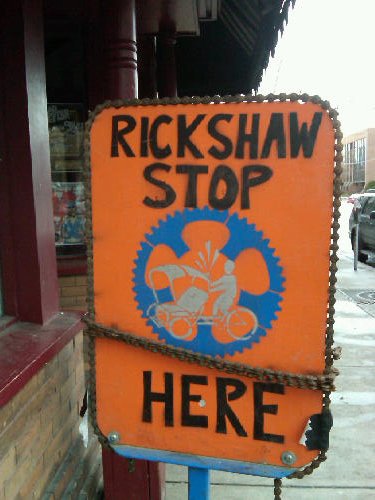
Fourth, seen in downtown Missoula, who needs a bus stop when you have:

Wednesday, December 9, 2009

Damn Cold

Winter finally seems to be here. After an extended summer where I got used to riding my bike in 60 degree weather in the middle of Oct./Nov. things have dramatically changed in the last two weeks. For a good article on winter riding, visit this link written by a fellow BWAM member.

Temperatures have been as low as -15 in the last couple of days and that means a change in behavior on my part. Luckily for me there is a bus stop within a block of our place. Of course the bus takes a little longer, about another ten minutes, and requires a transfer in downtown Missoula, but its worth it for the nice, relaxing, and warm commute. I don't have to be all sweaty when I show up to classes and spend an hour coughing and sniffling from the ride in the cold temps.

I was going strong even last week when temperatures in the morning were in the single digits. But my three mile commute makes the cold even more pronounced on my extremities. Even with heavy gloves and boots, my fingers and toes were feeling the brunt of the cold temperatures. The tip of my left index finger even has a spot of frostbite thanks to the 20 mile an hour winds Missoula experienced much of last week.

As soon as temps start to get back to a more normal winter level, I plan on hoping back on my bike and can't wait to try out my mountain bike in the snow... that is if Missoula ever gets any snow this year. I still see plenty of people out there on their bikes, although many of them don't seem to be very smart... wtf is with riding your bike in sub-zero temps without even a hat or gloves? Until then I'm happy to take a warm seat on Missoula's great bus service.

Monday, September 21, 2009

James Corless of Transportation for America

Photo via T4A

Last week was a big week in terms of both my class load and things happening that I want to write about. I hope I can catch up a little this week.

On Thursday, James Corless from Transportation for America (T4A) was in Missoula for a small conference on health. While he was here he also gave a short guest lecture at the University of Montana sponsored by ASUM Transportation.

What is T4A? Its a large non-profit organization geared toward campaigning and advocating for reworking America's national transportation system. A large coalition has been built around the need for reform of over 300 other non-profit, for-profit organizations, and government officials. As an organization, T4A is very much geared toward lobbying and policy, but have a wide range of resources available for partner groups to access.

Mr. Corless' speech covered the usual "why we need reform" points that most of the people in the audience had probably heard before; certainly preaching to the quire. But he had a lot of good points to pass along. He stressed the connection of land-use and transportation and that the two are so interrelated that they can not be treated separately.

Our current land-use patterns certainly don't promote people getting out of their cars and hopping on transit or a bike. The last 70 odd years have seen an erosion of our cities and public spaces to provide for vehicular traffic. And as this process has continued, the more cars are accommodated, the more cars are present on our roads and need to be stored somewhere, which then reinforces the need for more space for cars and more travel by cars.

The only way to stop such a process is to stop designing for ever more cars and design for more public space to be given over to transit, sidewalks, and cyclists; as demonstrated by the recent Park(ing) Day events that aimed to take public space back from vehicles. This strategy needs to be accompanied by a reorganization of our land-use practices. Putting a transit corridor down a an area of sprawl does little to alleviate traffic. But add in mixed-use zoning and Transit Oriented Development (TOD) along that corridor for several blocks on either side, and all of a sudden you have a game changing situation.

Another important factor is the cost of transportation, not just monetary, but time and convenience (as even Thomas Friedman knows and points out in his recent column). If transit can be made to be faster and easier to use, while var travel is made harder to use, people will naturally switch. This is what has happened for almost a century, but in reverse; making it harder for people to use transit or walk to where they need to go. And so people have intuitively made the switch by the millions to use of the SOV because other modes of transportation where so damn hard and confusing to use.

Once people see that transit or active transportation (biking/walking) can be enjoyable, easy to use, convenient, and cheap they will flock to it to reach there destinations. Vehicular traffic now creates so much of its own friction as people compete for limited road space and congestion builds, that people don't want to deal with the stress of driving. Give people an enjoyable experience on their way to a destination, as Phoenix is discovering with their new light-rail line, and people will flock to public transportation.

A long road to reform looms ahead, but already local and national organizations like BWAM and T4A are already working hard to make a difference. It will take a lot of collaborative effort to achieve T4A's vision for transportation. Thanks again to James Corless for talk with us here in Missoula.

Wednesday, September 9, 2009

Infrastructure Needs to be Factored in on Long-Term Transportation Cost/Carbon Emissions Calculations


Tracy White recently left a comment on an old blog post of mine that discussed the per-mile Carbon Dioxide emissions of different modes of travel. She brought up an excellent point that infrastructure costs and resource-use needs to be taken into account in cost-benefit analysis.

She even conveniently linked to an abstract of a research paper that indicated that adding such information to the analysis can significantly add to the lifetime energy use and greenhouse gas emissions (GHG). The study's abstract finds... "that total life-cycle energy inputs and greenhouse gas emissions contribute an additional 63% for onroad, 155% for rail, and 31% for air systems over vehicle tailpipe operation."

This seems like a a substantial impact... and I'm sure that it is. But the headline numbers touted in the abstract can be misleading. Now, I will admit that I have not taken a look at the full text of the study. Rail's impact on a per mile basis is much lower than that of cars, especially SOVs. It is because rail starts out at such a smaller GHG impact that the increase is so much higher when infrastructure is taken into account.

I'm sure that rail's lifetime environmental impacts are still much lower than that of vehicles, and from the research I have seen that is what people are finding. I'll have to dig into the study a little more when I have the time. Thanks Tracy for bringing up a great point that needs to be considered in these types of issues.

Tuesday, July 21, 2009

Week 15 Carfree Statistics

Salt Lake was a fun time, and I have plenty to write about in a few coming posts. Of course the bus was the low point of the trip. Salt Lake City was not what I expected... in a good way.

The bus trip probably didn't save as much carbon as I had originally thought. The bus going both east and west between Missoula and Butte was completely full; we almost had to leave people behind in Butte. The journey down to SLC from Butte and back was nowhere near as full, maybe only 1/4 full. So I'm just going going to guess that I saved 50% , which would be about 600 Ibs of carbon. Thats some solid methodology.

Week 15 Statistics
Miles Biked: 77.46
Miles on Bus : 1046
Gallons Saved: 46.81
Carbon Not Emitted: 630.44 Ibs

Wednesday, July 15, 2009

And I'm leaving On a Greyhound, Don't Know When I'll be Back Again

I'll be heading down to Salt Lake City this weekend, and no I'm not driving. I figured I would take the opportunity of visiting my fiance at her clinical site to try out the luxurious travel offerings of Greyhound where I can expect to be treated to warm-moist towels and foi gras, and by warm-moist towels I mean sticky, urine-stained bus station restroom floors and by foi gras I mean vending machine pretzels.

The round trip is a total of 1046 miles and by taking the bus I expect to save about $25 in gas compared to the cost of the bus ticket. Of course the travel time almost doubles when taking the bus vs. a car, but then again my time is cheap since I have no real marketable skills.

So other than money, what can I expect to be saving (and the answer is certainly not my dignity)? As you can see by the chart below, a 3/4 full Transit Bus - intercity - produces approximately .2 Ibs of CO2 per passenger mile vs. approximately 1.2 Ibs of CO2 per passenger mile in a single occupancy vehicle (SOV).

Over 1046 miles my share of the CO2 produced adds up to 209.2 Ibs of CO2 for the bus vs. 1255.2 Ibs of CO2 for a car. So on the bus, my trip should produce only about 16% of the GHGs of an equivalent car trip.

Plus... there is the added bonus of not having to worry about getting a speeding ticket. That should be the only arguement anyone needs to hear to convince them that the only way to travel... is by bus.

Friday, May 22, 2009

Bicycle vs. Bus

More than a month and a half into going car-free and I have yet to hop on one of Missoula's buses. Its not like taking the bus anywhere would be extremely difficult, as there is a stop on my street two blocks down from where I live.

I think I still have a mental block about the convenience of bus service. Anytime I want I can hit the road on my bike and get to anywhere in Missoula about as fast as a car (sometimes its actually faster). That freedom to come-and-go as I please is still an issue that I seem unable to get over at this point; which is ironic because this is one of the main arguments that opponenets of mass transit use when defending single occupancy vehicle travel.

I love the freedom of a bike and the joy of experiencing the weather, hearing the birds, and anything in general that I might pass. I know that at some point I need to get on the bus here in Missoula, especially come winter when the snow hits, but for now I'll continue to enjoy the spring on my bike.
Bookmark and Share