Showing posts with label pedestrian. Show all posts

Wednesday, February 10, 2010

Missoula Residents Show Up to Support Active Transportation

Missoula has started the long and arduous bureaucratic process of updating one of its many long term plans. And this time its an update to the non-motorized transportation plan and recently Missoula's Office of Planning and Grants (OPG) held a community workshop to get input from Missoula citizens. And the general message from the good people of Missoula was for the city to finish the trail/sidewalk/bike lane system.


Missoula's planning apparatus (and I use that term half jokingly because we are a small community that gets a lot of planning done on limited resources) has in recent years really integrated collaborative planning into the process and this time is no different. Collaborative planning aims to be as open and inclusive of different interests and community groups as possible to allow a wide variety of input to be included in the planning process.

And from the parts of the process I have been involved in... there is a lot of input coming in. Transportation is one of those topics in Missoula that really brings out a lot of people and groups. The advisory committee alone has close to thirty people (from various city/county departments, nonprofits, community groups, and business organizations) in attendance guiding the process.

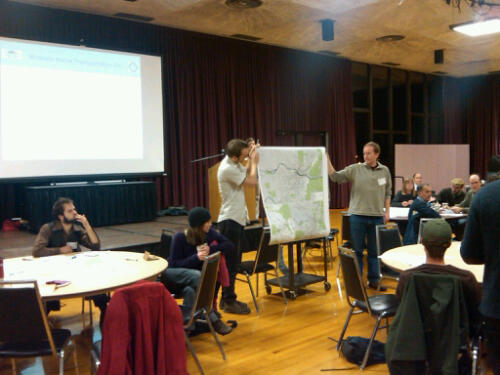
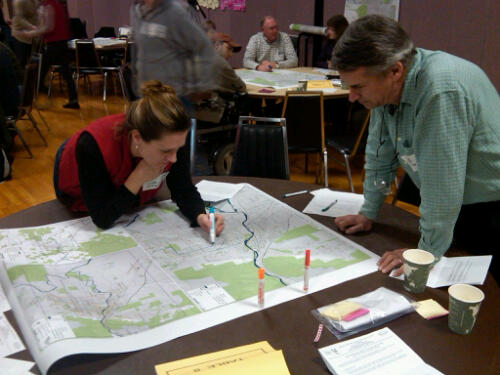
The community workshop was pretty interesting to watch play out. The night it was held was cold and snowy, yet about 2/3 of people biked and most of the rest walked. With perhaps upwards of 60 or 70 people in attendance, everyone worked through a series of group oriented activities. Of course everyone's favorite involved drawing on a map of Missoula.


And once the individual groups had finished their discussion and mapping each shared their results with the entire workshop.


Out of this event came a lot different input but the general themes included:
- improved connectivity
- finish the trail/sidewalk/bike lane network
- reduce posted speed limits, at most 35 mph
- improve street lighting
- implement our complete streets policy
- focus transportation more on safety than traffic flow

Wednesday, January 13, 2010

Walkscore: Something seems a little off

What do I do with my free time? Play around with Missoula's Walk Score of course... and find that it is broken.

For those who have never been to the Walk Score website, the purpose is to calculate the friendliness of different neighborhoods based on the proximity of amenities such as services, restaurants, etc. According to the Walk Score website, the algorithm used assigns the maximum number of points for amenities that are within a 1/4 mile of the location entered. While this is a good measure of walkability, I would argue that factors such as street design, traffic volume, speed limits, and neighborhood character would make the model Walk Score uses much more accurate and relevant.

To illustrate my point you can see below the streetscape of Phillips, the street on which I live. My address received a 69, meaning that only 27% of locations had higher walkscores than my house.


Now contrast my neighborhood's Walk Score with the one received by the location seen below. I randomly typed in an address along Brooks, a four lane arterial with speeds ranging from 35-45 with lots of traffic, congestion, business activity, and almost no cyclists or pedestrians.


This section of Brooks received a Walk Score of 83, 14 points higher or about 20% more "walkable" than where I live. I think its pretty intuitive just from the pictures of the two different locations which one would be more friendly to active transportation... and its not the one Walk Score recommends.


There is a lot more to getting people walking than just how close they live to given amenities or their job. Paramount is safety, or at least the perception of safety along design aesthetics. I would venture to guess most people would rather walk down a tree lined, quiet street with on street parking acting as a buffer, than a busy, loud arterial surrounded by parking lots and neon lights.

I think Walk Score might be broken.

Monday, January 11, 2010

Coeur d Alene: Safety Fail, No Saftey in Numbers for Bike/Peds

Over the weekend I was hit by a car, and it provides me with a good opportunity to talk about safety in numbers that cyclists and pedestrians create and how streetscapes and development patterns contribute to safety.

Let me setup what happened. I took the Greyhound from Missoula to Coeur d' Alene (CDA) Saturday morning to visit my folks. There is no physical transfer station in CDA, rather the bus drops you off at a gas station that sits at the corner of a large intersection (Ramesy and Appleway) where two four-lane arterials meet (total of 22 lanes at the intersection).

Anyway, the bus dropped me off at a different location than the Greyhound website gave for the (nonexistent) station. My father was coming to pick me up, but since he doesn't have a cell phone there was no way to get a hold of him, so I decided to walk north along the western side of Ramsey to find a good place to wave him down as he came to pick me up.

Two blocks later I was crossing the intersection below, which is an old picture as the intersection now has a four-way light, within the cross walk while a car was waiting for an opening to turn right-on-red. I walked out in front of his car, attempting to make eye contact because I could sense he was ready to hit the gas to make an opening, but he was looking the other direction. Needless to say he hit the gas and ran right into me. Luckily he immediately stopped and I wasn't hurt other than a small bruise on my leg.


This incident got me thinking how ridiculous the incident was. Living in Missoula, I have walked hundreds, perhaps even a thousand miles around town over the course of seven years. In that time I have never been hit by a car... I don't even remember having a close call. But here I am, back in the town I grew up in, and five minutes after stepping off the bus I am hit be a car.

The whole time I lived in CDA, I never once got around by walking or biking, rather the only real way to get around is by car. Seven years of walking in Missoula = no problem, five minutes of walking in CDA = getting hit by a car. Missoula and CDA are also fairly close in terms of population size.

Why is this? Because of not only the streetscape that dominates in CDA (suburban arterials with speeds above 35 mph) but also the development pattern that essentially forced those types of roadways to be built.

You can see these patterns at play in the photo of CDA below. I have highlighted all the four lane arterials (red corresponding to suburban arterial design and yellow representing four lane roads with an urban character). CDA is a maze of suburban subdivisions that are only connected to the wider community through the use of a lot of arterials. Only a small portion of CDA (which also includes the towns of Dalton Gardens, Hayden, and Hayden Lake) actually has a street network laid out in a grid. This pattern results in a very spread out population with very low densities (Dalton Gardens is zoned at 1 house/acre).


Because people have to drive everywhere and there are almost no pedestrians or cyclists, the motorists don't look out for these types of people. Those whom do walk or bike are mostly a working-poor underclass -except for the roadies - that most suburbanites don't spend any time thinking of between trips to Starbucks, work, and dropping the kids off at soccer practice.

Now contrast this with Missoula (a photo with the same types of streets highlighted can be seen below). The bulk of Missoula is based on a grid system and subdivisions with a suburban character only exist at the fringes of the town. Not only that, but the most of the four lane roads that Missoula does have exist within areas that are urban in character (higher densities, tree lined streets, sidewalks, smaller lot setbacks, and slower speeds). The four lane suburban arterials are located again mostly at the edges of Missoula and so cyclists and pedestrians can largely avoid these roads by choosing quieter streets.

Also consider the the geographic distance these two photos show. The photo of Missoula covers most of the town and most of the town's population. The photo is 3.5 miles x 3.5 miles while the photo of CDA shows an area 7.5 miles x 7.5 miles that leaves out a considerable amount of development to the north. Missoula's compact nature encourages alternative transportation simply through its shorter distances.


The higher densities, shorter distances, and more welcoming streetscape encourages people to walk and bike. In much of the central part of Missoula you can't go more than a couple of blocks without seeing another pedestrian or cyclist. Just the numbers of pedestrians and cyclists using Missoula streets makes motorists more aware of them and creates a situation where motorists must constantly be on the lookout. This creates a Safety in Numbers phenomenon whereby the more cyclists and pedestrians out on the roads, the less absolute fatalities and crash cars have with cyclists and pedestrians.

Describing what had happened, even my very conservative father understood the relationship between development patterns, streets, and mode of travel. In his opinion, and I have to agree with him, CDA is a town that will never see a lot of people walking, biking, or using transit simply because the towns infrastructure makes those options economically difficult and even dangerous.

Tuesday, December 29, 2009

Carnage Saddens Missoula Community

Four girls where struck by a drunk driver over the weekend in Missoula along highway 200 connecting Missoula with East Missoula. All four were local high school girls; two of the girls died at the scene while the other two suffered fairly major injuries and were taken to the hospital.

This incident has really shocked all of Missoula and I even found myself choking up over this incident. I'm sorry to admit that I have become desensitized to hearing stories about cyclists and pedestrians getting struck and killed by vehicles. It just seems to be one of those daily occurrences that I read about almost everyday as a bike/ped advocate.

But this really hit home and I can't really explain it. There have been three other pedestrians hit and killed in the Missoula area this year that I can remember and while I was angry, nothing hit home like this. One man was even struck and killed this Monday and that incident almost seems like an after thought judging by the amount of attention and comments being posted (135 vs 10). I even witnessed a man in a crosswalk be hit by a car (he ended up being ok) and I didn't seem to make much of it at the time other than to think "fucking stupid driver."

Is it the youth of the girls? Does my grief over these girls that I don't even know say something about me or the society we live in? Are we supposed to value their lives more because they are still perceived to be young and Innocent while the other three pedestrian deaths have been of more elderly people that have already lived their lives? Are those three separate deaths any less tragic and sad? Or is it simply the shock from comprehending 4, not 1, people getting hit by a truck?

All I know is, this incident has created a hole in the heart of our community and there seems to be an outpouring of grief and support to try and fill it. If you would like to donate, please see here for details.
Bookmark and Share